Alternatives to Mass DMs in Discord Once Your Community Outgrows Manual Follow Up
Direct messages have no shared history, no owner and no guarantee of delivery. Here is what to replace them with, and the member count at which each version of the problem shows up.

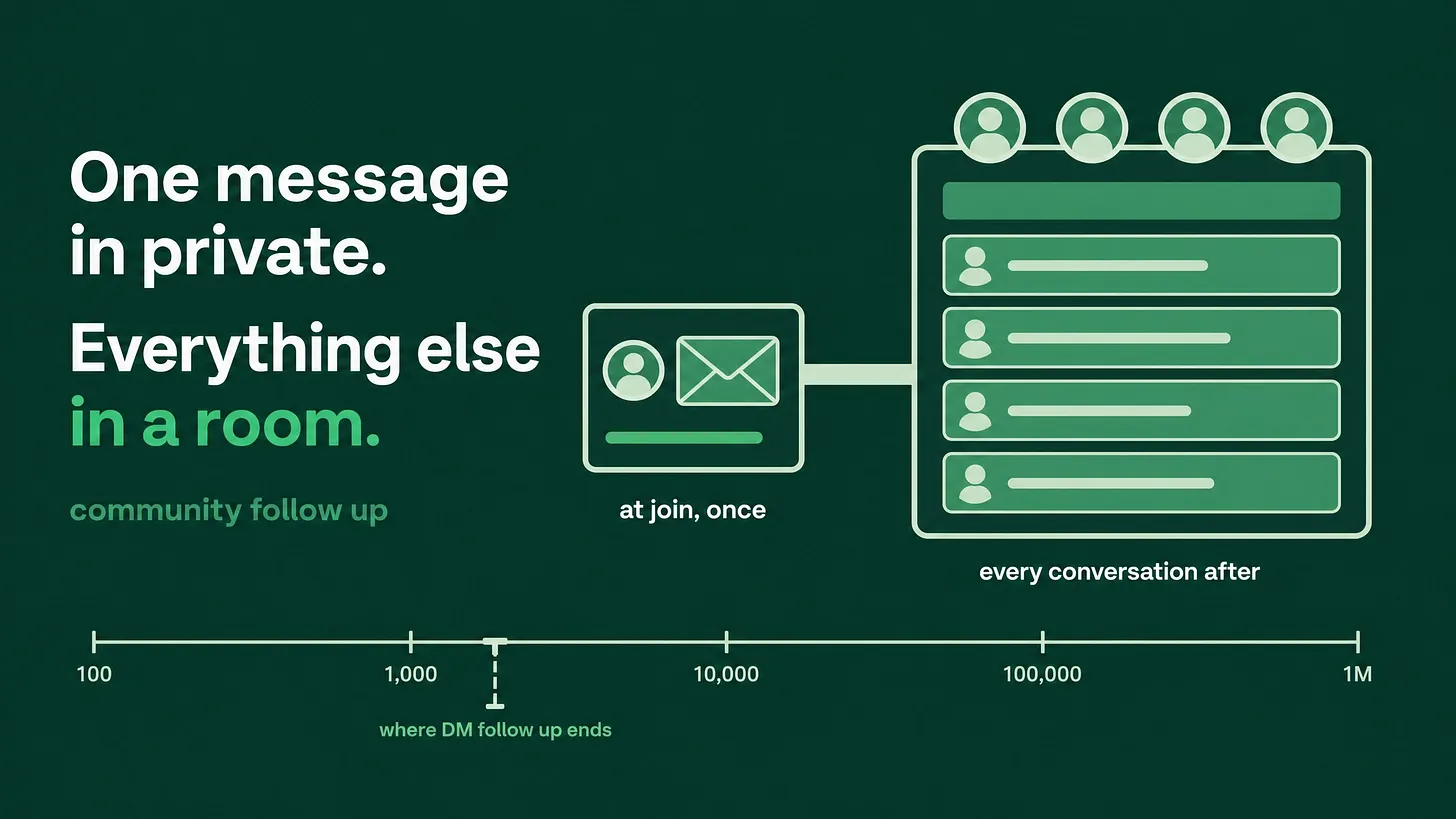
📌 The alternative to mass DMs in Discord is one welcome message at join, private threads for every one to one conversation after that, and role mentions in a channel for anything going to a group. Threads give you shared team visibility, a history that survives turnover, and delivery that does not depend on a member's privacy settings. Trigger follow up on events rather than on somebody remembering.
The one message worth sending privately
A member joins. That is the single moment they expect a private message from you, and it is the only one you should spend. Make it short and give it one instruction. Where to go first, or what to post, or who to ask. Not a tour, not five links, not the full channel list. One action, phrased so the member can complete it in under a minute. Everything after that belongs somewhere else.
What breaks at a hundred members
Nothing, apparently. One person knows every member, notices who went quiet, and sends a note. It works and it feels like the reason the community is healthy. What is actually happening is that all of the relationship history lives in one person's message list. Nobody else can see any of it. When that person takes a week off, follow up stops completely and nobody can tell which conversations were mid flight.
What breaks at a thousand
This is where teams discover the ceiling, usually by trying to message a few hundred members about an event. Three things go wrong at once. A large share of members have private messages from non friends switched off, so an unknown fraction of your sends simply never land and you cannot tell which. Bulk identical messages to strangers is behaviour the platform treats as spam, and the account doing it is the one that pays. And when replies arrive, they arrive in one moderator's inbox, so the rest of the team is answering questions blind.
⚠️ A channel a member cannot receive is a bad channel for anything that matters. Use direct messages for the welcome and for genuinely private matters, never as the system of record.
What breaks at ten thousand
Individual follow up stops being possible, so it has to become segmented. Not messages to people, messages to groups defined by something you can see: joined this week, completed onboarding, opened a support thread, holds a program role. This is the point where roles stop being decoration and become your addressing system. If your roles do not reflect the segments you want to talk to, you cannot talk to segments, and you fall back to broadcasting to everyone, which trains members to ignore announcements.
What breaks at a hundred thousand
Memory. At this size follow up cannot depend on a person deciding to do it. Every follow up needs a trigger, a queue, an owner and a record. Member joined. Member finished onboarding. Member asked a question that nobody answered within the window. Member has not posted in two weeks. Each of those is an event that puts an item in front of a named person, and each one closes with a note anyone on the team can read. At this size the reporting matters as much as the doing. If nobody can produce a weekly count of follow ups sent, answered and abandoned, the system is not running, it is just busy.
What breaks past a million
One to one follow up with the general population ends. It has to. What remains is two tiers. The community handles its own follow up, which only works if you built the rooms and the recognition that make members answer each other. Your team follows up individually with the small group where it changes the business: the top contributors, the customers, the partners, the people carrying the volunteer load. Everything else runs on published rhythm. Members know when the event happens and where updates appear, so they do not need to be individually reminded.
The replacement, in one table
| Follow up type | Wrong container | Right container |
|---|---|---|
| Welcome | Three messages over a week | One direct message at join, one instruction |
| Individual check in | Moderator's inbox | Private thread in a dedicated channel |
| Support continuation | Direct message with the person who replied | The existing thread, so handoffs keep context |
| Event reminder | Bulk sends to individuals | Channel post with a role mention |
| Program or offer | Copy pasted to a list | Role gated channel members opted into |
Why a private thread beats an inbox
Four reasons, and each one is operational rather than philosophical. Your whole team can read it, so a handoff carries its own context and the member does not have to explain themselves twice. It has a permanent history, so the conversation outlives the staff member who started it. It is moderatable, which matters the first time a conversation needs a second pair of eyes. And it does not depend on the member's privacy settings, so you know it was delivered.
If a follow up only exists in one person's inbox, your company does not have a relationship with that member. One employee does.
Trigger it instead of remembering it
Write down the events that should cause someone to reach out, then attach an owner and a window to each. Joined and did not complete onboarding within three days. Asked a question that went unanswered past your reply window. Went quiet after being active. Hit a program milestone. That list is short, it is specific, and it turns follow up from a thing your team feels guilty about into a queue that either has items in it or does not.
What to measure
Four numbers. The share of follow ups that have a written record, which should be all of them. The time from trigger to first message. The number of open conversations per owner, which tells you when to add a person. And undelivered attempts, which is the number that quietly proves direct messages were never a reliable channel.
Where this sits in the larger system
Follow up architecture is one layer of a community operating stack that also includes onboarding and the first forty eight hours, role and channel architecture, support routing and response time, moderation coverage, automation, and the reporting rhythm that turns all of it into something an executive reads. It leans hardest on role architecture, because roles are how you address groups, and on support routing, because most follow up is a continuation of a conversation that started with a question. Make the change before you need it. Moving from inboxes to threads at ten thousand members is a week of work. Doing it at a hundred thousand is a project.
Nobody remembers the message. They remember whether anybody came back. Build the thing that makes coming back automatic. More at danieljeong.org.