Agency vs In House Community Management: Who Decides What at Each Size
The staffing question resolves itself once you assign five categories of decision. Three of them should stay internal at every size, and the rest change as the room grows.

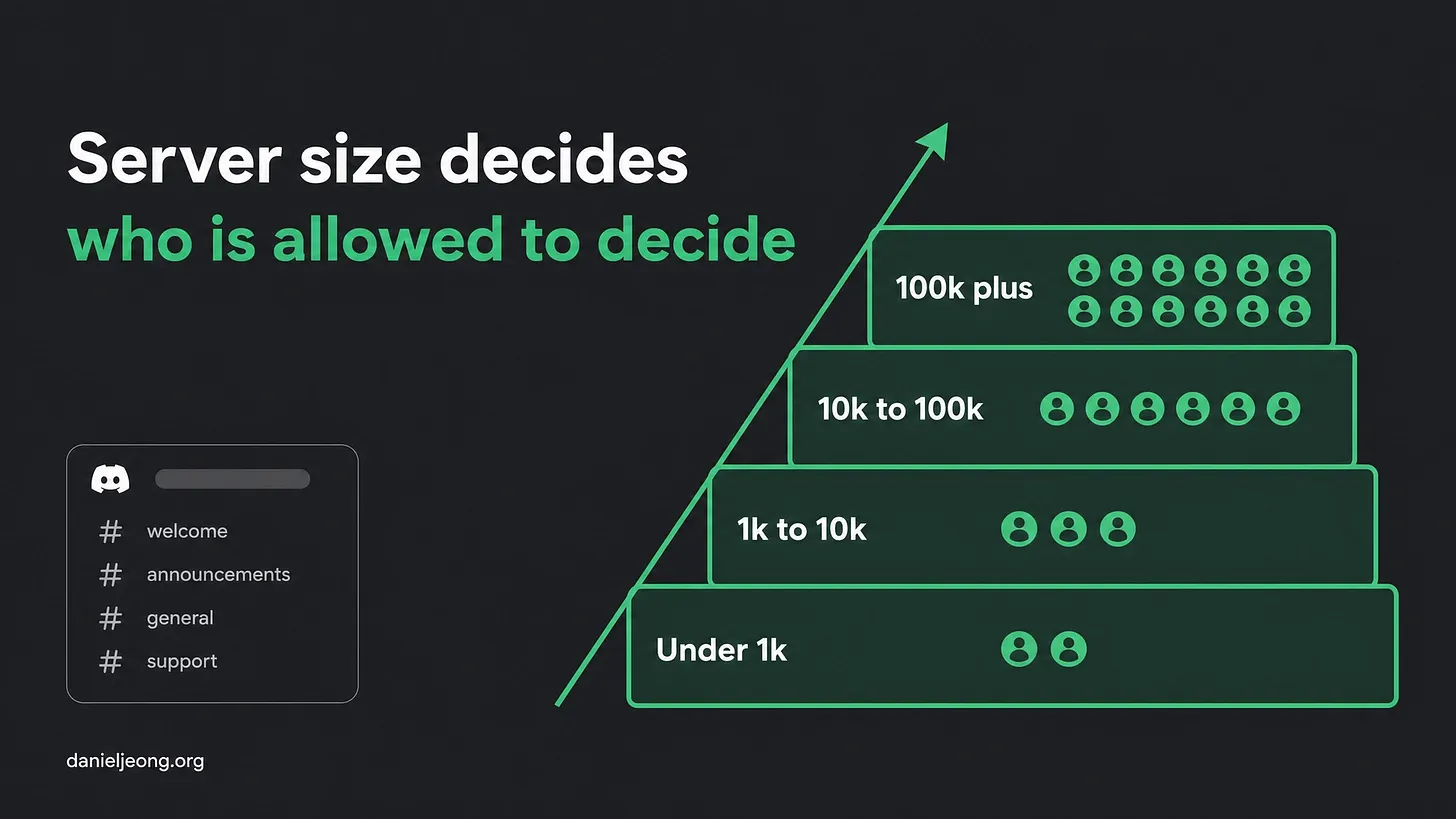
| Agency vs in house community management is decided by allocating five categories of decision: identity and voice, safety and enforcement, escalation, programming, and data and reporting. Three of those stay internal at every size. The rest shift as you pass one thousand, ten thousand and one hundred thousand members. |
|---|
Start with decisions, not with headcount
The usual version of this conversation compares a monthly retainer against a salary and picks the cheaper one. That comparison is unanswerable, because the two options are not doing the same job. A better first step takes about thirty minutes. List five categories of decision, write a name beside each, and then read the quotes again. Most of the time the staffing answer is already visible on that page. The five categories:
- Identity and voice. How the community sounds, what it stands for, what it refuses.
- Safety and enforcement. Who gets warned, muted, removed, and on what stated grounds.
- Escalation. What reaches the company, how fast, and to whom.
- Programming and calendar. What happens each week, who runs it, what gets retired.
- Data and reporting. What is measured, who receives it, and what decisions it feeds.
Under one thousand members
At this size the community is still an extension of the founding team. Members can tell when the person answering has real authority, and they respond to it. One internal person carrying the work part time, with outside help for the build and the technical setup, is usually correct. What you are buying externally is expertise you will use once, structure, permissions, automation, and the entry flow. What stays internal is everything a member experiences as personality. The failure at this stage is outsourcing voice too early. A community of four hundred that suddenly sounds like a brand loses the thing that made it worth joining.
One thousand to ten thousand
Coverage becomes the constraint. Questions arrive outside working hours and the internal person cannot be the only answer. This is where outside help earns its money, because what you actually need is hours distributed across time zones, and hiring for that internally is expensive and slow. Buy the hours. Hold two things back. Voice stays internal, which in practice means an internal person writes the response templates and reviews a sample every week. Escalation stays internal, which means an outside moderator can act on anything routine and has a written, unambiguous list of what must be handed over immediately.
⚠️ The most common failure at this size is not a bad answer. It is a correct answer given with the wrong authority, where an outside moderator resolves something that should have reached your product or legal team.
Ten thousand to one hundred thousand
Programming becomes a job by itself. Events, launches, recognition, contests and recurring rituals need somebody whose week is planned around them. A hybrid works best here, and it has a specific shape. One internal lead owns strategy, voice, escalation and the relationship with the rest of the company. External capacity carries moderation coverage, event operations, and the production work that scales with volume. The internal lead role is not optional at this size, because the community now touches support, product and marketing simultaneously, and somebody with internal standing has to arbitrate between them. An external party cannot do that, however good they are, because they cannot convene the meeting.
Outside help scales capacity. It cannot scale authority. Authority has to come from inside the company.
Above one hundred thousand
Volunteers appear at this scale whether or not you planned for them. Members start answering each other, informal leaders emerge, and some of them will ask for a role. Volunteer management becomes internal work, because it is about trust, access and enforcement. You are deciding who gets moderation permissions in your own house. That decision, and the process for revoking it, belongs to someone on your payroll. External capacity remains valuable for coverage, for specialist events, and for surge periods around launches. What changes is that the internal team is now managing a system of people rather than a channel list.
The three that never leave
At every size, regardless of structure:
| Decision | Why it stays internal |
|---|---|
| Who gets banned, and the stated grounds | It is a customer relationship decision with legal and commercial consequences |
| What members are told during an incident | The wording becomes the company's public position within minutes |
| Who holds server ownership | Ownership held outside the company is an outage waiting for a disagreement |
The first one is worth expanding. An external moderator can and should execute a ban under a written policy. Writing the policy, and deciding the edge cases the policy did not anticipate, is internal work, because those edge cases are usually about a paying customer.
The contract shape that makes a hybrid work
Three clauses do most of the work. A written escalation list naming what must be handed over and how fast. A response sample review, where an internal person reads a fixed number of member interactions weekly. And a documentation requirement, so the operating knowledge accumulates in your systems rather than in a contractor's memory. Without the third clause, a hybrid quietly becomes a dependency, and the cost of changing providers grows every month until it stops being possible.
What this framework leaves out
Decision rights are one layer. Around them sit the budget structure that funds either model, the coverage hours you actually need rather than the ones you assume, the documentation system that makes handovers survivable, and the reporting loop that tells the rest of the company what the community is producing. What this layer settles is the question underneath the staffing debate. Once five categories have names beside them, comparing a retainer to a salary becomes straightforward, because you finally know what each one is being asked to do.
Structure follows authority. Decide who decides, and the org chart writes itself. More at danieljeong.org.