A Generic Welcome Message Is Not an Onboarding System
What happens in the first few minutes decides more than any channel structure that follows

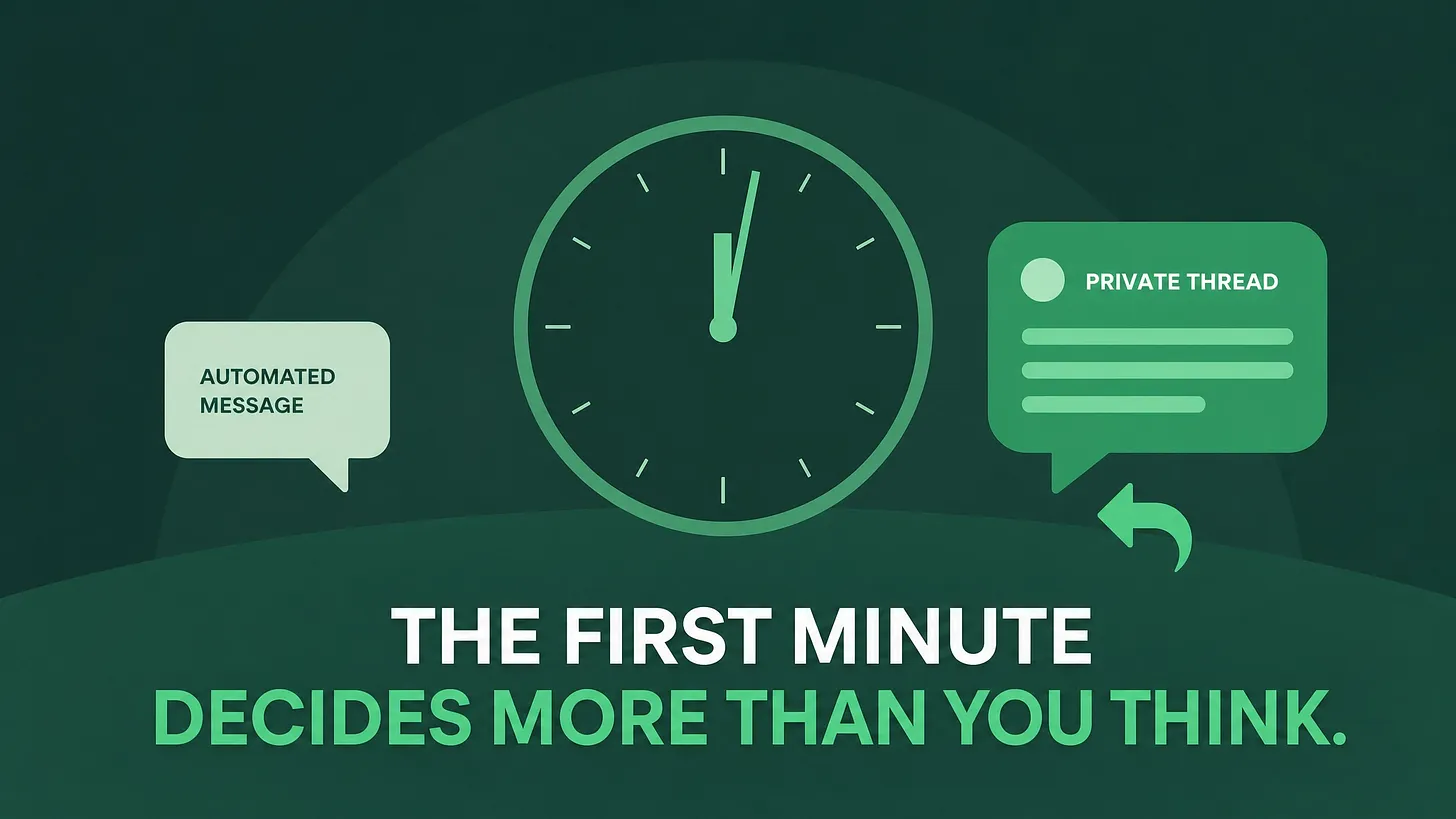
The Minute That Decides Everything
There's a narrow window right after someone joins a Discord server where their entire future relationship with that community gets decided, and it's shorter than most teams assume. It's not the first week. It's not the first day. It's the first few minutes, before the new member has had time to explore, before they've read a single pinned message, while their attention is still fully available and their patience for confusion is at its highest. Most servers spend that window on autopilot. A bot fires off the same welcome message to everyone who joins, worded identically regardless of who arrived or why. It's efficient. It's also nearly invisible, because a message addressed to no one in particular reads like it was written for no one in particular, and members treat it accordingly.
Why Automated Messages Get Skimmed
A generic welcome message fails for a specific, structural reason: it doesn't require anything from the reader, and it doesn't suggest that anyone is paying attention on the other end. There's no name attached beyond a bot's. There's no question waiting for a reply. It reads exactly like what it is, a broadcast, and broadcasts get skimmed the same way a mass email gets skimmed, regardless of how well it's written. This isn't a copywriting problem. No amount of clever phrasing turns a message sent to everyone into a message that feels sent to someone. The format itself signals what to expect, and members calibrate their attention accordingly before they've even finished reading it.
What a Private Thread Actually Does
The alternative is structurally different, not just warmer in tone. The moment someone joins, a private thread opens between them and an actual person on the team. It includes a real introduction, a real name, and a direct question, usually something simple like what brought them to the server or what they're hoping to get out of it. This does two things a broadcast message can't. It signals that a specific person is paying attention, which changes how the new member reads everything that follows. And it invites a reply, which means the new member takes an action inside the server within their first few minutes, before anything has had the chance to confuse or bore them into leaving quietly. That single reply matters more than it looks like it should. A member who responds to a private thread has already demonstrated engagement before the server has asked anything else of them. Communities that build this into onboarding consistently see higher follow-through into the rest of the structure, because the very first interaction already worked.
Scaling Without Losing the Person
The obvious objection is that this doesn't scale, and it's a fair concern for a server bringing in dozens or hundreds of new members a day. The answer isn't to abandon the personal element. It's to split the work between automation and a person, with each handling the part it's actually good at. A custom bot can detect a new join, open the private thread automatically, and send the first message using a template with the real team member's name attached. What it shouldn't do is pretend to be that person indefinitely. The team member picks up the actual conversation once the new member replies. The mechanical trigger scales infinitely. The human part only has to scale to the volume of replies that actually come back, which is a much smaller number than the volume of joins.
The Metric Nobody Tracks
Most communities track join counts and member counts, and almost none of them track first-reply rate: the percentage of new members who respond to whatever welcome interaction they receive within their first hour. It's a better predictor of long-term retention than either of the numbers most dashboards default to, because it captures whether the very first moment actually worked. If you're not tracking this number, you don't know whether your onboarding is functioning as a system or just running as a broadcast. The two can look identical on a settings page while performing completely differently in practice.
What This Means for Leadership
Executives evaluating a community's health tend to look at total membership and channel activity, both of which are downstream of something that happened much earlier. If the first few minutes don't create a reason to stay engaged, no amount of good channel structure further in the server will fully make up for it. A private welcome thread costs almost nothing to build once, and the return shows up in every cohort of members that comes through it afterward. A generic welcome message costs even less to leave in place, which is exactly why so many communities never get around to replacing it, even after they've noticed it isn't working.
Generalized from onboarding builds across multiple client communities. danieljeong.org