A Community With No Upgrade Path Is a Cost Center
Rooms full of qualified buyers produce no revenue movement when nobody designs the route from learning to hiring.

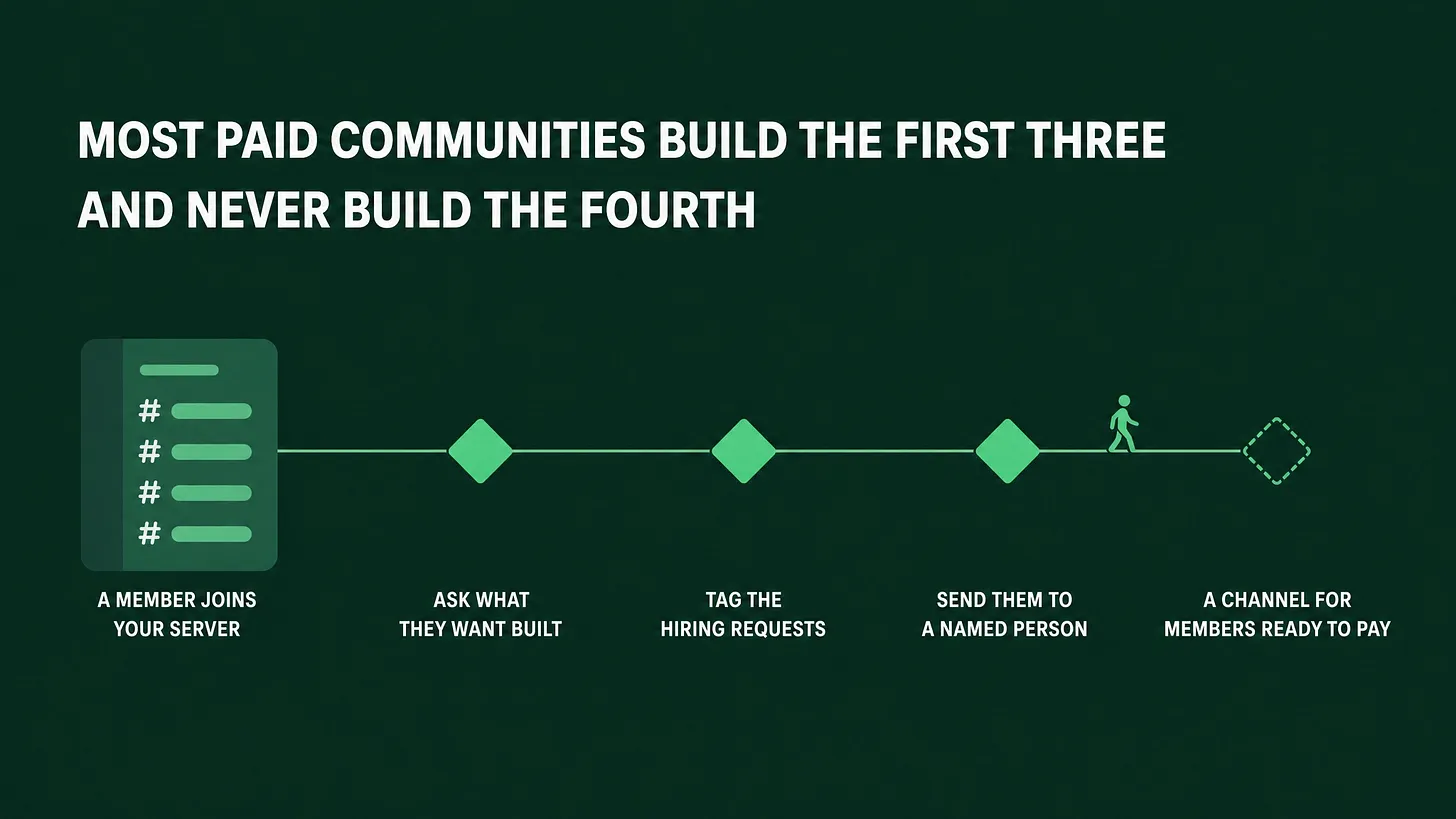
Paid communities collect qualified buyers and then give them no way to ask for more. The fix is routing infrastructure: capture intent at intake, tag support threads where scope exceeds skill, and give people a staffed door to walk through. Measure tagged conversations and contracts, not message volume.
There is a specific moment inside every paid community where money is either made or quietly lost, and almost nobody instruments for it. A member has worked through the material. They understand the concept. They arrive at the part that requires execution, and they realise they do not want to do it themselves. What happens next is decided entirely by structure. In most servers, that person posts a question. Someone helpful answers it. The thread closes and the room moves on. The member goes back to being stuck, only now with a better vocabulary for describing the thing they are stuck on.
The room only does what it was built to do
Communities inherit their behaviour from their architecture. A server built as a support desk answers questions. A server built as a lounge produces conversation. Neither one produces revenue movement unless somebody deliberately designed for it, and the absence is rarely noticed because the room still looks healthy from the outside. This is why leadership teams get confused when they review community performance. Message counts are fine. Sentiment is positive. Members say kind things in public. The line item still reads as pure cost, because nothing in the room converts attention into commercial conversation.
A community that only answers questions will only ever be measured by how many questions it answered.
The uncomfortable part is that these rooms are usually full of the most qualified buyers a company will ever have access to. These people already paid once. They already believe the approach works. They have already self identified as having the problem. No outbound campaign will ever produce a warmer list.
What a buying signal actually looks like
Buying signals inside a community rarely sound like buying signals. Nobody types the words "I would like to purchase your higher tier offer." What they type is closer to this:
Can someone sanity check my setup before I launch thisWe tried it and it broke, not sure whereIs there a faster way to do this, I have run out of timeDo you know anyone who does this for peopleEvery one of those is the same statement expressed four ways. The scope of the work has exceeded the member's appetite to do it themselves. That gap is the entire commercial opportunity, and it is visible in plain text, in public, dated and attributed. Most teams treat these as support tickets. They are, but they are also the only unprompted demand signal a community will ever hand you for free.
Intake is where the path begins
Routing starts long before anyone gets stuck. The onboarding questionnaire that most servers use to hand out roles is capable of carrying far more weight than it usually does. Ask two things at the door beyond the usual. First, what the person is actually trying to build. Second, how much of it they intend to do themselves. The answers cost the member ten seconds and give your team a permanent record of intent that support can read months later.
Intake data has a compounding property that message history does not. It is structured, it is attached to a person, and it can be filtered. A support thread from a member who told you at the door that they wanted this delivered rather than taught is a different conversation from an identical thread by someone who came to learn.
Tag the gap, do not chase it
The operational centre of an upgrade path is a tag. One tag, applied by whoever is closest to the support queue, on any thread where the request is really about delivery rather than instruction. This is deliberately low ceremony. It is not a sales qualification framework and it does not require anyone to change how they answer questions. Answer the question first, properly and generously, then tag the thread. The tag exists so that the pattern becomes countable.
| What the room does today | What routing adds |
|---|---|
| Answers the question | Answers the question, then records why it was asked |
| Closes the thread | Closes the thread and leaves a retrievable signal |
| Measures response time | Measures response time and unmet demand |
| Reports engagement | Reports engagement and pipeline created |
After a month of tagging, a community team can walk into a leadership meeting with something they have never had before: a defensible count of members who told you, in their own words, that they wanted more than the room provides.
The door, not the pitch
The last piece is a place for those people to go. This is where most teams overcorrect and start selling in public, which damages the room faster than almost anything else. The correct build is quiet and permanent. One channel or one short form, positioned where a member who has already decided will find it, described in the language of the outcome rather than the offer. Something closer to "get this built with us" than "book a strategy call". Behind it, a named person with a response time commitment, because a door that nobody answers is worse than no door at all. Nothing about this needs to be loud. The member is not being convinced. They arrived already convinced and were previously walking into a wall.
Instrument it or it will not survive budget season
Community functions get cut because they cannot describe their contribution in the language the rest of the business uses. Engagement metrics do not survive contact with a finance review. Two numbers change that conversation. The count of tagged conversations, which represents demand the room surfaced. The count of those conversations that became contracts, which represents demand the room converted. Both are simple, both are auditable, and both belong on the same dashboard as every other channel the company runs. Once those numbers exist, the strategic argument writes itself. The room is not a cost of doing business. It is a demand surface that happens to also provide support, and it should be resourced accordingly.
Where this leaves you
Run the audit this week. Read the last thirty support threads and mark the ones where the underlying request was delivery rather than instruction. Count them. Then look at how many of those people were ever told that a higher tier exists. The gap between those two numbers is the cost of not having a route. It is usually larger than anyone on the team expected, and unlike most community problems, it can be closed with a form, a tag, and one person who answers quickly. The buyers are already in the room. The only question is whether the room was built to notice.
Every community eventually reveals what it was designed to do. Build one that notices the people trying to hand you their business. More on community infrastructure at danieljeong.org.