A Community Built to Give Members Control Still Runs on Infrastructure Someone Designed
Decentralized communities do not need less structure than centralized ones. They need more, and it has to be built into the room itself.

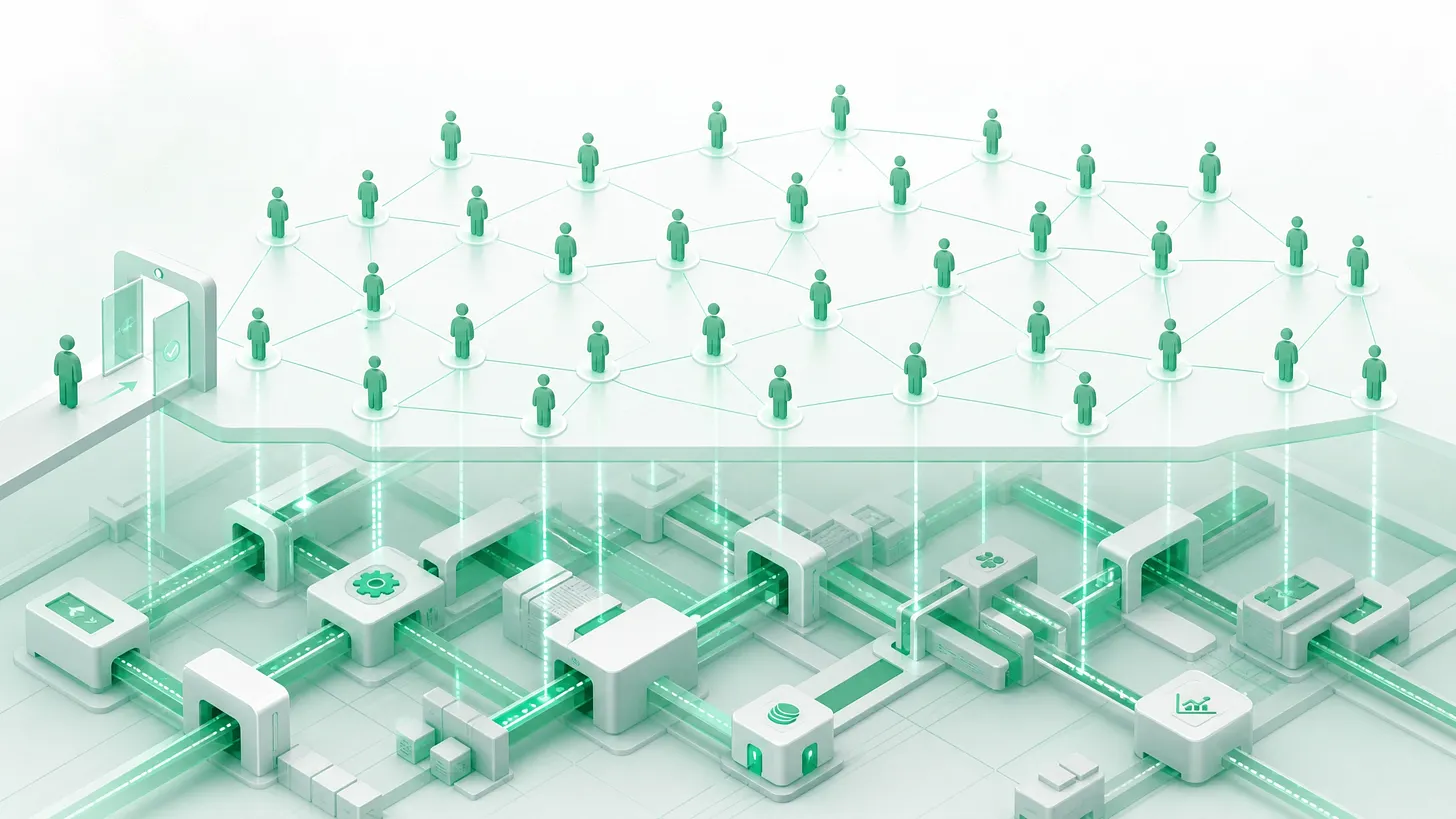
The vision that skips a step
An artist joined a call and laid out something he clearly cared about. He wanted a decentralized talent network, a place where performers could book their own work directly and stop routing their careers through agents and managers who might steer or skim. Everyone would be equal. No gatekeeper deciding who gets seen. The community would bring them all together and hand control back to the people doing the work. The vision is genuinely good, and the frustration behind it is real. But there is a step hiding inside the word community that almost everyone skips. A network that gives members control still runs on infrastructure, and someone has to design it. The freedom is not free of structure. It sits on top of structure that has to be deliberately built.
The quiet contradiction in decentralization
Most decentralized communities carry the same unspoken assumption. If we remove the gatekeeper, the space becomes open, fair, and self organizing. Members will find each other, trust each other, and transact on their own terms. The structure the old system imposed is treated as the enemy, and getting rid of it feels like the whole point. Here is the part that gets missed. A flat, open network needs more structure than a top down one, not less. In a centralized setup, one authority absorbs a lot of invisible work. They decide who gets in, they vouch for identity, they connect the right people, and they enforce the terms of a deal. Remove that authority and none of that work disappears. It just loses its owner. Now the community itself has to perform every one of those functions, out in the open, without a single person holding it together.
What the gatekeeper actually did
It helps to name the jobs a gatekeeper quietly runs, because those are exactly the jobs a decentralized community has to rebuild. There is intake, deciding who is allowed in and on what basis. There is identity, some way of knowing a member is who they claim to be, which matters enormously when people are booking real work with strangers. There is discovery, the ability for the right two members to find each other in a crowd. And there are the rules of exchange, the shared understanding of how a fair deal happens when no middleman is standing between the two parties. When those systems are missing, the network does not feel liberating. It feels like a room full of strangers with no way to verify, find, or trust one another. People arrive expecting freedom and encounter noise. The absence of a gatekeeper did not create fairness. It created a vacuum, and vacuums in communities fill with confusion and bad actors.
Structure that serves members instead of an owner
The reframe that makes decentralization actually work is simple to state and hard to accept. Decentralization is not the absence of structure. It is structure that serves the members instead of an owner. The systems still exist. They are just built into the community as shared infrastructure rather than controlled by one party who profits from them. Intake becomes a transparent process everyone can see, rather than a private decision. Identity becomes something members can establish and carry, rather than a favor granted by an authority. Discovery becomes a directory or a set of signals that surface the right people, rather than an introduction you have to earn from a gatekeeper. The rules of exchange become explicit and enforced by the design of the space, rather than by a person taking a cut to referee. The structure does not vanish. Its ownership changes.
Why members feel free anyway
The strange result of good decentralized infrastructure is that members feel more free, not less, even though there is more structure underneath them. That is because the structure is doing its job quietly. When intake is clear, people trust who they are dealing with. When discovery works, they find opportunities without begging for them. When the rules of exchange are solid, they transact without fear of being cheated. All of that engineered support fades into the background, and what members experience is autonomy. It is the same reason a well built floor lets you walk without thinking about the beams beneath you. The freedom is genuine. It is also manufactured, and the people who built the floor are the reason it holds.