Your Verification Form Is Your First Operational Decision
How to turn a basic onboarding gate into a routing engine that scales your Discord community

The Form Nobody Thinks About
Every Discord server with any kind of access control has a verification step. Sometimes it is a reaction role. Sometimes it is a bot challenge. Sometimes it is a short form with a question or two. In most cases, the entire purpose is to confirm that the person trying to join is a real human and not a spam bot. That is the beginning and end of what the verification form does for the majority of communities. It is a gate. A binary check. Pass or fail. But that form is the first moment where your community collects structured information from a new member. It is the first interaction where you can ask questions that feed directly into your operational systems. Treating it as nothing more than a spam filter means you are throwing away the most reliable data collection opportunity you will ever have with that member.
Why the First Interaction Matters More Than You Think
The verification form sits at a unique point in the member journey. It is the moment of highest intent. Someone has found your server, clicked join, and is now willing to answer questions to get access. Their motivation to complete the form will never be higher than it is right now. After they get in, asking them to fill out additional forms or surveys gets exponentially harder. Response rates drop. The willingness to provide detailed information fades. The verification form is your one guaranteed shot at collecting the data you need to serve them well. This is why the design of that form is an operational decision, not a security one. The questions you include determine what your systems can do with every new member who walks through the door.
What to Actually Ask
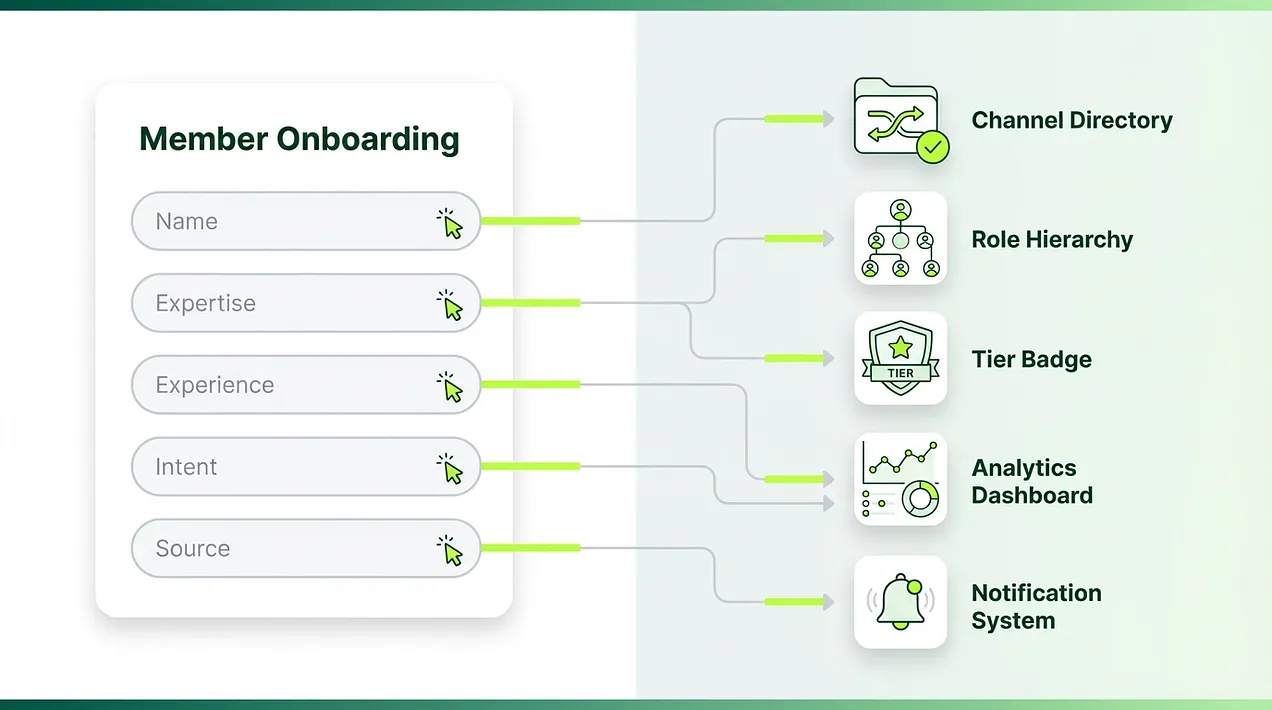
In a recent server build, we designed the verification form around four questions. Each one connects to a specific downstream system. The first question asks for area of expertise. This is not small talk. The answer feeds directly into channel routing. A member who specializes in backend development gets access to backend-specific channels. A member focused on design sees design-focused spaces. The routing happens automatically based on their response, with no manual assignment required. The second question asks about years of experience. This informs tier assignment. Members with deeper experience can be placed in advanced discussion channels or given access to resources that would overwhelm someone just starting out. The tiers are not about hierarchy. They are about relevance. Showing a new practitioner the same content as a ten-year veteran serves neither person well. The third question asks what brought them to the community. This is intent classification. Someone who joins to learn has different needs than someone who joins to network or someone who joins to recruit. Knowing intent at the point of entry allows your welcome sequence, channel suggestions, and early interactions to be tailored rather than generic. The fourth question asks how they found the server. This is acquisition tracking. Understanding which channels, referrals, or content pieces drive new members is fundamental data for growth decisions. Without it, you are guessing about what works.
Connecting Fields to Systems
The value of a well-designed verification form only materializes if the answers connect to operational systems downstream. Collecting data and leaving it in a spreadsheet is not meaningfully different from not collecting it at all. For each form field, there needs to be a clear connection to an automated action or a data pipeline. The expertise field triggers role assignment through a bot that maps keywords to roles. The experience field feeds into a tier system that controls channel visibility. The intent field populates a tag that your welcome sequence bot references when sending personalized onboarding messages. The referral field logs to an analytics tracker where you can measure acquisition channel effectiveness over time. If a field does not connect to a downstream action, it should not be on the form. Every question costs the member time and cognitive effort. Forms with unnecessary fields see higher abandonment rates. Each question needs to earn its place by delivering operational value.
The Spam Filter Is Not Enough
The standard approach to Discord verification treats it as a security measure. And security matters. You do need to filter out bots and bad actors. But that function can coexist with operational data collection in the same form. A single question like "Tell us about your experience with this topic" serves both purposes simultaneously. A spam bot will either skip it or generate nonsensical text that your moderation team can flag. A real human will provide information you can use for routing and classification. One field does double duty. The servers that rely on a simple reaction role or a CAPTCHA challenge for verification are missing the opportunity entirely. They confirm the member is human and learn nothing else. Every subsequent operational decision about that member has to be made with zero information.
Designing for Scale
The real payoff of a well-designed verification form appears when your community grows. At fifty members, you can manually sort people into channels and roles. At five hundred, manual sorting becomes a significant time investment. At five thousand, it is impossible without a team dedicated to nothing else. The form solves this by front-loading the data collection. When a member's form submission triggers automatic role assignment, channel routing, and tag classification, the operational cost of onboarding that member drops close to zero. Your systems handle it. Your team handles exceptions. This is how communities scale their onboarding without scaling their headcount. The verification form becomes the first node in an automated pipeline that handles the routine work and surfaces only the edge cases that need human attention.
What Most Operators Get Wrong
The most common mistake is designing the form from the member's perspective only. Operators think about what feels welcoming or what seems reasonable to ask. Those considerations matter, but they are not sufficient. The form needs to be designed from the systems perspective first. What data does your automation need to route this person correctly? What information does your analytics stack need to track acquisition effectively? What inputs does your tier system require to assign the right level of access? Once you have identified the operational requirements, you shape the questions to collect that data in a way that feels natural and reasonable to the member filling it out. The order matters. The phrasing matters. The number of fields matters. But the starting point is always what your systems need, not what seems friendly.
Testing and Iteration
A verification form is not a set-and-forget system. It needs to be tested and refined based on actual member behavior and operational outcomes. Track your form completion rate. If it drops below an acceptable threshold, you have too many fields or your questions are too demanding. Track whether the automated routing is placing members in the right channels. If expertise-based routing is consistently wrong, your keyword mapping needs adjustment. Track whether the tier assignments match the actual behavior of members. If advanced-tier members are asking basic questions, your experience thresholds need recalibration. Every form field generates data. That data should feed back into the form design itself. The communities that treat their verification form as living infrastructure, something that evolves as the community evolves, consistently outperform those that set it up once and never revisit it.
The Form as a First Impression
There is a secondary benefit that is easy to overlook. A well-designed verification form signals to new members that this community is serious. It communicates that there is structure here. That someone has thought about who joins and how they are welcomed. A community that asks thoughtful questions at the gate sets expectations for the quality of interaction inside. A community that asks nothing, or asks only for a CAPTCHA, sets a different expectation entirely. The form is your first conversation with every member. Make it count operationally, and it will also count experientially.
Daniel Jeong is a Discord systems architect and community operations strategist who builds onboarding infrastructure for communities that need to scale without adding headcount. https://danieljeong.org