Your Resentment Toward Discord Is Real. It Is Aimed at the Wrong Thing.
Why founders who have been burned by community managers usually inherited a presence problem, not a platform problem, and what infrastructure actually looks like when built correctly.

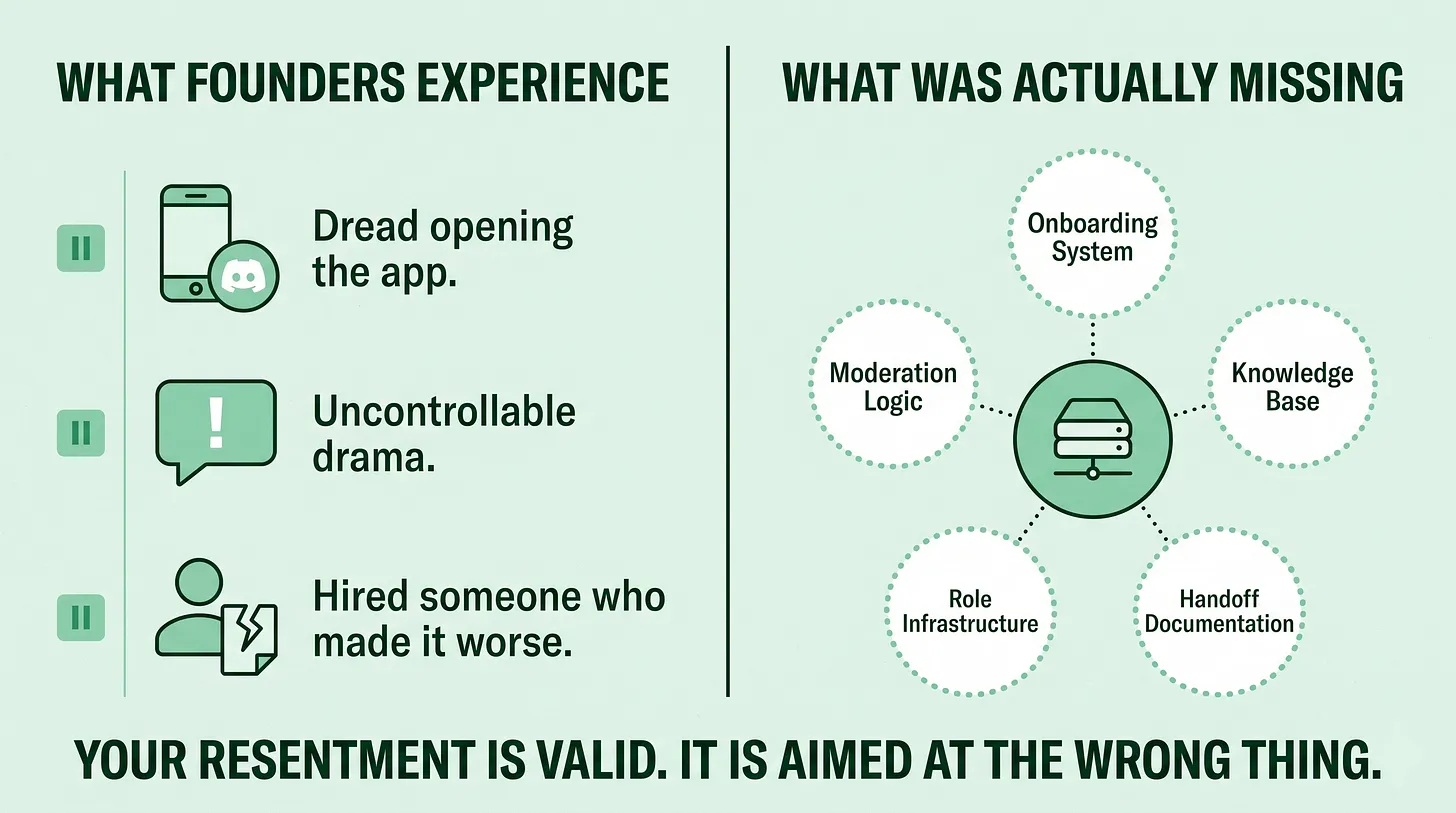
The Resentment Is Justified. The Source Is Misidentified.
There is a specific category of conversation I have with founders who are considering Discord community management consulting. It usually begins with some version of the same sentence: they are done with Discord. They do not want to hear what the platform can theoretically do. They have a story. The story ends with a community that turned toxic, or a community manager who disappeared, or a server that was supposed to drive product engagement and instead generated more operational damage than any other part of the business. The resentment is real and it is justified. The details vary but the underlying pattern is consistent. A decision was made to build a Discord community. Someone was hired to run it. That person delivered, for a while, something that appeared functional. Then things changed. The server either deteriorated slowly or collapsed quickly. The founder was left with the experience of having invested time, money, and trust into something that produced outcomes they describe as traumatic. I do not challenge the description. PTSD is how some founders characterize the aftermath. That is a serious word and they use it seriously. What I do challenge is the conclusion most founders draw from the experience: that Discord was the problem.
What Most Community Managers Actually Build
When a community manager takes over a Discord server, they arrive with a mandate: make this work. In most cases, they understand that mandate to mean: make it active, make it feel alive, keep the members engaged. So they show up every day. They greet new members. They start conversations. They handle moderation in real time, catching problems as they appear and dealing with them before they escalate. They produce engagement that is visible and measurable. The daily active users are up. The messages per week are up. The server looks healthy because someone is there all day making sure it does. This is not a bad thing in isolation. A community manager who is present and active is better than one who is absent. The problem is when presence is the only thing being built. When a community manager builds presence without building infrastructure, everything they produce is contingent on their continued availability. The moderation works because they are watching. The onboarding works because they are greeting new members manually. The engagement works because they are initiating conversations. None of it is automated. None of it is documented. None of it is transferable. This is an enormous structural risk that most founders do not identify until the community manager is gone.
When the Infrastructure Failure Becomes Visible
The failure mode that produces founder resentment almost always has the same trigger: the community manager leaves, or becomes unavailable, or is let go. Within days or weeks, the server reveals what was actually underneath the visible activity. New members arrive and nobody greets them. Questions go unanswered. Moderation calls that used to be made instantly now sit unaddressed because the logic for making them existed only in the departed community manager's working memory. Drama that used to be caught early escalates because the system that was catching it early was one person's attention, not a documented framework. The server that was producing strong engagement numbers six weeks ago is now producing nothing. Or worse, it is producing the specific kind of chaos that damages the brand. Founders experiencing this aftermath conclude that Discord does not work. That the platform is too volatile, too dependent on the right person being there, too difficult to manage at any meaningful scale. The conclusion is understandable. It is also wrong. The platform did not fail. The infrastructure that should have been built on top of it was never built.
What Infrastructure Actually Looks Like
The Discord servers that remain functional through community manager transitions, through growth, and through operational change are not functional because they found the perfect person. They are functional because the systems underneath them are designed to operate independent of any individual's availability. Onboarding infrastructure means that when a new member joins, a sequence of events occurs automatically. A role is assigned. A welcome message appears. The member is directed toward the channels relevant to them based on their entry path or stated interests. The first experience is consistent for every member regardless of whether anyone on the team is currently online. Moderation infrastructure means that the rules for what gets flagged, what gets removed, and what gets escalated are written down and implemented in systems that run without anyone watching. Common violations are caught automatically. The escalation path for edge cases is documented so that any team member, or a new hire, can make the right call without absorbing institutional knowledge from the person who left. Knowledge base infrastructure means that the questions members ask most often have structured, documented answers that members can access without requiring a person to respond. The knowledge base does not eliminate human support. It handles the predictable cases so that human support is available for the ones that require genuine judgment. Handoff documentation means that when a community manager transitions out, the incoming person can understand what the server is, how it works, what the moderation philosophy is, what the active initiatives are, and what decisions have already been made. This documentation is not a favor to the next person. It is evidence that the outgoing person built something real rather than managed a presence. When these systems exist, the server continues to function when personnel change. It does not return to chaos at the first sign of disruption because the systems that make it functional are not stored in any individual's head.
The Psychology of Discord Trauma in Founders
The reason founder resentment toward Discord is so persistent is that the experience of a failing server is visceral in ways that most operational failures are not. A SaaS product that underperforms produces data. A marketing campaign that fails produces metrics. These failures are legible and somewhat abstract. They live in dashboards and reports. A Discord server that fails produces something more immediate. It produces visible public drama the founder can watch in real time. It produces member complaints that arrive directly. It produces the specific discomfort of watching a community that was supposed to represent the brand become something the brand would not want associated with it. This immediacy makes the failure feel personal. Founders internalize it. They carry it. They describe it with language that communicates genuine distress rather than operational disappointment. The platform becomes associated with that distress. Discord equals the experience of losing control, of investing in something that turned against them, of trusting a hire who overpromised. Reframing that experience requires separating the platform from the failure mode that produced it. Discord has genuine capabilities and genuine limitations. Its capabilities include robust automation, structured permission systems, sophisticated role assignment, and a moderation framework that can handle communities at significant scale. Its limitations include a high operational floor, meaning it requires real infrastructure work to function well. The founders who experienced Discord trauma encountered the limitations without the infrastructure that would have made those limitations manageable.
How to Evaluate Whether Infrastructure Exists
For founders evaluating a Discord server they currently operate or are considering rebuilding, there is a simple diagnostic: what happens when nobody is watching? If onboarding still happens, the infrastructure exists. If it stops, it was a manual process. If moderation still functions, the infrastructure exists. If violations sit unaddressed, it was dependent on individual presence. If member questions still get answered, the infrastructure exists. If support falls silent, the knowledge base was never built. If a new community manager can start work informed by documentation, the infrastructure exists. If they are starting from zero, the outgoing manager built presence, not systems. These are not complicated questions. The answers are immediate and observable. But most founders have never asked them because they were told by their community manager that things were fine. The founders who asked these questions before the disruption happened are the ones who did not end up with the resentment.
What Changes When the Right Infrastructure Exists
The Discord communities I have managed that function well are not functioning because of my personal availability on any given day. They function because the systems are running. The onboarding processes are automated. The moderation logic is implemented and documented. The knowledge base addresses the predictable questions. The team, however small, operates against documented frameworks rather than individual intuition. When a team member is unavailable, the server continues. When priorities shift, the foundational systems maintain themselves. When the community grows, the infrastructure scales because it was designed to scale rather than because someone is working harder to compensate for the absence of systems. This is what community management as an operational discipline looks like. It is not fundamentally different from how any other operational function in a business works. You build systems. The systems run. You maintain and improve the systems over time. You do not rebuild from scratch every time personnel change. The resentment founders feel toward Discord is almost always resentment toward what it felt like to operate without that infrastructure. The platform was not the problem. The approach was. Building the right infrastructure does not guarantee a perfect community. It guarantees a community that is manageable, that responds predictably to operational decisions, and that does not collapse the moment any individual becomes unavailable. That is what a Discord community should feel like to run. The founders who have experienced it describe something that sounds nothing like PTSD.
Discord is not the source of the resentment most founders carry. The absence of infrastructure is. The two problems share the same fix: building what should have been built before the platform became a burden. danieljeong.org