Your Discord Is the Only Marketing Channel You Actually Own
Every other channel is rented. Here is what that costs you and what to do about it.

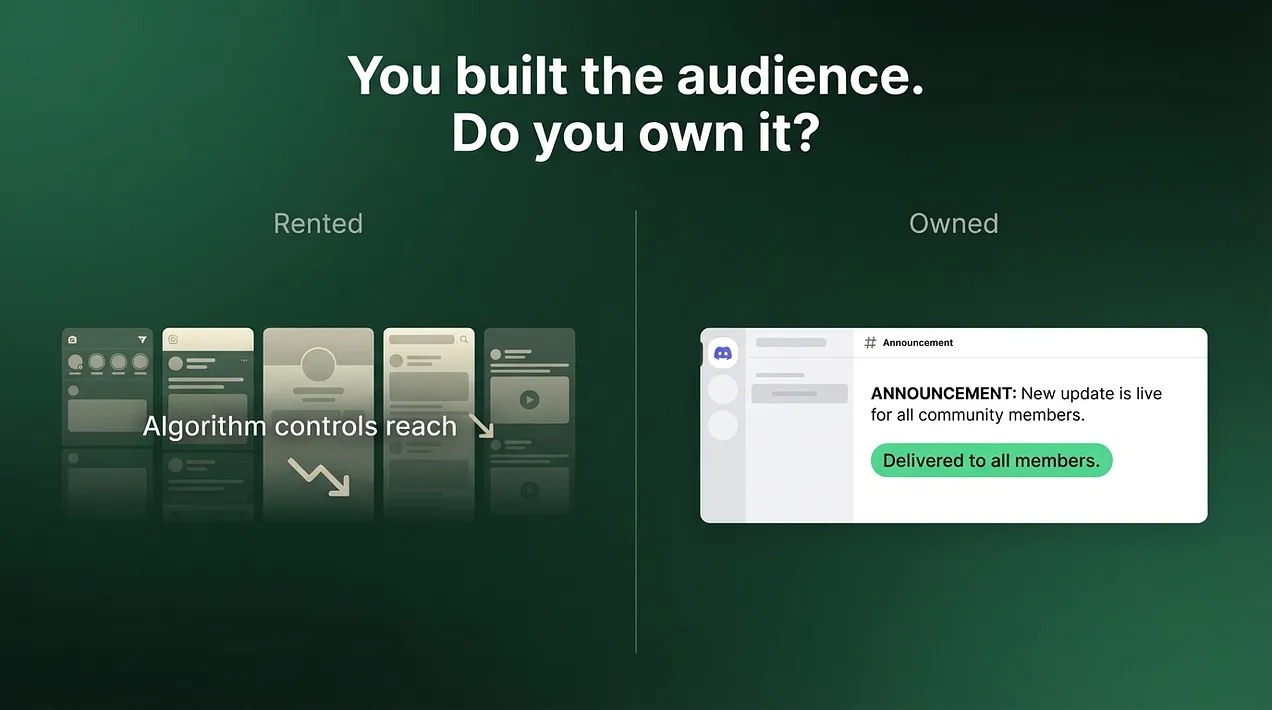
The channel you do not own is costing you more than you realize
There is a conversation that keeps happening across the companies I work with. They have invested serious time building an audience. Thousands of followers on Instagram. A LinkedIn presence that took months to develop. A YouTube channel that finally found its footing. And then one morning, the numbers shift. Not because the content got worse. Because the platform changed something they had no visibility into. An algorithm update. A shift in what types of content the feed prioritizes. A policy change that affects organic post distribution. Whatever the cause, the result is the same. The audience they spent time building becomes significantly less accessible, and nobody on the platform's side sent a notification to explain what happened. This is the core risk of building on rented infrastructure. You did the work. The platform owns the relationship.
What most companies misunderstand about followers
When someone follows you on Instagram or connects with you on LinkedIn, they are telling the platform they are interested in your content. They are not giving you direct access to them. They are not entering your ecosystem. They are staying on the platform's territory and opting in to occasionally see what you create, filtered through whatever the algorithm decides to surface on a given day. The business implication of this is significant. If your marketing strategy depends heavily on organic reach through social platforms, you are accepting a structural dependency on systems that can change at any time without your input or consent. Most teams do not fully feel this exposure until it hits them directly. By the time they do, they have sometimes spent years building on a foundation they do not control. There is also the issue of data. On most social platforms, you know how many followers you have and general demographic data. You do not always know who they are by name, how to reach them outside the platform, or what would happen to your business if that platform changed its terms tomorrow. The relationship exists on the platform's terms, not yours.
What changes when you build a Discord server
When someone joins your Discord server, they are not following a feed. They are entering a space you built, specifically to be part of the community you created. Your announcements and messages reach them inside an environment they chose to enter, not as one item in a curated content feed competing with hundreds of other posts. You set the rules in that environment. You decide who enters, what channels exist, what gets removed, and how the community functions day to day. The administrative and moderation tools available on Discord give you a level of control over the community experience that no social platform offers its creators or business accounts. This does not mean Discord replaces social media. The purpose of each channel is different. Social media builds awareness and attracts new people to your brand. Discord deepens relationships with people who are already interested. Social platforms are where you find an audience. Discord is where you keep and develop one.
Thinking about community as owned infrastructure
The mental model that helps most: think about a Discord server the way you think about an email list. Not because they operate identically, but because the underlying logic of ownership is similar. You built it. You maintain it. When you have something important to communicate, you communicate it directly to people who signed up to hear from you. An email list cannot host live events where members talk to each other in real time. It cannot run a support channel where your team and your community answer questions together. It cannot become a space where your most engaged customers develop relationships with one another, refer others, and produce conversations that surface product insights your team would never find from analytics alone. Discord can do all of that. The companies treating their Discord servers as business infrastructure rather than optional community features are building something that compounds over time. Every member who joins and stays adds long-term value. Every conversation inside the server provides information about what your audience actually wants. Every event run inside the server deepens the relationship between your brand and the people most likely to buy from you and refer others.
The practical difference in day-to-day operations
The most immediate practical difference shows up in how announcements work. On a social platform, an announcement might reach a percentage of your following depending on what the algorithm decides to show that day. Inside a Discord server, that announcement goes into a channel inside a space the member specifically joined, without competing against an algorithmically curated global content feed. Support is another area where the contrast is visible. A well-structured Discord can answer common questions through pinned messages or automated bot responses, reducing repetitive load on your team while keeping members engaged in a community context rather than a disconnected support queue. The member who asks a question in a public channel often sees another member answer it before the team even needs to step in. That kind of peer support does not exist in a social media comment section. Retention is where the compounding effect becomes most apparent. Members who are active in a community develop an attachment to the product or brand that goes beyond the initial transaction. They answer each other's questions. They spot problems before those problems escalate publicly. They stay longer and refer others more often than customers who never engaged with the community. The operational value of this is difficult to quantify in a single metric, but easy to observe across a six to twelve month period of community activity.
The difference between an audience and a community
One distinction that becomes clearer over time is the difference between having an audience and having a community. An audience consumes. A community participates. An audience can be built entirely through one-way content distribution. A community requires a space where interaction is possible and expected. Social media platforms produce audiences. Discord produces communities. Both have value, but they produce different outcomes for the business that maintains them. An audience that watches your content is valuable. A community that discusses your product, onboards new members, advocates for your brand, and surfaces real feedback is a fundamentally different asset. The first is a distribution mechanism. The second is infrastructure.
The cost of waiting
The companies that will be difficult to compete with in the next several years are not necessarily the ones with the largest follower counts on social platforms. They are the ones with the most invested, active communities. An audience you own, that trusts you and engages consistently, is a durable business asset in a way that social followers are not. Building that asset does not require waiting for your social reach to decline. It requires recognizing that owned infrastructure and rented reach serve different functions, and that only one of them belongs to your business long term. The algorithm will change again. Platforms will adjust their distribution models. New formats will receive preferential treatment and old formats will see reduced reach. None of that will affect a Discord server you built, maintained, and grew into a genuine community. The founders who understand this earliest are building the asset now, before it feels urgent. That is typically how good infrastructure decisions get made.
*Daniel Jeong is a Discord infrastructure consultant helping companies build scalable community systems that function as core business assets. To learn more, visit *danieljeong.org https://danieljeong.org