Your Discord Is Designed Around What You Know, Not What Your Members Know
The assumptions built into your server structure are the reason new members leave before they ever engage

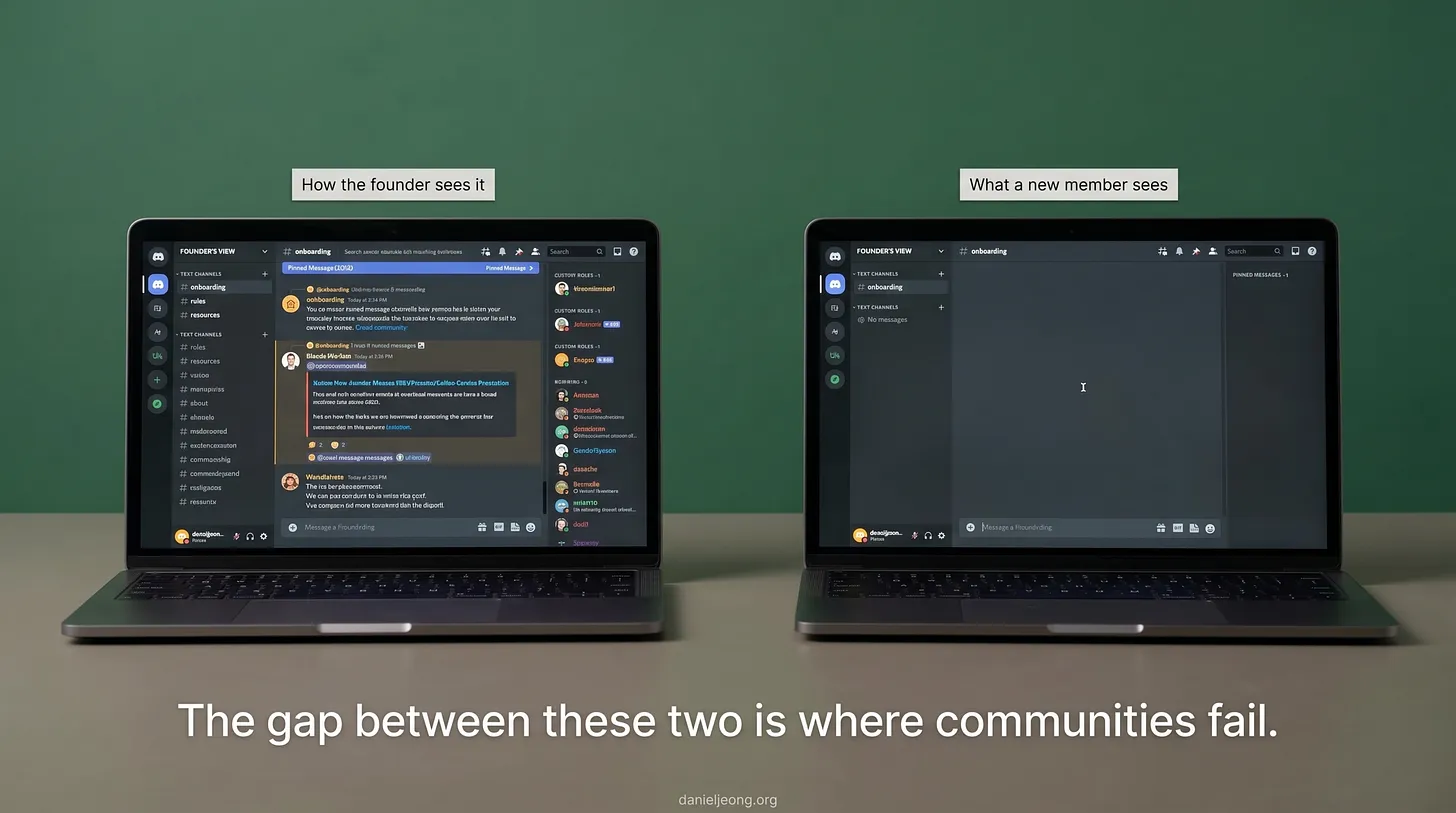
The thing almost nobody says out loud
There's a conversation that happens in almost every Discord audit I do. The founder shows me their server. Channel names are clean. Roles are configured. There's a pinned welcome message with all the important links. They've clearly thought about it. Then I ask one question: when was the last time you watched someone who had never used Discord before try to navigate your onboarding? The answer is almost always silence. Sometimes a deflection. Usually something like, "Well, our members are pretty tech-savvy." And that assumption is the problem. The server was built by someone who knows the product deeply. Who has used Discord for years. Who understands what every channel is for and why the role structure is set up the way it is. Every design decision made sense to the person making it. That is exactly why it doesn't work for new members. You built your Discord for yourself. Not for the person who clicked a link 30 seconds ago.
Assumption one: they know your product
The most common assumption I find baked into Discord infrastructure is that members arrive with a solid understanding of what the company does. This makes sense from the inside. Your team has been living with the product for months or years. Your community managers know the features, the use cases, the pricing tiers, the roadmap. It feels obvious. So channels get named after features people might not know exist. Roles get structured around use cases that require product knowledge to understand. Welcome messages reference things that only make sense if you've already gone through onboarding somewhere else first. A member who found you through a single post on LinkedIn or a 90-second YouTube clip has none of that context. They liked what they saw. They joined. Now they're in a server that assumes they understand terms and systems they've never encountered. The fix is simple in principle and harder to execute: write your onboarding as if the member knows nothing about your product. Not because they're inexperienced. Because they genuinely haven't had time to learn yet. That's what the first 48 hours is for.
Assumption two: they know Discord
The second assumption is almost as common, and it creates more friction than most people realize. Discord is not a universal tool. Plenty of people who join your server have used it only casually, or only for gaming, or only because a friend added them to a group once. They don't know how threads work. They don't understand why some channels are hidden. They're not sure what happens if they pick the wrong role. When someone joins a server and immediately hits a role selection screen with no context, the logical response is confusion. "Why do I need a role? Which one is right for me? What if I pick wrong?" None of those questions get answered if the screen just says "Select your role" with five single-word options. The person who built that screen knows exactly what each role means and where it leads. The person joining for the first time does not. And confusion at the very first step produces one consistent outcome: people leave. Design your onboarding as if Discord itself is new to your member. Not to oversimplify. Because the gap between your Discord fluency and theirs is wider than you think.
Assumption three: they'll read what you've written
Pinned messages. Welcome channels. Long text explanations of what each channel is for. These are everywhere in Discord communities, and they are read by almost nobody. This isn't a critique of the writing. It's a structural reality. When someone joins a new Discord server, they scan. They look at channel names. They notice what's active. They check whether anything is happening. They don't sit down and read three paragraphs of onboarding text before deciding whether to stay. The assumption that members will read detailed written onboarding before engaging is the same assumption that leads to most new members never posting at all. The onboarding exists, technically. It's just not working. What works is short, visible, immediate direction. One clear instruction. One obvious next step. One channel that tells them exactly where to go first. If your onboarding requires five minutes of reading to understand, you've already lost most of the people who just joined.
Assumption four: you know who's in your server
This one runs deeper than onboarding. It's an assumption about the composition of your community itself. Most teams assume their Discord members are primarily existing customers. Active users. People who already use the product and joined the community for support or connection. Sometimes that's true. Often it's not. Without intake data, you don't actually know. People join Discord communities for dozens of reasons. Curiosity. A recommendation. A link someone shared. A giveaway they found through a post. Without tracking how members found the server and what their relationship to the product actually is, every decision about channel structure and content strategy is built on a guess. The communities that operate well collect this information at the point of joining. What brought you here? What's your experience with the product? What are you hoping to find in this community? That data shapes welcome messaging, channel priority, and the support content you produce. If you're designing for an audience you haven't actually described, you're designing for a fiction.
Assumption five: they'll figure it out
This is the final assumption, and it's the most damaging because it requires the least effort. Servers built on this assumption aren't necessarily bad. They're just not built for anyone in particular. Channels exist. Roles exist. There might even be good content somewhere. But nothing guides a new member through the experience. The expectation is that people who want to be there will find their way. Some do. They're the members who post in the wrong channel first and adapt. Who ask a question, get a response, and gradually learn how things work. They exist in every community. They are not the norm. The majority of people who join and find an environment with no clear direction make a quick calculation. There's nothing here that's easy to engage with. There's no obvious reason to stay. They leave. Not because your community is bad. Because nothing in the first few minutes told them what to do next. Designing for the first-timer is not about dumbing things down. It's about respecting that the person who just arrived has no reason to spend time decoding your server's logic. Give them direction immediately, or don't expect them to stay.
What this actually looks like in practice
Changing these assumptions doesn't require rebuilding from scratch. It requires asking different questions when you evaluate what you've already built. Look at your role selection screen. Does it explain what each role actually unlocks, or does it assume the member already knows? Look at your first visible channel. Does it tell a complete newcomer what this community is and why they should stay, or does it assume they arrived with context? Look at your channel list. Could someone with no product knowledge navigate it, or does understanding the structure require familiarity you take for granted? These questions are simple. The answers often reveal that the server was built for the team, not for the member. The fix is just as simple in theory: rebuild each of those decisions with the lowest-context member in mind. The people who already know your product will navigate a beginner-friendly server without any problem. The people who don't know your product will not navigate an expert-first server at all. Build for the person who just arrived. Everyone else already knows the way.
Daniel Jeong is a Discord infrastructure consultant who helps founders and operators turn community servers into scalable operational systems. https://danieljeong.org