Your Creators Join Your Server Looking for a Partnership Form That Isn't There
Why creator audiences need a dedicated path, and what you lose when that path does not exist

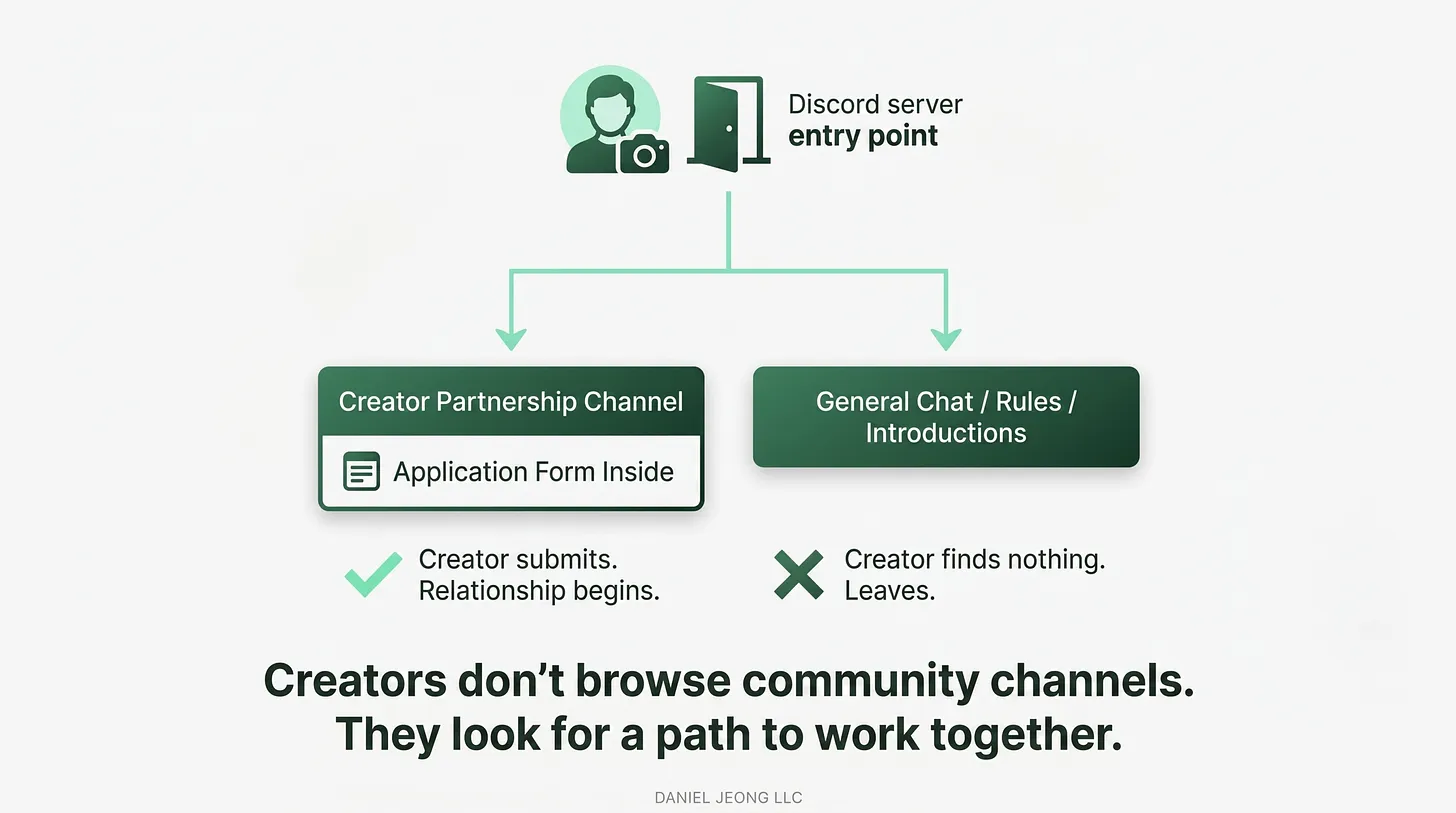 A creator who joins your Discord has already made a decision. They are not browsing for information or general community discussion. They are evaluating your brand as a potential working relationship.
This distinction changes what the first few minutes of their server experience should be. A regular community member benefits from a clear welcome, an explanation of the community's purpose, and an easy path to relevant content. A creator evaluating a partnership opportunity needs something different. They need a signal that your brand has a structured approach to creator relationships, and they need a place to start that process without having to figure out who to message.
Most Discord servers provide neither of those things for creators.
A creator who joins your Discord has already made a decision. They are not browsing for information or general community discussion. They are evaluating your brand as a potential working relationship.
This distinction changes what the first few minutes of their server experience should be. A regular community member benefits from a clear welcome, an explanation of the community's purpose, and an easy path to relevant content. A creator evaluating a partnership opportunity needs something different. They need a signal that your brand has a structured approach to creator relationships, and they need a place to start that process without having to figure out who to message.
Most Discord servers provide neither of those things for creators.
What Creators Are Looking For
The pattern is consistent across platforms. Creators who arrive at a brand community are looking for one of three things. The first is social proof. They want to know whether other creators they respect have worked with this brand. Testimonials, case studies, or visible past collaborations in a dedicated channel accomplish this quickly. The second is a clear offer. What does a partnership with this brand look like? What do creators receive in exchange for what they contribute? This information needs to be available without requiring a DM to a team member. The third is a path to apply. A form, a link, or a clear process for expressing interest. The bar for this form does not need to be high. It needs to exist. When all three are present in a dedicated channel, a creator with genuine interest will complete the application within the same session they discovered the channel. The motivation is already there. The infrastructure just has to catch it. When none of the three are present, the creator does a quick scan, finds nothing that matches their intent, and leaves. They may revisit the brand through another channel later. They may not. Either way, the community failed to do the one thing it could have done to capture that specific member.
The Partnership Channel Infrastructure
A creator partnership channel in Discord is straightforward to build. The channel should appear in the server navigation in a location that is visible before a creator reaches the general community channels. If they have to scroll past dozens of channels to find it, many will not. The channel content needs three elements. A clear explanation of who the partnership program is for, which should be specific enough to help creators self-qualify quickly. An honest description of what the partnership looks like in practice, including what creators are expected to contribute and what they receive in return. And a form or application link that collects the basic information required to evaluate a creator fit. A pinned message handling all three elements, with a form link at the bottom, covers the full requirement. The form itself can be a simple external form tool. The complexity of the evaluation process lives outside the Discord. The channel's job is to capture interest and route it into that process.
The Invisible Cost of Not Having It
The specific challenge with creator churn in community settings is that it does not generate a signal that looks like a failure. When a creator joins a Discord server without a partnership channel and leaves within a few minutes, that appears in the team's data as a standard low-engagement member. There is no drop-off event from a specific funnel stage because the funnel stage does not exist. The team sees a member joined and was not retained. They conclude the community has a general retention problem rather than a specific structural gap. This means the fix does not get prioritized, because the problem is not legible in the data. Building the partnership channel before you see the data signal is the correct sequence. If your brand is actively bringing creator traffic to the server through campaigns, social posts, or creator-led acquisition, the assumption should be that creators are arriving regularly and finding nothing for them. The infrastructure should precede the evidence of need.
Matching the Channel to the Creator You Want
One refinement worth considering is tailoring the partnership channel to the specific type of creator your brand works with best. A developer tool company looking for technical content creators has different partnership criteria than a consumer product looking for lifestyle creators. The channel content should reflect this. Generic language about working together produces generic applicants. Specific language about the type of content you are looking for, the audience profile that fits your program, and the platforms you prioritize produces applicants who are already qualified before the form is reviewed. The channel also provides a passively useful signal to creators who do not meet the current criteria. If a creator reads the channel and sees their profile does not match what the program needs, they leave without applying. That is efficient for both sides. The alternative — where there is no channel and the creator has to DM someone to find out if they qualify — wastes both parties' time.
Why This Belongs in the Initial Server Build
Creator partnership infrastructure is often treated as a nice-to-have that gets added after the community has grown. This sequence is backwards. The creators who discover your community when it is newer are typically more willing to take a chance on a smaller brand. They are evaluating early-stage relationships before the program is crowded. The partnership channel captures those early relationships, which then become the social proof that future creators use to evaluate whether the program is worth their time. Waiting until the community is larger to build the creator partnership infrastructure means you miss the cohort with the lowest acquisition cost and the highest potential for long-term engagement. The channel takes a few hours to build. The form takes an afternoon. The program criteria can be written in a single meeting. There is no phase of community growth where this is not a worthwhile investment.
The Larger Pattern
What makes this infrastructure gap so consistent is that it reflects a broader assumption teams make about community members: that everyone who joins is arriving with the same intent. They are not. Developers arrive looking for technical support and peer community. Enterprise buyers arrive looking for a private path to ask business questions. Creators arrive looking for a partnership process. Building a server that treats every member identically is a choice that effectively serves the most generic audience and fails every specialized one. The fix is not complexity. It is a few dedicated channels that speak directly to the people who arrived with a specific purpose. Creators are one of the most actionable segments in that group because their intent is clear and their contribution, when captured, has direct marketing value. The path to capturing them is simple. It just has to be built.
Daniel Jeong is a Discord infrastructure consultant who helps brands build community systems that capture every type of audience member they need to serve. https://danieljeong.org