Your Community Does Not Stop When Your Team Logs Off
Time zone coverage is not a staffing preference. It is a structural requirement for any community that serves members across more than one region.

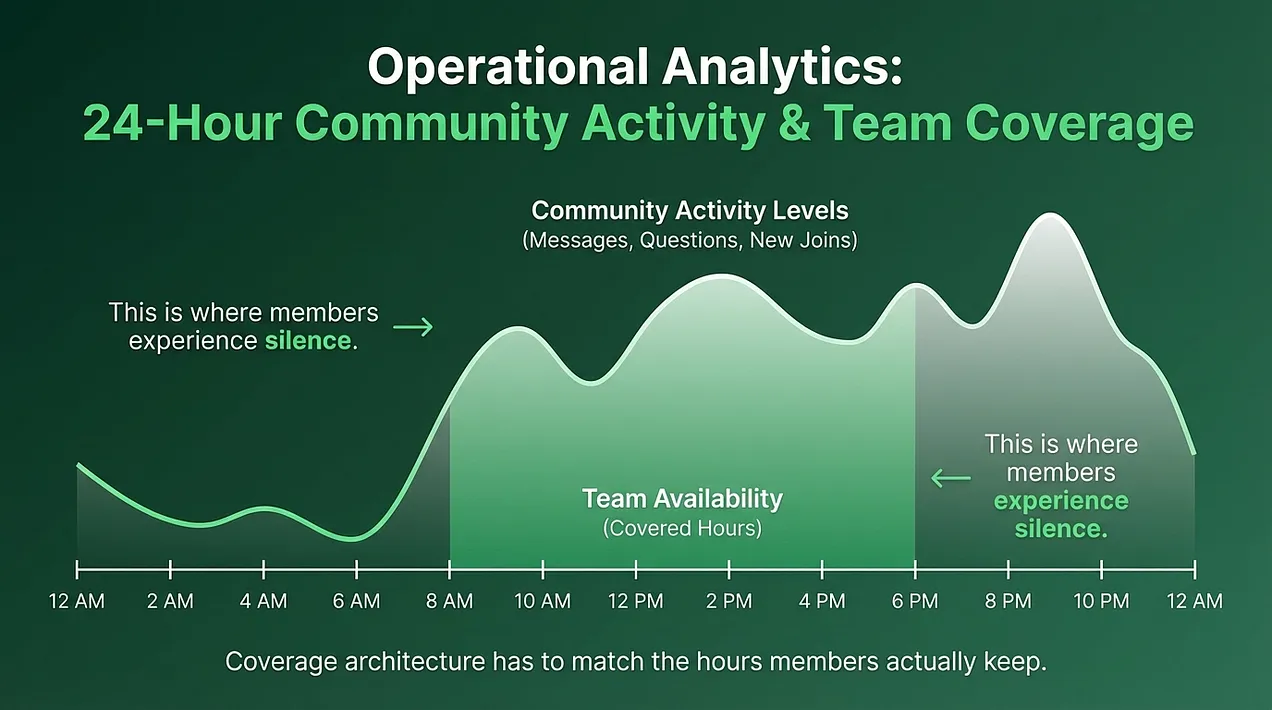
The Community Is Always Active. The Team Is Not.
There is a pattern in community management that is easy to overlook because it is invisible. The members it affects tend not to complain about it directly. They just leave. The pattern is the coverage gap. A community team based primarily in one region, working something close to standard business hours, creates a window of reliable coverage for the members who happen to be active during that window. Questions get answered. Issues get addressed. New members get acknowledged. The experience of those members reflects well on the community. For everyone else, the experience is different. They arrive during the hours when the team is offline. They ask a question and wait. They hit an onboarding issue and have no one to help them resolve it. They start a conversation that would have been easy to redirect with a timely response and watch it go silent. They form an impression of the community based on that silence, and they do not always give it a second chance.
The Global Default
When a community grows beyond the immediate network of its founder or core team, it will almost inevitably begin attracting members from outside the founder's time zone. Those members arrive with the same expectations as any other member. They expect their questions to be answered within a reasonable window. They expect new member acknowledgment. They expect that if they surface a problem, someone will see it. The time zone they are in is not part of the service they are evaluating. They are evaluating the community on the same terms as someone who happens to be in the same time zone as the team, and that evaluation happens during the hours they are active, not during the hours the team is present. A community that performs well for members in one region and poorly for members in another has an inconsistent product. The experience is not determined by the quality of the team or the design of the community. It is determined by the clock.
What the Coverage Gap Costs
The most direct cost of a coverage gap is member retention at the entry point. New members are the most vulnerable members in any community. They have not yet built habits around coming back. They have not yet had enough positive experiences to compensate for a negative one. When they arrive during an unmanaged window, experience silence in response to a question or issue, and leave without resolution, they often do not return. The retention loss from coverage gaps is difficult to measure because it happens silently. There is no complaint, no cancellation note, no off-boarding survey. The member simply stops showing up. The data shows reduced activity after a certain date, but the cause is rarely traced back to a coverage gap if no one was present to observe the experience. Beyond new members, coverage gaps affect the quality of ongoing community experience for members who are consistently active during off-hours. For those members, the community is effectively unmanaged. They have learned not to expect responses during those hours. They have adjusted their participation accordingly, asking fewer questions, posting less, engaging at a lower level than they would if responses were reliable.
Solutions That Do Not Require a Full Global Team
The standard mental model for solving coverage gaps is to hire staff in every time zone. That is one solution, and for large communities it may eventually be necessary. But it is not the only starting point. Regional moderators drawn from the community membership itself can provide significant coverage at low cost. These are members who are already active, already know the community culture, and are in time zones where the core team is absent. A light support role, acknowledging new members, holding complex questions for the core team, maintaining basic moderation, can be handled by well-selected community members without a full-time commitment. Automated response systems can also bridge coverage gaps in specific ways. A bot that acknowledges a new question with a message noting that a team member will follow up within a defined window is not a substitute for a real response, but it signals that the community has a system and that the member's question has been received. That acknowledgment alone reduces the experience of being ignored. Ambassador networks distributed across time zones can handle light support and orientation functions that would otherwise require paid staff. The specific combination depends on the community's size, the nature of the support needs, and the budget available. But the starting point is the same regardless of scale: acknowledge that the coverage gap exists and treat it as a structural problem rather than an edge case.
The Expectation Is Not Going to Change
Members who are active outside of one region's business hours are not going to start expecting less. The expectation of reasonable response times in communities is set by the best experiences members have had across all of the online communities and platforms they participate in. If a member has been in other communities where questions get answered within a few hours at any time of day, that becomes their baseline. A community that answers questions in two hours for nine hours a day and ignores them for the remaining fifteen is not meeting that baseline for the members who are active during the fifteen hours. The baseline is set by the best available experience, not by the average. This is true across all service contexts. The communities that will differentiate themselves over time are the ones that acknowledge this reality and build infrastructure to address it rather than accepting uneven coverage as inevitable. Time zone coverage is not a scheduling preference. It is architecture. And like all community infrastructure, it either works or it does not, regardless of whether the people running the community are there to see it fail.
Daniel Jeong consults on Discord community infrastructure and operational systems for organizations building long-term community engagement strategies. https://danieljeong.org