You Shouldn't Have to Recover From Your Last Community Manager
Why Most Discord Management Fails and What Operational Community Infrastructure Actually Looks Like

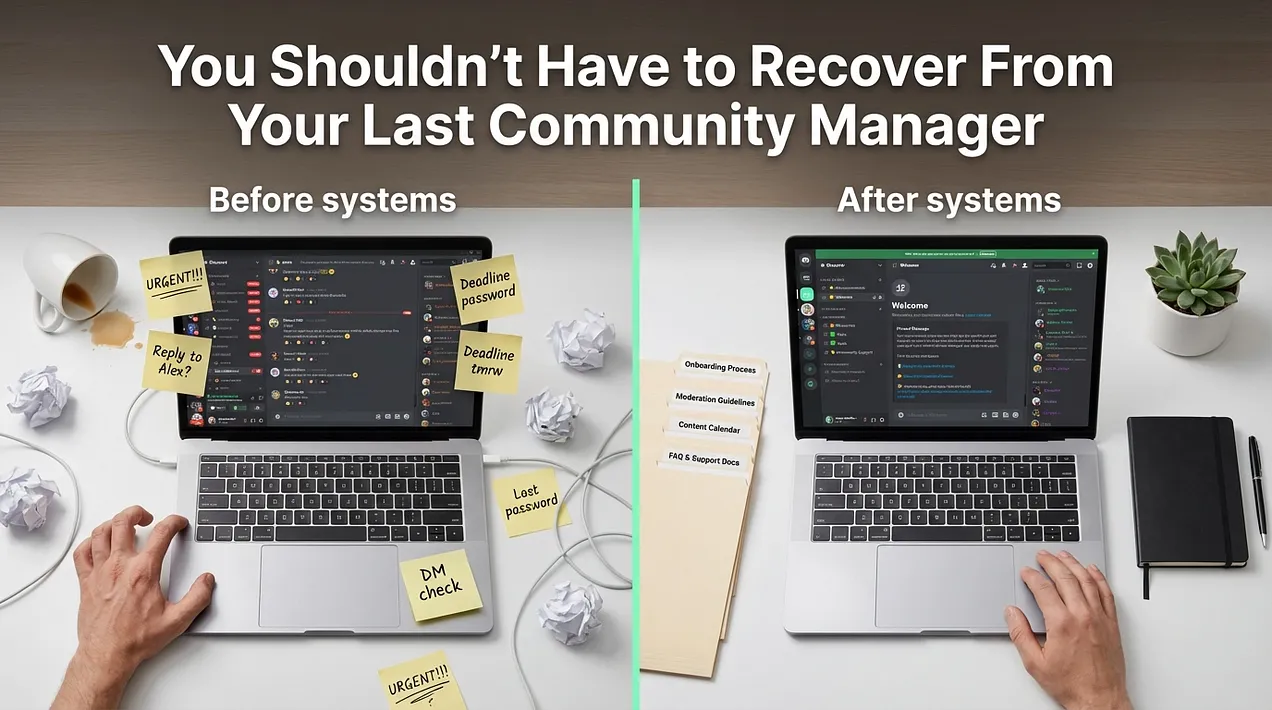 There is a pattern I see repeatedly when founders reach out about their Discord communities. They don't start the conversation excited about what Discord could do for their business. They start by telling me what went wrong with the last person they hired to manage it.
The stories follow a familiar arc. They brought someone on who seemed enthusiastic about community. That person spent the first few weeks greeting new members, posting messages in general chat, and running a couple of events. Activity looked decent on the surface. The founder stepped back, believing the server was being handled.
Then things started slipping. New members joined and nobody guided them anywhere. Questions went unanswered for hours. When something contentious happened, the response was improvised. There was no escalation process, no documentation for how to handle disputes, no moderation framework that could be referenced by anyone other than the person who made it up in the moment.
Eventually the community manager moved on. And the founder was left with a Discord server that had no systems, no documentation, and no clear path forward. The only institutional knowledge walked out the door with the hire.
There is a pattern I see repeatedly when founders reach out about their Discord communities. They don't start the conversation excited about what Discord could do for their business. They start by telling me what went wrong with the last person they hired to manage it.
The stories follow a familiar arc. They brought someone on who seemed enthusiastic about community. That person spent the first few weeks greeting new members, posting messages in general chat, and running a couple of events. Activity looked decent on the surface. The founder stepped back, believing the server was being handled.
Then things started slipping. New members joined and nobody guided them anywhere. Questions went unanswered for hours. When something contentious happened, the response was improvised. There was no escalation process, no documentation for how to handle disputes, no moderation framework that could be referenced by anyone other than the person who made it up in the moment.
Eventually the community manager moved on. And the founder was left with a Discord server that had no systems, no documentation, and no clear path forward. The only institutional knowledge walked out the door with the hire.
The Resentment Is Real
This experience creates something deeper than frustration. Founders develop genuine resentment toward Discord as a platform because their only reference point is failure. They invested time, money, and trust into community management and got back a chat room that drained their energy. When they hear someone talk about Discord as a strategic business tool, the reaction is skepticism. They've heard that pitch before. The last person who made that pitch spent three months hanging out in general chat and left behind nothing. That resentment is understandable. But it's aimed at the wrong target. Discord as a platform has the capability to function as serious business infrastructure. The problem wasn't the tool. The problem was the approach.
What Went Wrong
Most community managers who fail in a business context fail because they approach Discord the way they would approach personal servers or hobbyist communities. They show up, participate, and believe that presence equals management. Presence matters. But presence without systems is just hanging out. In a business context, a Discord server needs operational infrastructure the same way a customer support team needs ticketing systems or a sales team needs a CRM. Without onboarding systems, new members arrive and have no clear first action. They look around, see an active but unstructured space, and leave within 48 hours. Nobody tracks that they left. Nobody knows why. Without moderation frameworks, disputes get handled inconsistently. One incident gets a warning. A similar incident two weeks later gets a ban. Members notice the inconsistency, and trust erodes. The community manager doesn't see this as a systemic problem because there's no system to reference. Without documentation, every decision is made from memory. When someone asks why a particular rule exists or how to handle a specific situation, the answer lives in one person's head. If that person leaves, the answer leaves too. Without automation, repetitive tasks eat hours. Role assignment, welcome messages, basic moderation triggers, FAQ responses. These are tasks that should be handled by bots and workflows, freeing the community manager to focus on relationship building and strategic decisions. Most failed community management hires don't fail from laziness. They fail because they were never equipped to think about community as an operational discipline.
The Systems That Actually Matter
When I work with a company's Discord server, the first thing I build is infrastructure. Before any engagement strategy, before any events calendar, before any content plan. Onboarding is the foundation. When a new member joins, there should be a clear, guided path from entry to engagement. This includes verification, role selection, a structured welcome experience, and a prompt that gives the new member a concrete reason to participate. This system runs whether the community manager is online or not. Moderation gets documented. Every type of incident has a defined response. Warnings, escalations, bans. The criteria are written down. Anyone on the team can reference them. Decisions are consistent, and members can trust that the rules apply equally. Automation handles the repeatable work. Role assignment happens automatically. Welcome messages deploy based on the roles a member selects. FAQ responses surface without human intervention. Moderation bots flag potential issues before they escalate. Documentation captures everything. Channel purposes, workflow descriptions, escalation procedures, automation configurations. If someone new joins the team, they can read the documentation and understand how the server operates without shadowing anyone. These systems don't just improve the day-to-day experience. They make the entire operation transferable. If the community manager leaves, the server keeps running. The infrastructure stays. The documentation stays. The automations stay. The next person inherits a functioning system instead of a mystery.
Why This Matters for Founders
For founders evaluating Discord as a business investment, the difference between a community manager and a community operations professional is significant. A community manager who treats Discord like a presence job will create a server that depends entirely on their individual effort. When they're active, things feel alive. When they're not, things drift. The founder stays involved because stepping away means things fall apart. A community operations approach creates a server that functions as infrastructure. Engagement systems run independently. Moderation operates from documented frameworks. Onboarding converts new members into active participants systematically. The founder can step away and the server continues to operate because the systems were built to work without constant manual intervention. The first approach feels good initially because activity is visible. Someone is in the server, talking to people, running events. The second approach takes longer to build but produces something durable.
Rebuilding Trust After a Bad Experience
If you've been through a bad community management hire, the path forward starts with understanding what was actually missing. Most of the time, it wasn't motivation or work ethic. It was the absence of systems thinking. Community management at a business level requires someone who thinks about Discord the way an operations lead thinks about workflows. What happens when a new member joins? What happens when a dispute occurs? What happens when the team isn't online? What happens when the community scales from 500 members to 5,000? These questions need documented answers, not improvised ones. And those answers need to exist in the server's infrastructure, not in someone's head. The founders who successfully rebuild their Discord communities after a bad experience don't just hire a better person. They hire differently. They look for systems thinking, not just enthusiasm. They ask about automation experience, not just engagement ideas. They want to see documentation processes, not just activity metrics.
Moving Forward
Discord can be one of the most valuable tools a business operates. It provides direct access to your audience, real-time feedback loops, support infrastructure, and community-driven retention that no other platform replicates at the same cost. But realizing that value requires treating it as infrastructure from day one. Hiring someone to "manage the Discord" without defining what management means operationally is how resentment gets built. You shouldn't have to recover from your last community manager. The next one should hand you systems that work whether they're online or not.
If your Discord server feels like it's draining more energy than it creates, the problem is almost never the platform. https://danieljeong.org