Why the Intake Form Is the Most Underused Piece of Community Infrastructure
When you run multiple community spaces for different audiences, the routing decision at the entry point determines whether the experience works for anyone.

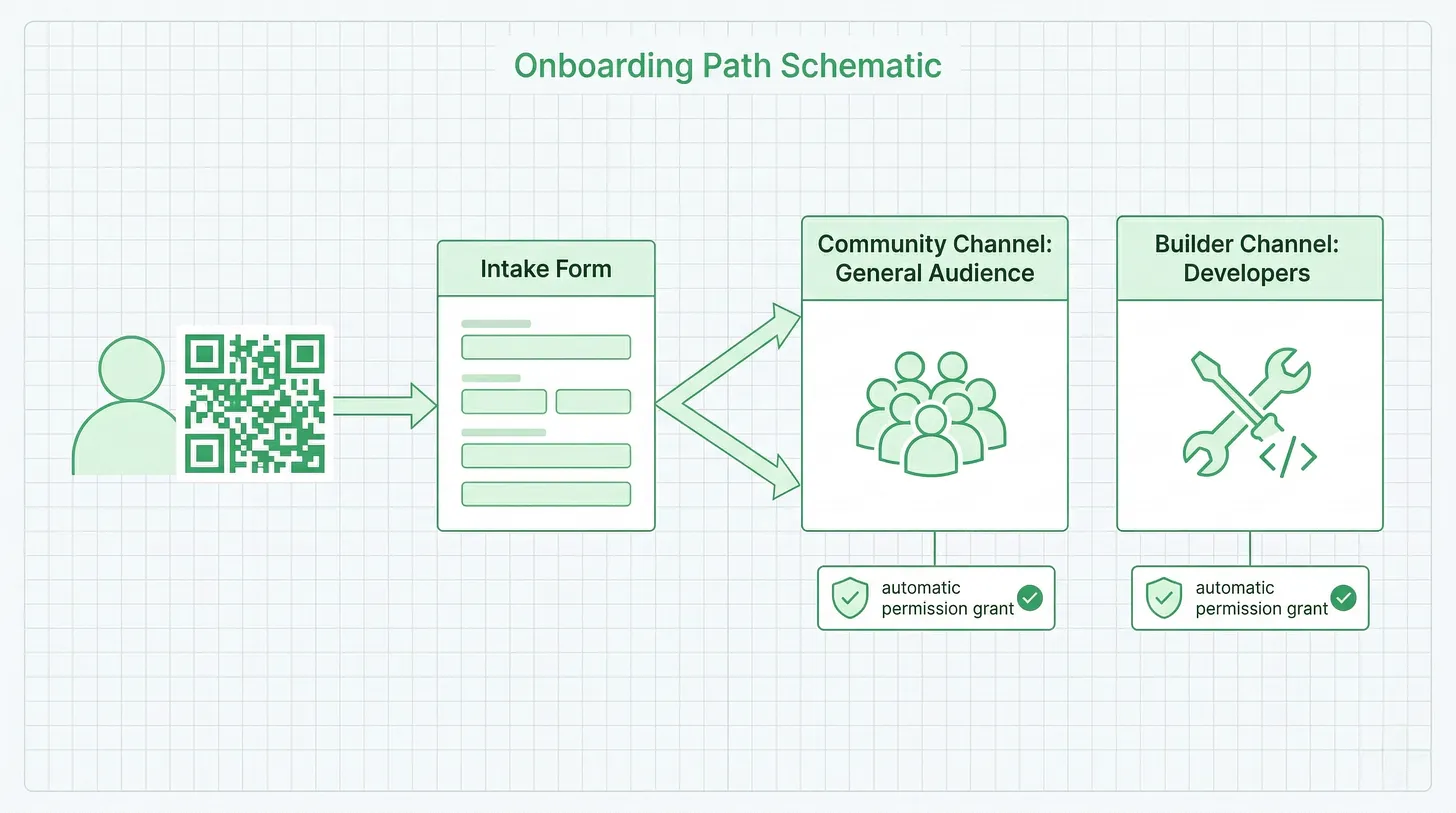
The moment when multi-platform community management gets complicated
Running a single Discord server with a defined audience is relatively straightforward. You know who the members are, what they need, and how the channels are organized to serve them. The community has a clear identity and the infrastructure reflects it. Running multiple community spaces across different platforms for audiences with different purposes is a different kind of problem. You have a general community on one channel. A technical or developer audience on another. The platforms themselves may differ, Discord for one group, Telegram for another, because different audiences have different platform preferences. And the question becomes: how do you get the right people into the right space without creating friction or confusion at the entry point? This is the problem the intake form solves.
What the intake form actually does
An intake form placed at the entry point to your community ecosystem collects information about a new person before they join any channel. That information drives a routing decision: which community space does this person belong in, and what role or access level should they receive when they arrive? The questions on an intake form for this purpose do not need to be extensive. Email address for record-keeping. Occupation or job function. A brief indicator of what the person is working on or what they are interested in. Sometimes a single dropdown question that asks the person to self-select their role in the ecosystem. With that information, the routing is automatic. A developer who selects a technical role is directed to the builder channel and assigned the appropriate permissions in Discord. A general community member is directed to the public-facing channel. Both people get into the space that is relevant to them without having to navigate through a combined server and figure out where they belong.
Where this matters most: events and conferences
One of the highest-value applications of the intake form is in event settings. When you are at a conference with QR codes on your badge or at a booth, every person who scans that code is a potential community member. But they are not all the same kind of potential community member. Some are general audience members who want to follow along with what you are building. Some are developers who want access to technical resources. Some are potential collaborators. Some are investors or enterprise evaluators. Without a routing system, they all land in the same place, and the experience is optimized for none of them. An intake form converts each scan into a routing event. The same QR code, the same entry point, but different destinations based on what the person indicates about themselves. The general audience member gets one invite. The developer gets another, with different access and different channel visibility when they arrive.
The difference between a gate and a routing system
A common concern with intake forms is that they function as a gate: an additional barrier that reduces the number of people who actually complete the join process. This is a legitimate concern if the form is long, the questions are unclear, or the process feels like a qualification test. A well-designed routing intake form is not a gate. It is three to four questions that most people can answer in under a minute. The purpose is not to evaluate whether someone deserves access. It is to collect the minimum information needed to give them the right access. The distinction matters operationally. A gate optimizes for exclusion. A routing system optimizes for fit. The people who were going to join are still joining. They are just landing in a space that is actually relevant to them rather than a combined channel where the experience is optimized for nobody.
The role assignment layer
The intake form connects directly to the role assignment infrastructure within each platform. On Discord, a person who identifies as a developer through the intake form arrives with the developer role already assigned. They can see the channels relevant to their access level from the moment they land. They do not need to go through a verification step or navigate to a role-selection channel. On Telegram, the routing is handled differently because the platform does not support role-based channel access in the same way Discord does. The intake form sends a different invite link to each segment. A general audience member gets a link to the general community. A developer gets a link to the builder-focused space. The routing logic lives in the form rather than in the platform. This difference in platform capability is itself a reason why the intake form matters more in multi-platform environments. When platforms have different access control models, the intake form becomes the single point where routing logic can be applied consistently regardless of where the person ends up.
Building it before you need it
The intake form is an infrastructure component that is most valuable when it is in place before the high-traffic moments arrive. For community teams managing conferences, launch events, or marketing campaigns, the time to build the routing system is before the first QR code goes on a badge. The form itself does not require complex tooling. A Google Form with a redirect based on form response, a simple Webflow page with conditional logic, or a dedicated onboarding tool can all serve the function. The technical barrier is low. The operational value of having it in place when the volume arrives is high. Community infrastructure, like most infrastructure, is invisible when it works and very visible when it does not. The intake form is one of those components that new members will never consciously notice if it is working correctly. They will just arrive in the right place and have an experience that makes sense from the first channel they see. That is the goal.
Daniel Jeong is a Discord community infrastructure consultant. He works with AI companies, Web3 projects, and high-growth digital communities to build entry-point systems and multi-platform community infrastructure. https://danieljeong.org