Why Human-Led Community Management Is Becoming the Signal in a Noisy Market
As AI floods every content channel, the communities that feel genuinely human are the ones people remember. Here is what that means operationally.

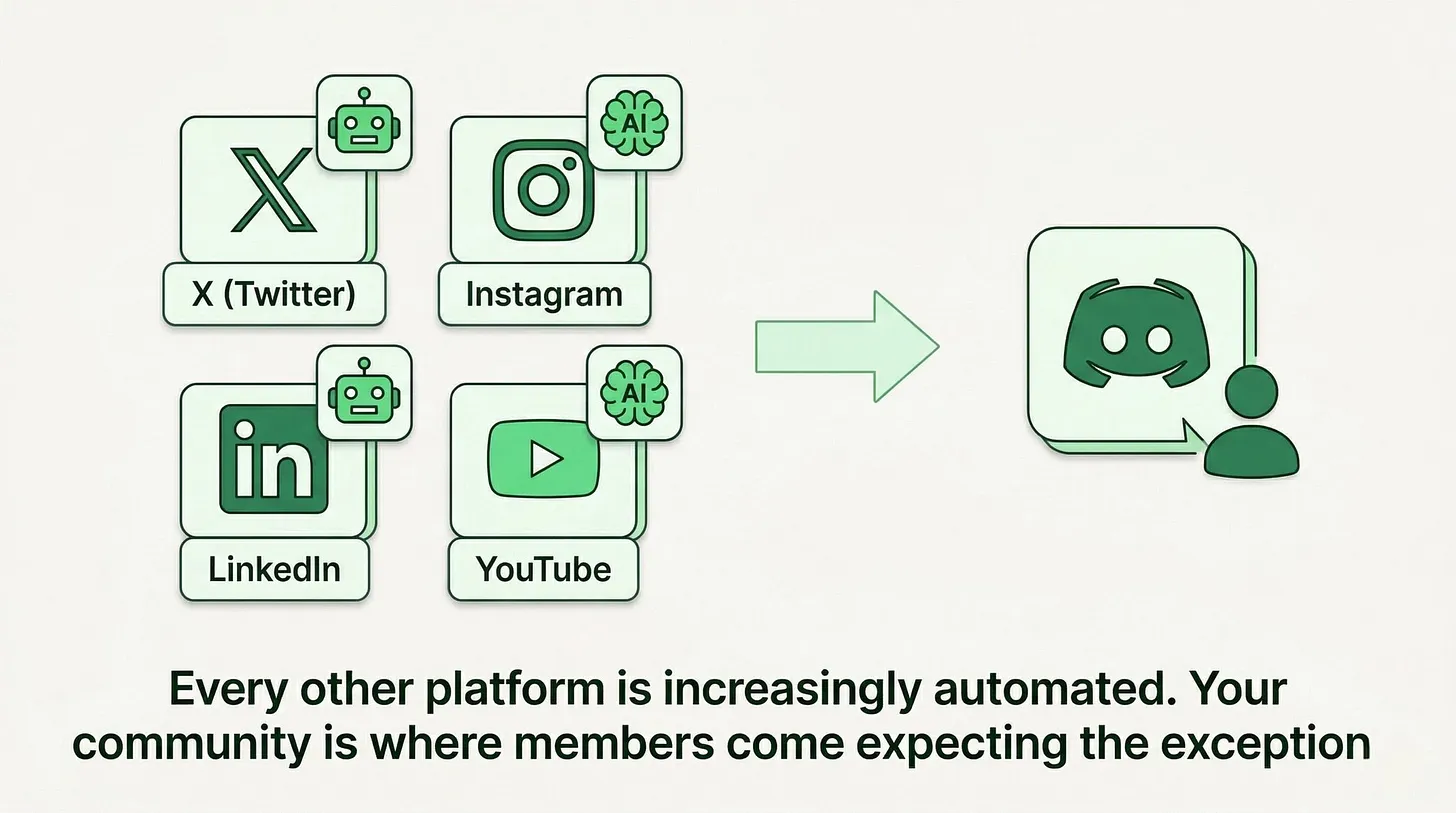
What the shift in member expectations looks like
Community members are more sophisticated than they were a few years ago about detecting automated interaction. This is not a skill they developed intentionally. It happened because every platform they use is increasingly populated with AI-generated content, and they have learned to feel the difference between something written by a person responding to them specifically and something produced by a system responding to a trigger. When a new member joins a Discord server and receives a perfectly formatted welcome message with a standard set of links and instructions, they know. It is not that the message is unwelcome. It is that it does not create the sense of being seen that a real interaction would provide. The automation tells them immediately what kind of space this is. The communities that members stay in are the ones where that first signal is different. Where someone acknowledges the specific thing they said. Where a response has texture, variation, the kind of unevenness that comes from a person actually reading and reacting.
The paradox of efficient community automation
There is a genuine tension in community management between operational efficiency and member experience. Automation solves real problems. It handles role assignment, onboarding instructions, FAQ responses, moderation triggers. It removes the repetitive operational load from the human team and allows them to focus on more complex interactions. But when automation extends into the actual conversation layer, it solves the wrong problem. Efficiency in conversation is not a value. What members want from a conversation is not speed or consistency. They want responsiveness. They want the sense that the person on the other side of the exchange is actually engaged with what they said. A well-automated community can handle ten thousand members without proportional increases in human staffing for operational tasks. That is a real efficiency gain. But it requires keeping the automation in the infrastructure layer and not letting it migrate into the interaction layer.
What I use AI for in community work
The productive application of AI in community management is in analysis and reporting, not conversation. Pulling patterns from member conversations, identifying what topics are driving the most engagement, flagging sentiment shifts before they escalate, summarizing activity for management review. These are tasks where AI produces genuine operational value. They are tasks where the AI is not trying to simulate human presence. It is processing data and surfacing insights that a human team can then act on. When the AI shows up in the conversation itself, even in well-intentioned forms like automated personalized welcome messages or bot-generated engagement prompts, it tends to produce the inverse of what community management is trying to achieve. Members feel less connected, not more. The efficiency gain is real. The relationship cost is real too.
Why this is a more acute problem now than it was before
The context that makes human-led community management a competitive advantage today is the state of every other channel those members are coming from. LinkedIn, X, Instagram. The volume of content on these platforms has increased substantially. A significant portion of that content does not sound like it was written by a person. The cadence is too regular. The phrasing is too smooth. The structure is too predictable. Members recognize this pattern now in a way they did not a few years ago. So when they come into a community expecting a different kind of interaction, the gap between automated output and genuine engagement is more visible than it has ever been. The community that gives them real human interaction is not just meeting expectations. It is standing out from a baseline that has shifted.
The e-commerce signal
One of the clearest indicators of how members feel about AI interaction comes from e-commerce communities. In communities built around consumer brands and products, members are particularly vocal when they encounter AI-generated content. They notice it in customer service responses. They notice it in community posts. They make their reaction public. This is a specific audience in a specific context, but the underlying dynamic is not unique to e-commerce. It is a visible version of a discomfort that exists across community types. Members joined to interact with people. When they find automation in that space, the reaction is not neutral.
What this means operationally
The practical implication for community operations is a clear separation of functions. Automation belongs in the infrastructure layer: role assignment, onboarding logistics, moderation triggers, information delivery, reporting. These are places where automation improves operations without affecting the relationship. Human interaction belongs in the conversation layer. Responding to member messages. Acknowledging specific contributions. Engaging with what people actually said. Creating the texture of interaction that tells a member they are in a space where their presence matters. The ratio of automation to human interaction is not fixed. It depends on community size and operational resources. A small community can have more human interaction per member. A large community requires more automation in the infrastructure layer to stay functional. But in both cases, the principle is the same: keep the conversations human. The members who stay longest in a community are the ones who feel like their presence was noticed. That is not something you can automate. But you can build the operational infrastructure that gives your human team the time to provide it.
Daniel Jeong is a Discord community infrastructure consultant working with AI companies, SaaS platforms, and high-growth digital communities. He builds community systems that balance operational efficiency with the human-led engagement that keeps members returning. https://danieljeong.org