Why Fewer Channels at Launch Produces More Engagement
After looking at over a hundred Discord servers, one of the clearest patterns is that the communities with the strongest early activity are the ones that started small.

The error most new communities make in week one
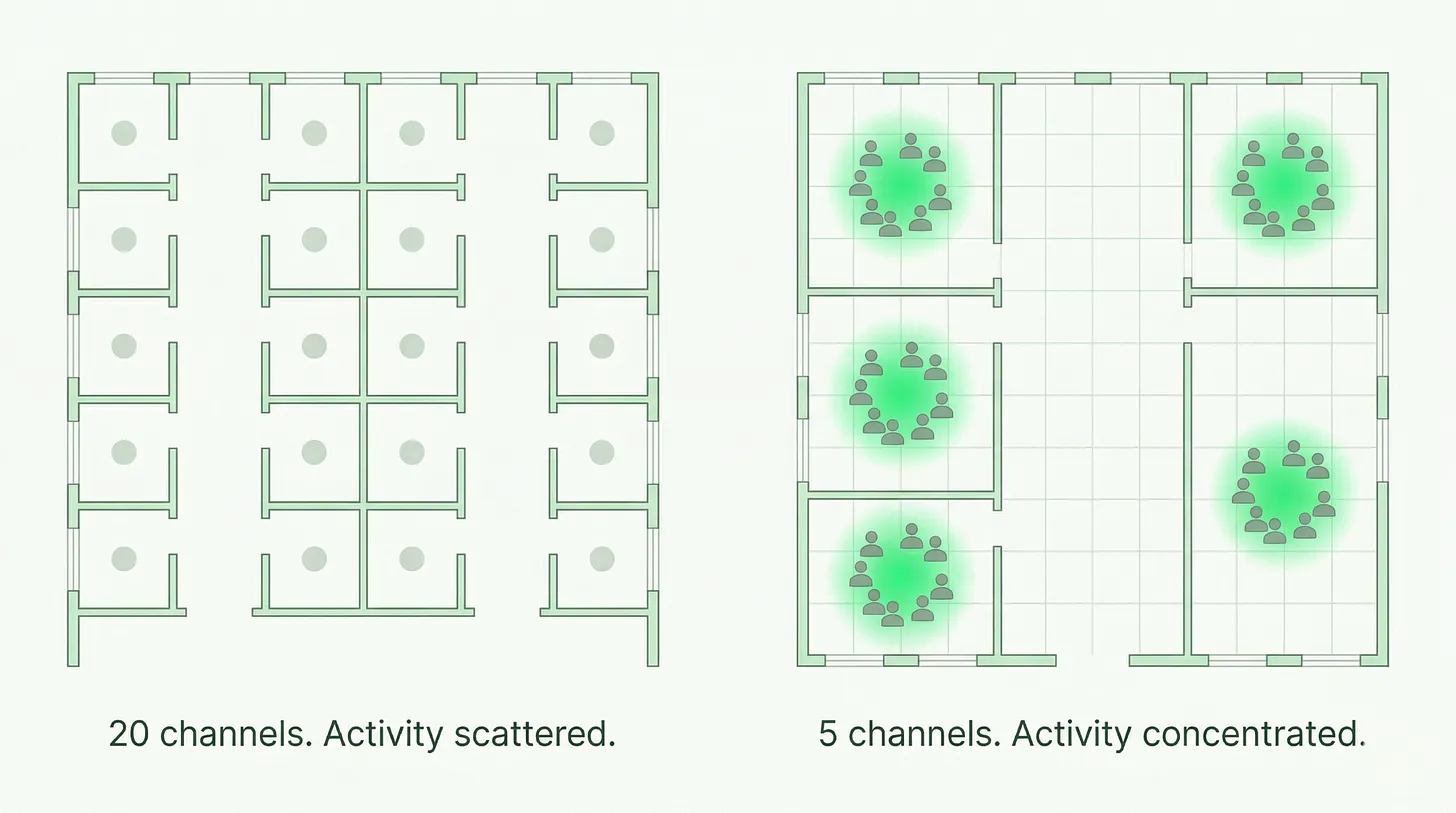
When someone sets up a Discord server for the first time with serious intent, the instinct is to build it out. Categories for every major topic. Channels for every type of conversation they anticipate. A structure that looks complete and professional from the moment the first member joins. It is a reasonable instinct. A well-organized server feels ready. It projects competence. It says to anyone who joins that the people running this community thought about it in advance. The problem is that a new community cannot sustain a fully built-out server. It does not have the member activity to generate consistent conversations across twenty channels. Often it does not have enough to generate consistent conversations across ten. And the consequence of building that structure before the activity exists to fill it is that every new member who arrives sees mostly empty channels and interprets that signal as evidence that the community is inactive. The environment feels dead before it has had a chance to become alive.
Why the empty channel problem is worse than it looks
When a member joins a new community and sees an extensive channel list with minimal activity scattered across it, they face a set of problems that compound each other. First, they do not know where to post. With twenty channels, the decision of which one is appropriate for their specific thought or question is not obvious. Different channels have slightly different scopes. Posting in the wrong one feels like a social mistake in a space they just arrived in. Many members simply do not post rather than risk it. Second, when they do post and nothing happens, the quiet reinforces the impression that the community is not active. Even if other members are present, their activity is distributed across enough channels that any individual channel may see only occasional contributions. The community might have genuine activity happening. It just is not visible in any single place. Third, the extensive channel structure creates a maintenance burden for the moderation team. A server with twenty channels requires attention across twenty channels. For a small community in its early stages, that is an operational load that the team is almost never positioned to handle well.
What concentrated activity does for community perception
After looking at many Discord servers across different communities and industries, one of the clearest patterns in the ones with strong early engagement is that they started with fewer channels than their peers. The activity that exists concentrates into a small number of spaces. Those spaces feel active. New members arrive and see regular discussion happening. The community reads as alive. This is not a coincidence. Activity concentration is what creates the perception of a healthy community. When members see that conversations are happening regularly in the channels they are looking at, they are more likely to contribute to those conversations. Each contribution makes the channel look more active. More activity attracts more contributions. The dynamic builds on itself. When activity is spread thin across many channels, that dynamic cannot get started. No individual channel generates enough regular activity to create the sense of momentum that pulls new members into participation.
The right channel count for an early community
The specific number varies by community type and audience, but the principle is consistent: start with fewer channels than you think you need. For most new communities, the functional minimum covers three to five distinct purposes. A general conversation space. An announcements or updates channel. One or two topic-specific channels for the primary subjects the community is built around. Possibly an introduction channel. That is often enough. What it is not is a channel for every conceivable sub-topic, a channel for memes, a channel for off-topic discussion, a channel for feedback on every separate product area, a channel for every geographic region or team. Those may all be legitimate channels eventually. They are not legitimate channels at launch when the community does not have the activity to support them.
The growth model that avoids the problem
The channel structure should grow from activity, not in anticipation of it. The signal that a new channel is needed is specific: members are consistently having multiple distinct conversations in the same channel that would genuinely be better served in separate spaces. The conversations are getting mixed up in a way that creates noise for members who only want one of them. At that point, creating a new channel with a clear scope is a response to a real need. Creating a channel before that need exists does not serve the community. It serves the operator's sense of completeness. And it costs the community the concentrated activity that would have made those early months feel like something was building.
What to do with the channels you do not launch
The topics and purposes you are not launching channels for on day one do not go away. They go into a backlog. When the community generates enough activity that a topic is consistently generating conversation, that is the moment to create the space for it. This approach also has a practical benefit beyond engagement: each channel addition becomes an event. A new channel signals growth. It tells existing members that the community is expanding because it is active enough to need more space. That is a more useful signal than a channel list that was fully built at launch and has been mostly empty ever since. Start with the minimum. Build from activity. The community that feels alive in week four is the one that managed concentration in week one.
Daniel Jeong is a Discord community infrastructure consultant. He works with founders, AI companies, and high-growth digital communities to build server architecture that supports engagement at every stage of community growth. https://danieljeong.org