Why Discord Only Works After You Already Have an Audience
The sequencing most founders get wrong and the cost of getting it backwards.

The sequencing problem most founders never talk about
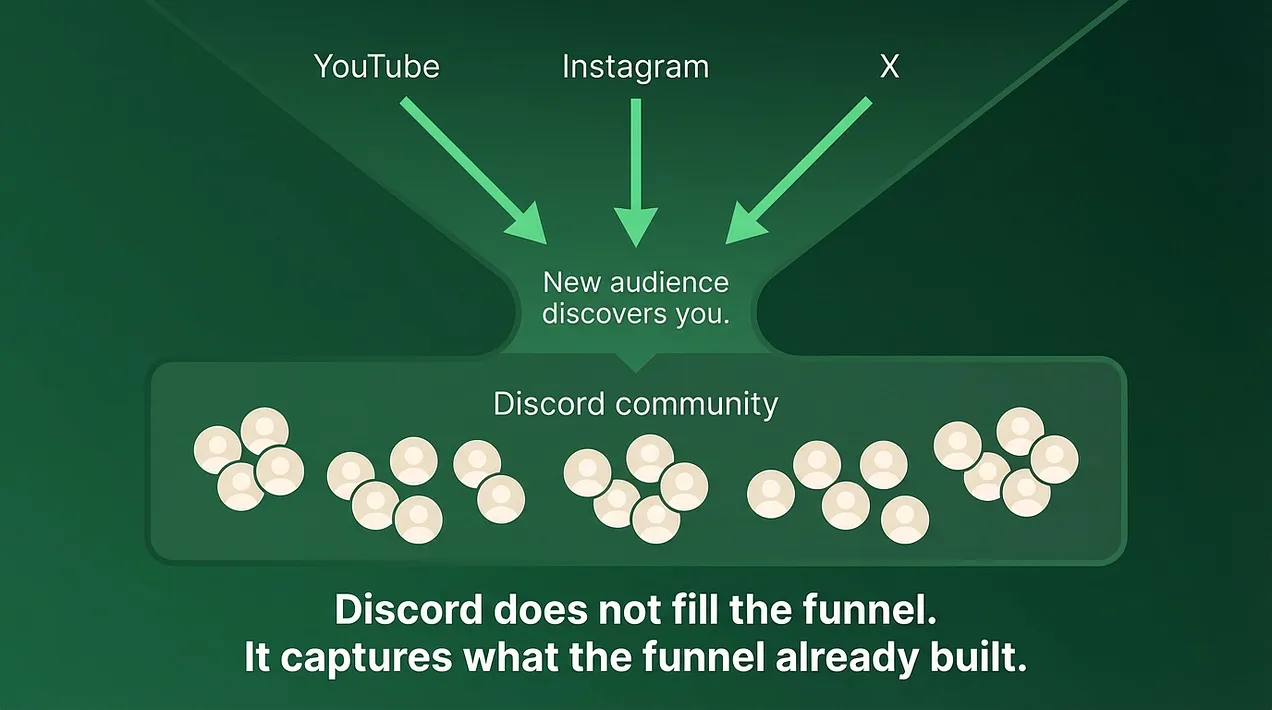
There is a question I get asked often in early conversations with founders building communities. They have designed a Discord server, set up their channels, and are ready to launch. They want to know how to grow it. My answer usually surprises them. The question of how to grow a Discord server comes after a more important question: do you already have an audience to bring in? Discord is a retention platform. This is a fundamental characteristic of how it works, and it is something that most content about building communities does not explain clearly. Discord does not surface your server to people who have never heard of you. It does not have a discovery feed where someone new stumbles across your community and decides to join. It works when you already have an audience somewhere else and give that audience a place to gather. If there is no external audience to pipe in, the server sits empty. And an empty server is worse than no server, because it creates a poor first impression for anyone who does eventually find their way in.
Where audiences actually come from
Every Discord community that has meaningful, organic engagement shares the same origin story. The audience built first on an external platform where discovery was possible. For some communities, that was YouTube. A channel that built an audience over months or years, and then gave that audience a Discord server as the place to go deeper into the content and the conversation. For others, it was Instagram, X, or Reddit. The platform does not matter as much as the fact that the audience existed before the community did. The job of those external platforms is discovery. They put content in front of people who have not encountered you before. They let strangers decide whether what you are doing is worth their attention. That is a function Discord cannot perform and was not designed to perform. Once someone finds you on an external platform and decides they want more, Discord becomes a logical next step. It gives them a place to connect with others who feel the same way, to ask questions directly, to participate in events, and to develop a relationship with the brand or creator that goes beyond passive consumption.
The cost of the wrong sequence
When founders build Discord first and external channels second, several things go wrong. The most obvious is the empty room problem. A new member who joins the server and finds no activity has no reason to stay. Retention requires something to retain members within. An active community, regular conversations, events, and genuine value from being present. None of that exists in a new server without an audience. The second problem is the investment mismatch. Building a Discord server well takes real time. Channel architecture, onboarding flows, moderation systems, bot configuration, welcome messages. All of that work becomes highly effective once there is an engaged audience to experience it. Before that audience exists, it is infrastructure with no traffic running through it. The third problem is that an empty server rarely recovers. Founders sometimes try to seed the community with team members posting to make it look active. This usually does not work well because it is transparent, and it creates a different kind of first impression problem. Members who join and sense that the activity is artificial disengage faster than members who join and find nothing at all.
What the right sequence looks like
The founders who build successful Discord communities start by asking: who already has a relationship with what I am building? Where do those people currently spend time? How do I reach them there and give them a reason to come closer? Once that audience exists, even at a modest scale, the calculus for Discord changes completely. The same infrastructure that sits idle without an audience becomes highly effective when people are actively coming in. The onboarding system that felt like overkill with ten members starts reducing confusion at five hundred. The automated FAQ responses that felt unnecessary start saving team hours at a thousand. The community events that felt hollow with a handful of attendees start generating real energy at a few hundred participants. Discord does not make an audience grow. It makes a growing audience worth keeping.
The role of Discord in the overall growth system
Once you understand that Discord is a retention layer rather than a discovery layer, the question shifts from how to grow inside Discord to how to grow outside Discord so that the people you bring in have a community worth joining. The external platforms handle acquisition. YouTube videos, Instagram posts, X threads, and other content formats bring new people into awareness of what you are building. Some percentage of those people will want more. Discord is the answer to what more looks like. This also changes how you think about the relationship between your content strategy and your community strategy. They are not competing priorities. They are sequential ones. Content builds the audience. The community deepens the relationship with the audience that content built.
Practical implications for founders
If you are considering a Discord server and you do not have an established external audience yet, the practical recommendation is to delay the Discord launch. Invest the time you would have spent building the server into the external channels that will generate the audience. When you do launch, even a small but genuinely engaged audience will make the community feel alive from day one. A server with two hundred active members generates more momentum than a server with two thousand inactive ones. The first impression a community makes is more powerful than most founders account for, and that first impression depends almost entirely on what a new member encounters when they arrive. Build the audience. Then build the place for it to gather. In that order, both investments pay off. In the reverse order, the community investment waits indefinitely for the audience investment to catch up.
*Daniel Jeong is a Discord infrastructure consultant helping companies build scalable community systems that function as core business assets. To learn more, visit *danieljeong.org https://danieljeong.org