Why Creators Stop Reading Your Onboarding Messages
The problem is rarely the information. It is the packaging.

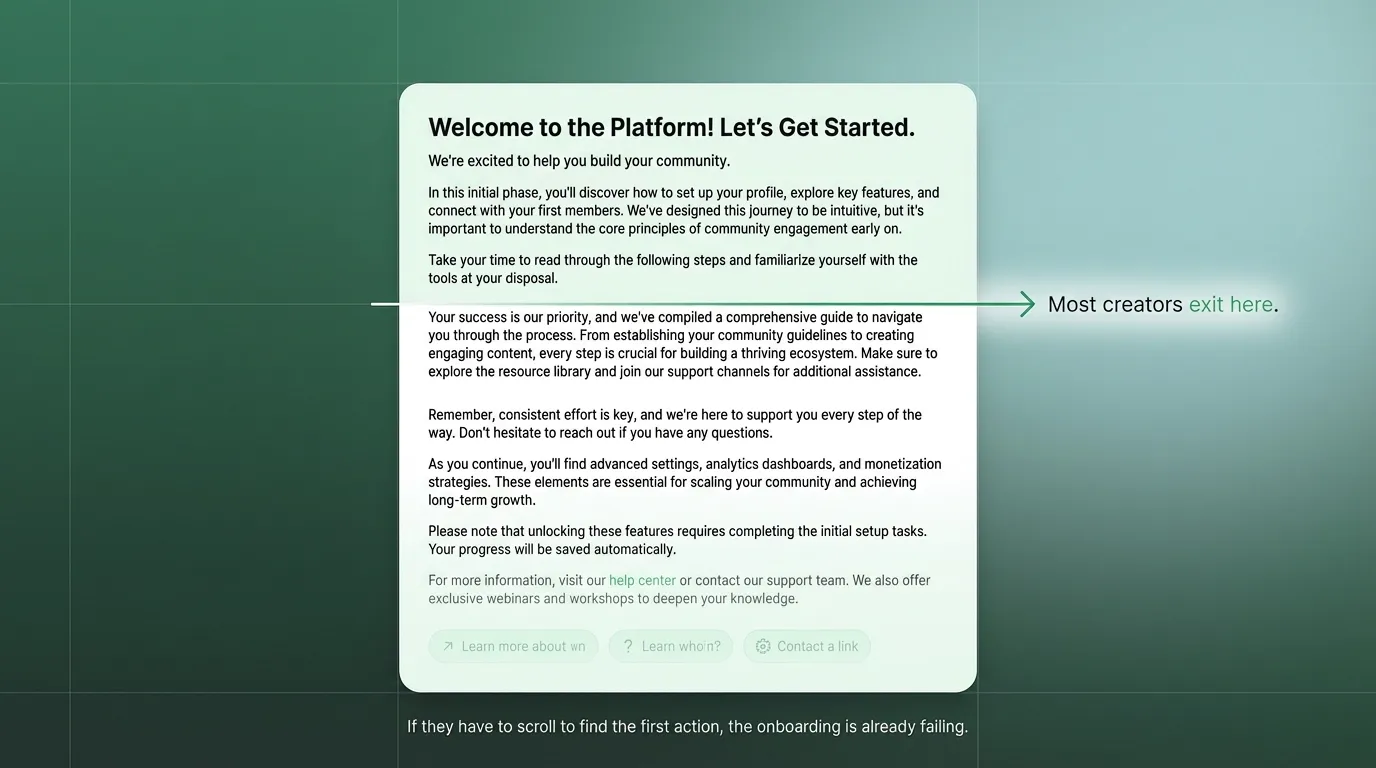
The Information Is There. Nobody Is Reading It.
One of the most consistent patterns I see when working with programs that manage creators or community members is the assumption that if someone does not follow the onboarding process correctly, they did not try hard enough. The message was sent. The links were included. The steps were numbered. Everything a new member needed was right there. But most of them still missed step three, submitted the wrong format, asked a question that was already answered in the welcome message, or dropped off entirely before completing the process. This is not a motivation problem. It is a packaging problem.
What Creators Are Actually Looking For
When someone accepts an invite to a new community, program, or platform, they arrive in a specific mental state. They are open. They are curious. They want to know how this works and how to participate. But they are not in a reading mood. They are in a looking-for-one-clear-thing mood. The question every new member is asking, whether they articulate it or not, is: what do I do right now. Not what is the full history of this program. Not what are all the rules I should memorize. Not what is the complete list of resources available to me. Just: what is the next action I should take. When the onboarding message buries that action under three paragraphs of context, a set of links, a numbered list of nine steps, and a note at the bottom asking them to confirm receipt, most people will not find the action they are looking for. They will read enough to feel slightly overwhelmed, close the message, and hope someone reminds them of what to do. Some of them will follow up. Most will not. And the ones who do not often get treated as disengaged when the actual problem was in the design of the information they received.
Why Agencies and Brands Overpack
There is a logic to sending comprehensive onboarding messages. The team has been burned before by creators who missed a step, used an old link, submitted content in the wrong format, or asked questions that were already answered. So the next version of the onboarding message tries to cover everything. But the more it tries to cover, the less of it gets read. The comprehensiveness that was supposed to prevent confusion ends up creating it. This dynamic is extremely common in programs where the people building the onboarding are experts who already know the system. They know why each piece of information is important. They can see all of the ways things could go wrong if a creator skips a step or misses a detail. So they include it all. The problem is that a new creator does not have that context. They are seeing this for the first time. They do not know which of the nine steps is the one that cannot be skipped. They do not know which link is the critical one and which ones are supplementary. Everything looks equally important, which means nothing stands out as where to start.
The Sequencing Fix
The communities and programs that consistently onboard creators well share a structural characteristic. They give new members one thing at a time. Not everything at once. Not the full picture in the first message. One step. A specific, clear action with a specific, clear link. When that step is complete, the next one becomes visible or is sent automatically. This works for a few reasons. First, it removes the decision about where to start. There is only one thing to do, so there is no friction in choosing it. Second, it creates a sense of progress. Completing a small first step gives new members a feeling that they can navigate this space. That small win makes the second step feel manageable. The psychological barrier to continuing is lower after the first action than it was before it. Third, it surfaces problems early. When a new member gets stuck on step one of a sequential onboarding, it is much easier to identify and fix than when they get stuck somewhere in a twelve-step all-at-once process. The support burden goes down because the support requests are specific rather than general.
Packaging Is Part of the System
There is a tendency to treat the content of onboarding as the thing that matters and the packaging as secondary. Get the information right, and people will figure out how to receive it. But packaging is not separate from the information. It is part of how the information functions. A clear, well-paced onboarding that delivers one step at a time communicates the same information as a dense, all-at-once message, but with a dramatically different completion rate. Simple language matters here as well. Many onboarding messages are written in the language of the people who designed the program. They use internal terminology, reference processes that have their own names inside the organization, and assume familiarity with tools that new creators may never have used. A new creator does not know what submitting to the queue means if the queue was never explained. They do not know which support channel to use if the support channel options were buried in paragraph six. Writing for someone who has never seen the system before, using the simplest possible language, with no assumed context, is not dumbing things down. It is designing for the actual user.
What a Well-Packaged Onboarding Delivers
A creator onboarding that retains members through the first week typically looks like this: a short, warm first message with one action, a second message that confirms completion of the first action and introduces the next step, and a third touchpoint that orients the creator to the most valuable resources in the community. Three messages. Three actions. No wall of text. No comprehensive manual in the first exchange. This structure works at any scale. It works for a program with thirty creators and one with three thousand. The volume of information being conveyed does not change. The pacing and packaging do. If creators in your program are consistently missing steps, asking questions that were answered in the onboarding, or dropping off before completing the first week, the answer is almost never to give them more information. It is to give them the same information in a structure that actually gets read.
Daniel Jeong consults on Discord community infrastructure and operational systems for organizations building long-term community engagement strategies. https://danieljeong.org