When No Bot Can Do What You Need, Your Community Has Real Requirements
Why outgrowing generic Discord tools is a milestone worth celebrating and investing in

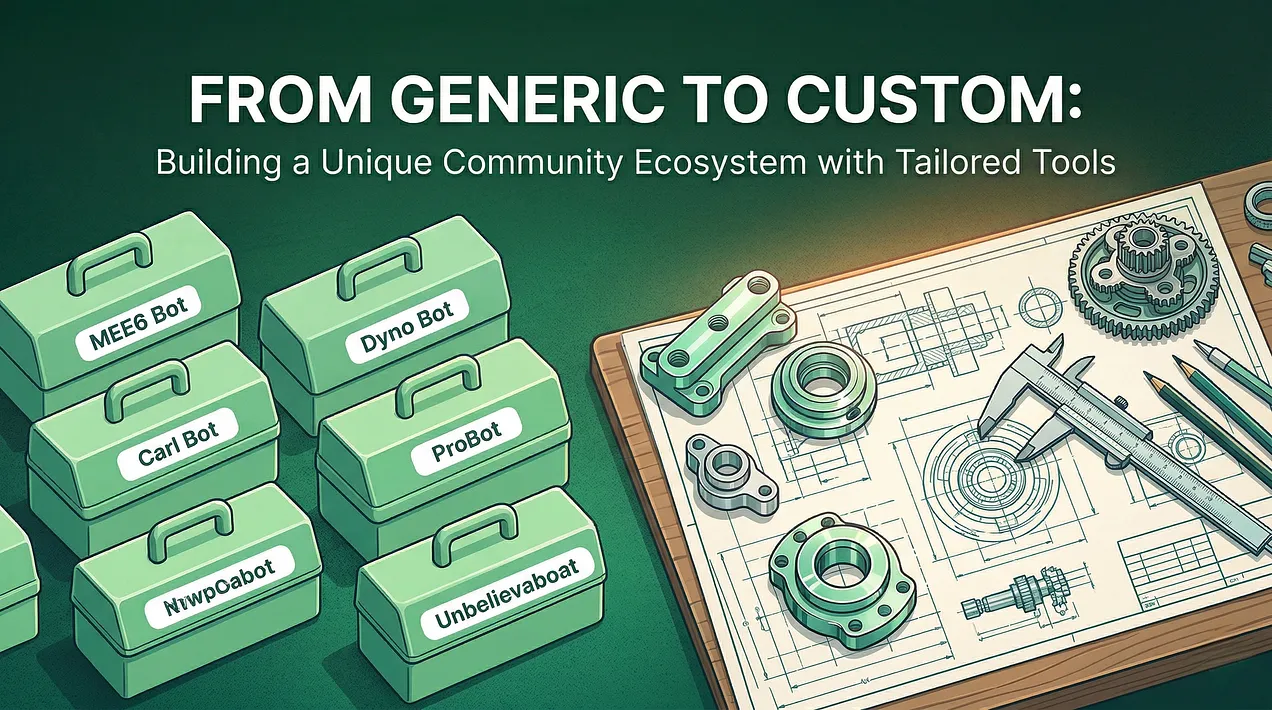
The Three-Hour Search
Every community operator knows this experience. You have a specific need for your Discord server. Maybe it is an onboarding flow that asks different questions based on how a member answers the first one. Maybe it is a points system that weighs voice channel participation differently from text messages. Maybe it is an event registration system that syncs with an external platform. You open a bot directory and start searching. You try the first result. It handles part of what you need but not all of it. You try the second. Closer, but the configuration options do not extend far enough. The third bot requires a premium tier for the one feature you actually need, and even then the documentation suggests it might not work the way you expect. Three hours later, you have installed and uninstalled multiple bots and you are no closer to solving the problem. This is the moment where most operators make a decision that shapes the trajectory of their community.
The Compromise Trap
The most common response to this situation is compromise. You take the closest available tool and adjust your requirements to fit what it can do. The conditional onboarding becomes a simple linear form. The weighted points system becomes a basic message counter. The event integration becomes a manual process where someone copies data between platforms. This feels practical. It feels like you are being realistic about what your tools can do. But what you are actually doing is degrading your operational vision to match the limitations of generic software. Generic bots are built for the widest possible audience. They handle the use cases that most communities share: basic moderation, simple role assignment, standard welcome messages, general purpose point tracking. They are good at these things because these things are common. The moment your community needs something specific, something that reflects the particular way your members interact and the particular goals your community serves, generic tools hit a wall. That wall is not a failure of the tools. It is a signal about your community.
What the Signal Actually Means
When your requirements exceed what available tools can handle, your community has crossed a threshold. It has developed operational needs that are specific enough to require purpose-built solutions. This is not a problem to be solved by lowering your standards. It is a milestone that indicates your community has real infrastructure requirements. Consider what it means when your onboarding flow needs conditional logic. It means your community serves members with meaningfully different needs, and you understand those differences well enough to route people accordingly. That understanding is valuable. Reducing it to a one-size-fits-all form because no bot supports conditional flows throws away operational intelligence you have already built. Consider what it means when your points system needs weighted interactions. It means you have identified which behaviors drive value in your community and you want to reinforce them proportionally. That insight did not come from guessing. It came from observing your members. Flattening it to a simple message counter because the available bots do not support weighting ignores everything you have learned. The specificity of your requirements is directly proportional to the depth of your understanding of your community. Protecting that specificity is protecting the operational intelligence that makes your community different from every other server running the same generic tools.
The Custom Solution Spectrum
Custom does not always mean building a bot from scratch. There is a spectrum of solutions between installing a free bot and commissioning a full custom development project. At the simplest level, some bots offer API access or webhook integrations that let you connect them to external services. A workflow automation tool can bridge the gap between what the bot does natively and what you need it to do. This approach works when the core functionality is close to your requirements and you just need to extend it. At the middle of the spectrum, some development frameworks let you build lightweight bots with relatively modest code. Discord.js, Pycord, and similar libraries have mature ecosystems with documentation and community support. A developer with moderate experience can build a focused bot that handles your specific use case in days rather than weeks. At the far end of the spectrum, complex requirements with multiple integrations, conditional logic, data persistence, and external platform connections need dedicated development. This is where you write specifications, work with a developer or team, test extensively, and deploy something purpose-built for your server. The right place on this spectrum depends on the complexity of your needs and the operational cost of not addressing them. A simple webhook integration might cost a few hours of setup. A fully custom bot might cost weeks of development. Both are valid investments if the alternative is compromising your community's operational requirements.
The Cost Calculation Most Operators Skip
When evaluating custom solutions, most operators focus on the upfront cost and compare it unfavorably to the zero cost of a free bot. This comparison misses the ongoing cost of compromise. Every time your team manually copies data between platforms because you do not have an integration, that is operational cost. Every time a member gets routed to the wrong channel because your onboarding cannot handle conditional logic, that is experience cost. Every time you look at your points data and know it does not reflect actual member value because the system cannot weight interactions, that is intelligence cost. These costs compound. They are small individually but they accumulate daily. Over six months, the total cost of manual workarounds, experience gaps, and degraded operational intelligence often exceeds the cost of building the custom solution in the first place. The calculation is not "free bot versus expensive custom bot." The calculation is "daily cost of compromise multiplied by time versus one-time cost of building what you actually need."
Specification as Operational Clarity
One of the underappreciated benefits of building custom solutions is the specification process itself. When you sit down to define exactly what a custom bot needs to do, you are forced to articulate your operational logic with precision. What happens when a member selects option A on the verification form? What role do they get? What channels do they see? What welcome message do they receive? What if they select both A and C? What if they change their answer later? Writing these specifications reveals gaps in your operational thinking that generic tools let you ignore. The free bot does not ask you these questions because it does not handle these scenarios. The custom specification forces you to think through every branch, every edge case, every interaction between systems. That clarity has value beyond the bot itself. It becomes your operational documentation. It defines how your community actually works at a systems level. Even if you never build the bot, the specification process makes you a better operator.
When to Stay Generic
Not every community needs custom tools. If your server runs standard moderation, simple role assignment, and basic announcements, the available bots handle those functions well. There is no operational advantage to building custom solutions for common needs that generic tools already address. The decision point is specificity. When your requirements start reflecting the particular characteristics of your community rather than the general characteristics of all communities, that is when generic tools begin falling short. When you find yourself configuring a bot to approximate what you actually want rather than to deliver it directly, that is the signal. Some communities reach this point at a hundred members. Others reach it at ten thousand. The trigger is not size. It is operational maturity. The more clearly you understand what your community needs and how your members interact, the more likely your requirements will diverge from what generic tools were designed to handle.
Building for Your Community, Not for Everyone
Generic tools are built for the average community. They optimize for the features that the most communities will use. This is good engineering and good business. But your community is not the average community. It has specific members, specific goals, specific interaction patterns, and specific operational requirements that no tool designer anticipated. When you build custom, you are building for your community specifically. The bot does exactly what your operations need. The integration connects exactly the platforms your workflow requires. The automation handles exactly the sequence your processes follow. That precision is the difference between running a community on borrowed infrastructure and running a community on infrastructure you own. Borrowed infrastructure constrains you to what the tool allows. Owned infrastructure adapts to what your community demands. When your search for a bot comes up empty, do not lower your standards. Raise your investment. Your community has told you something important about what it needs. The right response is to build it.
Daniel Jeong is a Discord systems architect and community operations strategist who builds custom infrastructure for communities that have outgrown off-the-shelf solutions. https://danieljeong.org