WhatsApp Is Not a Community Platform
The operational case for why growing communities migrate off messaging apps, and what they gain when they do.

The Familiar Starting Point
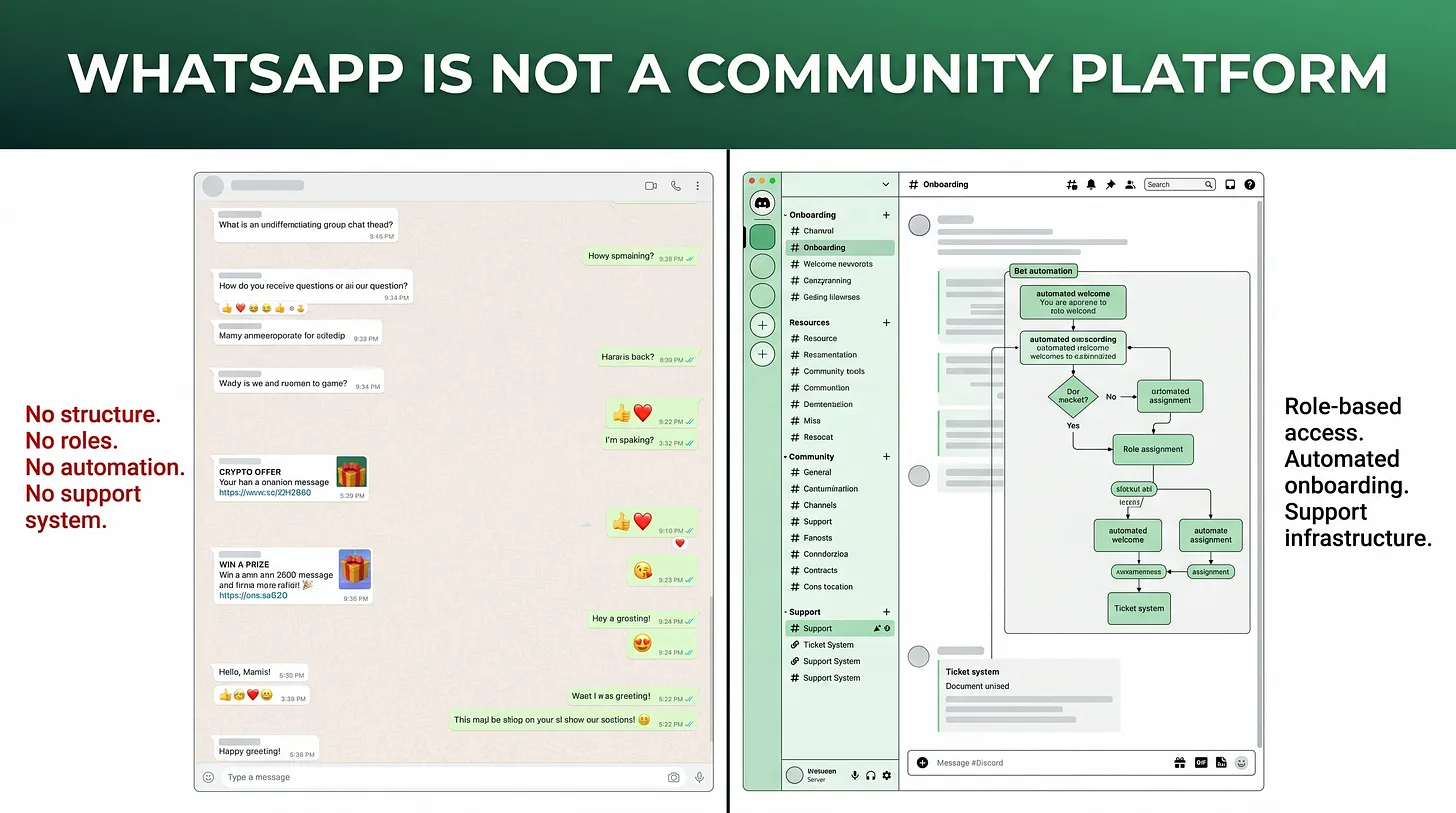
For many communities, the beginning is a WhatsApp group. It is the path of least resistance. Everyone already has the app, creating a group takes under a minute, and the first few dozen members can be invited through existing contacts. At this scale, the group works. Conversations flow. Questions get answered. The founder is accessible, the members are all known quantities, and the personal feel of a chat group matches the intimacy of an early community. Then the community grows. And WhatsApp begins to reveal what it actually is: a messaging application designed for personal and small-group communication. Not a community platform.
When the Group Chat Starts to Break
The signs of a WhatsApp-based community exceeding its operational capacity are consistent and predictable. They appear at different member counts depending on how active the community is, but they all appear eventually. Information gets buried. In a single chat thread, every new message pushes previous messages down. A question asked on Monday may be completely inaccessible to a member who joins on Thursday. The community's knowledge is stored in a format designed for real-time conversation, not organized reference. Members ask questions that have already been answered repeatedly because there is no way to find the previous answer. Personal boundaries erode. In communities run on WhatsApp, the moderator or community manager's personal phone number is the contact point for every member issue. Support happens through direct messages to personal contacts. This creates both a privacy problem and an operational bottleneck. One person becomes the entire support infrastructure, reachable at any hour, through a communication channel that was not designed for structured support. Moderation becomes reactive and limited. WhatsApp's moderation tools are minimal. An admin can remove a member, but there is no role-based access system, no automated moderation trigger, no ticket-based reporting mechanism. When a disruptive member appears in a group of 400 people, the options are limited and manual. Onboarding is impossible to design. WhatsApp has no mechanism for structured onboarding. New members join and are dropped into the current conversation with no context, no guidance, and no clear first step. Some figure it out. Many do not. There is no way to know which members completed onboarding in any meaningful sense, because there is no onboarding system to complete.
What Discord Provides That WhatsApp Cannot
The operational capabilities that distinguish Discord from messaging apps are not cosmetic. They are structural, and they determine whether a community can grow without requiring proportional increases in human effort. Role-based access is the foundation. In Discord, different members can have access to different channels and functions based on their role. This single capability enables onboarding gates, course-locked content, verified member access, and support tiering. None of this is possible in WhatsApp, where all members see the same content in the same thread. Automated onboarding changes the economics of community management fundamentally. When a new member joins a structured Discord server, they enter a designed experience. A welcome message fires automatically. They are directed to a verification channel. They complete a short step that assigns their role. The relevant channels unlock. This entire sequence happens without a person present. At 300 members, the difference in operational load compared to manual onboarding is substantial. At 3000 members, it is the difference between a functioning community and a collapsed one. Ticket-based support is how community management stops depending on personal availability. When a member needs help, they open a ticket. The ticket creates a structured channel for that specific conversation. The support team responds on their schedule. Tickets can be tracked, prioritized, and closed. The history of resolved tickets becomes documentation that reduces future support load. This system does not exist in WhatsApp. Bot automation removes repetitive tasks from human hands. Role assignment, welcome sequences, FAQ responses, event reminders, content moderation triggers: these are all tasks that automation handles in Discord. They are tasks that must be done by a person in WhatsApp. Across hundreds or thousands of members, this difference accumulates into a significant operational gap.
The Migration Moment
Most communities that eventually move from WhatsApp to Discord reach a specific moment that precipitates the decision. It is usually not a single event. It is the accumulation of friction until the cost of staying on the wrong platform exceeds the effort of moving. The moment often arrives when a key team member burns out. When the community becomes humanly impossible to manage by hand, when the same questions are being answered for the hundredth time, when new members are joining faster than anyone can personally welcome them, something has to change. The migration itself is not frictionless. Members who have built habits around the WhatsApp group do not always follow immediately. Some resist the new platform. Some require the transition to be managed carefully with clear communication about why the move is happening and what they will gain. But the communities that make the transition and build proper infrastructure on Discord consistently report the same outcome: the team has more time, the member experience is more consistent, and the community can grow without the operational ceiling that was previously invisible until everything hit it simultaneously.
The Decision Worth Making Early
For communities that have not yet launched or are still in the early stages, the choice of platform is not just a technical decision. It is an infrastructure decision that will determine the operational ceiling of the community. WhatsApp works for a group. It does not work for a community infrastructure that needs to function at scale, across time zones, without depending on any single person's continuous availability. The cost of building on the right platform from the beginning is lower than the cost of migrating an established community later. The technical setup is comparable. The operational advantage compounds from day one. The members who join into a structured experience develop better habits and higher retention than those who join into a group chat and are later asked to change their behavior. Platform choice is an infrastructure decision. Making it early, based on operational requirements rather than familiarity, is one of the more consequential choices a community builder makes before the community begins to grow.
The platform you start on shapes the community you can build. Choose for where you are going, not for where you are. https://danieljeong.org