Two Platforms Is Not a Problem. Using the Wrong One for the Job Is.
Discord and Circle solve different problems. Here is how to know which one you actually need.

The platform debate that founders keep having
Almost every founder I speak with who is building a membership community or a course-based business eventually arrives at the same question. Should they use Discord or Circle? It is understandable. Both platforms have community features. Both allow members to interact. Both can serve as a destination for an engaged audience. On the surface, they seem to be solving the same problem. They are not. Discord and Circle were built with different purposes at their core. Understanding what each platform was actually designed to do removes most of the confusion about which one to use and turns the question from "which one" into "which one for this specific function."
What Circle is built to do
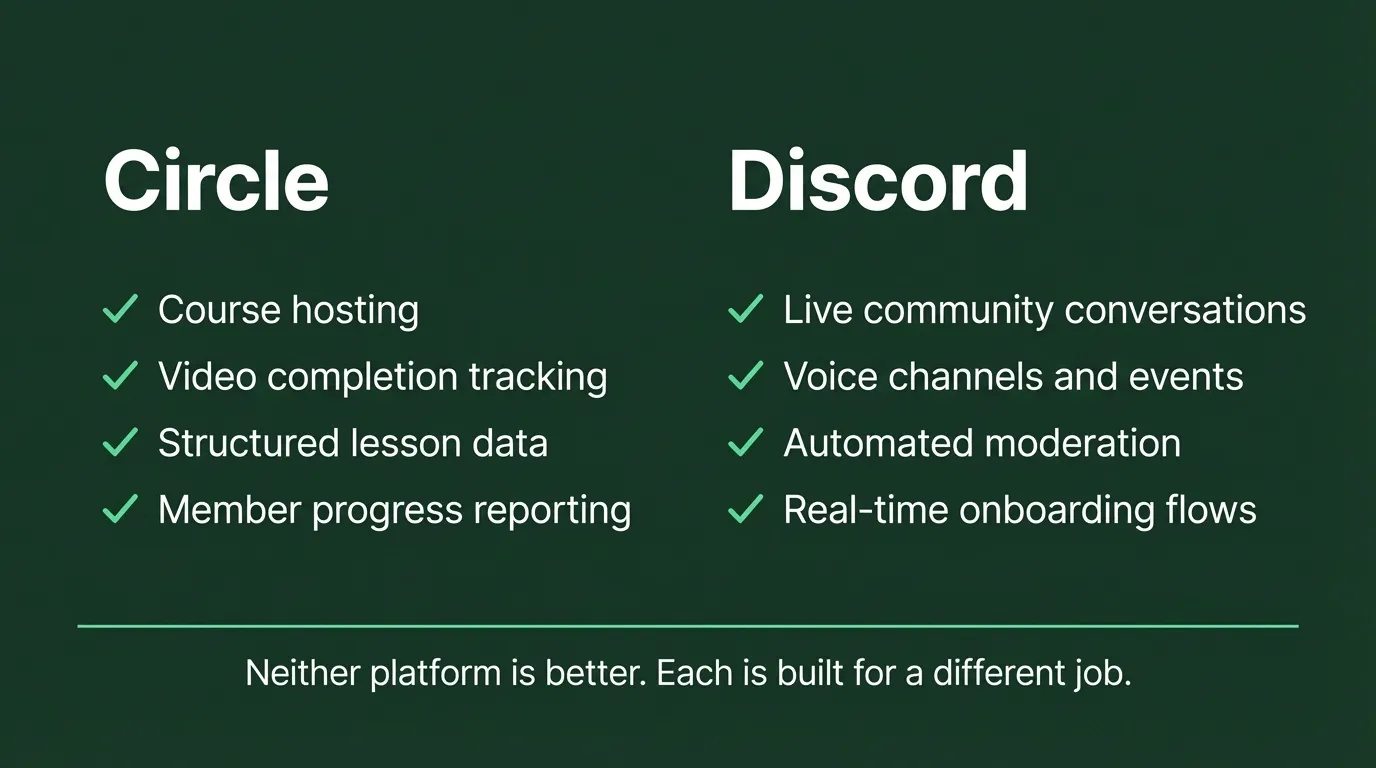
Circle is designed around structured content delivery. It handles course hosting, lesson organization, video hosting, and completion tracking with a level of precision and purpose that Discord was never designed to match. If you need to know whether a specific member has watched a video, how far they progressed through a lesson, or which members have completed your onboarding course, Circle gives you that data cleanly. You can build out course modules, organize content in a logical progression, track member engagement with that content, and gate access to later material based on completion of earlier stages. For any community where structured learning is a core value proposition, Circle handles the educational infrastructure in a way that gives your team real operational visibility into member progress.
What Discord is built to do
Discord was built for real-time interaction at scale. Voice channels, live text conversations, event scheduling, role-based access control, advanced moderation systems, and bot automation are the areas where Discord's capabilities significantly exceed what Circle offers. When members want to join a voice channel and talk through a problem together, that is a Discord function. When you need a moderation system that automatically flags spam, assigns roles based on member activity, and handles escalation workflows without constant human monitoring, that is a Discord function. When you want to run an onboarding flow that welcomes new members, assigns them initial roles, and walks them through structured first steps automatically, Discord handles that natively. Discord is also where live community culture develops. The informal conversations, the members who become regulars and help answer other members' questions, the organic dynamic that makes a community feel like a community rather than a product. That energy lives in real-time communication.
Why people confuse them
The confusion between Circle and Discord often comes from the word "community." Both platforms use it. Both have channels, posts, and member profiles. Both position themselves as places where groups of people gather online. But community is a broad word. It covers everything from a live chat room to a structured course platform to a professional networking group. The fact that both platforms facilitate some form of community interaction does not mean they are interchangeable for the same specific use case. The founders who get into trouble are the ones who try to use Discord as a course platform, setting up channels as if they were lesson modules and expecting members to work through them in a logical order. Discord is not built for linear content consumption. Members can join at any time, see any channel they have access to, and interact in any order. The structured progression that course delivery requires does not map cleanly onto Discord's architecture. The opposite problem is equally common. Using Circle as the primary community hub and expecting it to produce the kind of real-time relationships and organic engagement that sustains a community long-term. Circle's asynchronous format works well for structured learning but does not generate the same informal, live interaction that Discord's architecture produces naturally.
The operational case for running both
The founders who build effective membership communities and course-based businesses often run both platforms simultaneously, each doing what it was designed to do. Members who purchase access get their course content delivered through Circle. They can move through lessons at their own pace, track their progress, complete modules, and engage with structured learning materials in an environment built for that purpose. The Discord server serves as the live community layer. New members go through a structured onboarding experience. They can join voice channels, participate in events, ask questions in real time, connect with other members, and get support from the team and from each other. The informal culture of the community lives in Discord's real-time environment. The two platforms do not compete with each other in this setup. They cover different parts of the member experience. One handles what happens when a member sits down to learn. The other handles everything that happens when they want to talk about it.
Making the decision
If your primary goal is course delivery with structured content progression and completion tracking, Circle is the right starting point. Build that first. Once you have an audience moving through structured content, Discord can serve as the community layer that surrounds and deepens that learning experience. If your primary goal is live community engagement, moderation at scale, and real-time interaction, Discord is the right starting point. Structured course content can be added through Circle later, when the community reaches the scale where formal learning programs become a meaningful product addition. The question is not which platform is better overall. It is which function you are trying to serve right now, and which platform was built to serve it. The founders who ask that question clearly tend to use both. The ones who treat it as an either/or decision tend to end up using the wrong one for something important.
*Daniel Jeong is a Discord infrastructure consultant helping companies build scalable community systems that function as core business assets. To learn more, visit *danieljeong.org https://danieljeong.org