The Thirty-Day Engagement Calendar Is Not Optional. It Is the Engine.
Why communities that rely on organic activity alone eventually lose momentum, and what structured programming does to prevent it.

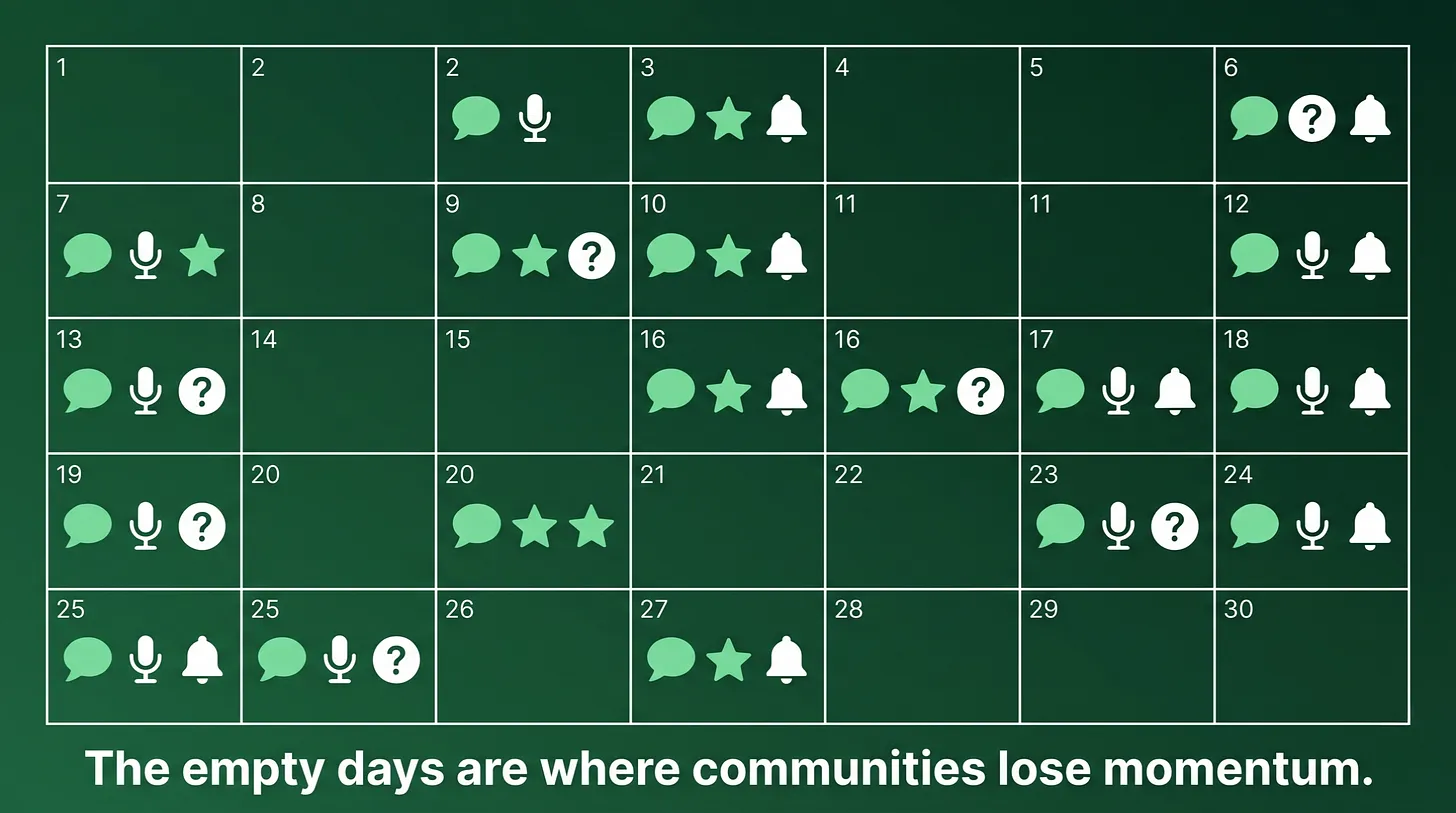
The Assumption That Kills Communities
There is a common assumption in community building that engagement is something that surfaces naturally from a motivated group of members. If you bring the right people together around a shared interest or purpose, the conversations will happen. The questions will come in. The discussions will take off. The community will be alive because the members want it to be. This assumption is not wrong exactly. But it is incomplete in a way that causes real problems as communities grow. Organic engagement does happen. In communities built around genuine shared interest or purpose, members do initiate conversations, share ideas, and generate activity without any prompting from the community team. This is one of the most valuable qualities a community can have. But organic engagement is not consistent. It fluctuates based on factors that have nothing to do with the quality of your community. Long weekends and holiday periods reduce activity. Major news events redirect attention. Seasonal patterns in your audience's professional lives affect how much time they have for community participation. The natural ebb and flow of attention means that even the most engaged community will have quiet stretches. Communities that rely entirely on organic activity lose momentum during those quiet stretches. When members check in and find nothing happening, they stop checking in. When enough members stop checking in, the organic activity that used to sustain the community dips further, creating a feedback loop that is difficult to reverse.
What a Thirty-Day Calendar Actually Solves
A structured thirty-day engagement calendar does not replace organic community activity. It provides the foundation beneath it. The calendar ensures that even during natural low periods, there is always something scheduled that gives members a reason to return. A discussion prompt that invites participation. An event that was announced two weeks ago and that members have been anticipating. A member spotlight that recognizes a contribution and makes the featured member feel valued. A Q&A format that brings members together around a shared question. These scheduled moments function as anchors. They create predictable reasons to check in even when the organic conversation is slower than usual. Members who know that something worth engaging with is coming on Thursday return on Thursday. Members who found nothing happening the last three times they checked in do not.
The Operational Discipline Behind It
Building a meaningful engagement calendar requires understanding your audience well enough to know what kind of programming generates genuine participation versus what kind generates polite but shallow engagement. Discussion prompts work best when they connect to questions or challenges that members are actively dealing with. Generic prompts produce generic responses. Prompts that address a specific, recognized pain point in the community tend to generate longer, more substantive conversations. Events need a specific format, a clear purpose, and enough advance notice that members can plan for them. An event announced the day before it happens draws a fraction of the attendance of an event announced ten days in advance with one or two reminder touchpoints. Member recognition programming works best when it highlights specific contributions rather than general participation. Recognizing a member for a particularly insightful answer they gave, or for helping another member solve a problem, feels meaningful. Generic "member of the week" posts without substantive context feel performative. The calendar is not just a scheduling exercise. It is a programming strategy that requires thinking carefully about what your community finds valuable and building a month of experiences around that understanding.
Using the Calendar as an Analytics Tool
Over time, a structured engagement calendar becomes one of the most useful data sources available to a community team. When you know exactly what programming was scheduled on each day, you can correlate that programming with the engagement data from your community analytics. You can see which types of prompts generated the most conversation. Which event formats drew the most attendance. Which member recognition approaches generated the most visible appreciation from other members. This data compounds. After two or three months of structured programming, you have a clear picture of what your specific community responds to and what it ignores. That picture shapes better future calendars. The programming gets more effective because it is informed by real behavioral data rather than assumptions. Community teams that operate without a calendar are flying without instruments. They know roughly how engaged the community feels but they cannot trace that feeling to specific decisions. Teams operating with structured calendars and the analytics to match them can identify exactly which decisions drove which outcomes.
The Relationship Between Structure and Spontaneity
A common concern about structured programming is that it will make the community feel managed rather than organic. This concern reflects a misunderstanding of how structure and spontaneity interact in well-run communities. Structured programming does not suppress organic conversation. It provides the conditions that make organic conversation more likely to happen. A community that is active and engaged around scheduled programming is a community where members are already in the habit of showing up. Those members are more likely to initiate conversations on their own because they are already present and connected. The calendar is scaffolding. It holds the structure in place while the natural community activity grows around it. Once a community reaches a level of organic activity that is self-sustaining, the calendar can be adjusted to do less heavy lifting. But that level of self-sustainability almost never arrives without structured programming having carried the community through the early and middle stages of growth.
The Analysis Layer
One of the most valuable tools available to community managers that is underused in most operations is conversation analysis. Building custom workflows to analyze what members are talking about, what questions come up repeatedly, and what pain points surface consistently across the community provides data that improves programming quality significantly. When you understand what your community is actually thinking about rather than what you assume they care about, your discussion prompts become more relevant. Your events address real questions rather than hypothetical ones. Your content responds to the community's actual state rather than the state you imagined it to be in. This analysis does not need to be technically complex. Reading conversations carefully and tracking patterns manually is a legitimate starting point. As the community grows, more sophisticated approaches become worth the investment. The principle remains the same at any scale: programming informed by real community data produces better engagement outcomes than programming produced from assumptions.
Building the First Calendar
For community teams building their first structured engagement calendar, the process does not need to be elaborate. Start by identifying the types of programming that make sense for your community: discussion prompts, events, member recognition, content drops, or whatever format fits your audience. Schedule at least one anchor activity per week. This gives members a predictable reason to return on a consistent cadence. As you gather data on what works, add more programming to the calendar. Adjust based on what the analytics tell you. The goal of the first calendar is not perfect programming. The goal is to establish the habit of planning ahead and the discipline of following through. Communities that plan thirty days forward are communities that stop being reactive and start being operational. That shift changes what kind of community you can build and maintain over time. Daniel Jeong builds Discord community infrastructure and operational systems for SaaS companies, AI startups, and high-growth brands. Learn more at danieljeong.org.