The Sequencing Error That Kills Most Discord Communities Before They Start
Discord is built for retention. If you try to use it for discovery, you will build something quiet and wonder why.

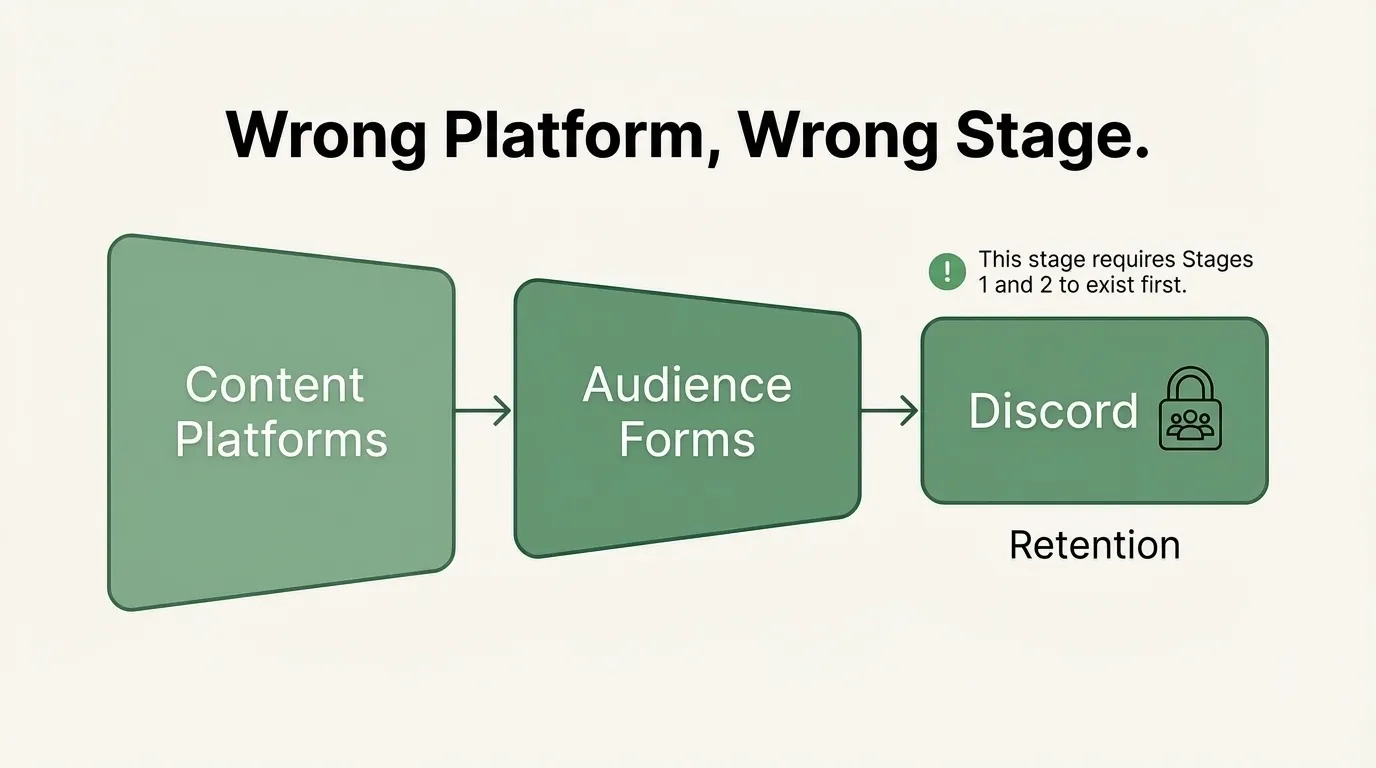
The setup that almost always goes wrong
A founder, a creator, or a brand decides to build a community. They set up a Discord server. They configure the channels, post an invite link, and wait. A week later, the server is quiet. A month later, it still is. They try some engagement tactics. They post more frequently inside the server. Nothing takes hold. They conclude that Discord does not work for them. In most of those cases, Discord is not the problem. The sequencing is. Discord is not a discovery platform. It does not have an algorithm that surfaces your content to people who have never heard of you. It does not generate organic reach. The only people who will ever join your Discord are people who already know you exist, already follow you somewhere with an active presence, and care enough to take the additional step of joining a separate closed platform. That is a very different function from what most people assume when they set up a server.
What Discord actually is
The most accurate way to describe Discord in a community context is middle-of-funnel retention. It is the place where an existing audience deepens its relationship with a brand, a creator, or a product. The discovery platforms, YouTube, Instagram, TikTok, X, are where audiences form. Those platforms are built to put content in front of people who have no prior relationship with the creator. They have recommendation systems, algorithmic feeds, and search functionality that can generate first-contact reach. Discord has none of that. Discord is a closed space. The only way someone enters is through an invite link. And the only reason someone follows an invite link is because they encountered the creator or brand somewhere else first and decided the relationship was worth extending into a more direct space. This means that every person in your Discord server is already a warm audience member. They converted from somewhere else. Discord is where that conversion deepens into something ongoing.
Why the quiet server is almost always a sequencing problem
When a Discord server stays quiet, the instinctive response is to blame the platform or the channel structure. Operators add more channels. They try new engagement tactics. They post prompts and questions to spark conversation. None of that addresses the actual issue, which is that the server was built before the conditions for it to function existed. A Discord community needs content on external platforms to feed it. Members come in with context. They reference something they watched, something they read, something they heard in a recent video. That context is what gives them something to talk about when they arrive. Without it, they join, find a quiet space with no obvious entry point for conversation, and leave. The volume threshold varies by audience type. For a small, highly invested audience, even a modest external presence can sustain early Discord activity. For a broader, more casual audience, the external content volume needs to be substantially higher before Discord becomes a viable extension.
The consistent pattern in early-stage communities
The pattern I see most often with early-stage brands and creators is that they build Discord at the same time as everything else. The YouTube channel is new. The Instagram presence is new. The Discord is new. Everything launches together. The YouTube channel grows, slowly. The Instagram builds, slowly. The Discord stays quiet, because the audience forming on those other platforms is not yet large enough or invested enough to justify the additional step of joining a closed community. This is not a failure of Discord. It is a failure of sequencing. The server was built at stage one of audience development, when the platform's function requires stage two or three to exist first.
The right time to build a Discord
The signal that a Discord community is ready to exist is that the conversation is already happening without one. Comments on your content, replies to your posts, direct messages from audience members, recurring interactions with a consistent group of people. That is the audience that will show up in Discord and continue the conversation they are already having. At that point, Discord gives the existing community a home with more structure, more privacy, and more continuity than public platform comment sections can provide. It does not create the community. It concentrates it. Before those signals exist, a Discord server is an empty room with no one to fill it. You can build the room. But the people who will make it worth entering have not arrived yet on the platforms where they need to find you first.
What this means for how you invest your time
The practical implication is straightforward. If you are early in your content journey or brand building process, Discord is not the priority. The priority is building content volume and consistency on the platforms that have algorithmic reach. That is where the audience forms. Once that audience exists, once people are actively engaging with your content on a regular basis and a recognizable group of repeat commenters and followers has formed, that is the moment to build Discord. Not before. Building Discord early is not a mistake with catastrophic consequences. But it is a use of time and energy that produces very little until the prerequisite conditions exist. The sequencing matters. Build in the right order.
Daniel Jeong is a Discord community infrastructure consultant working with founders, creators, and high-growth digital communities to build systems that function as core business infrastructure. https://danieljeong.org