The Outbound Team and the Community Manager Never Talked
Why the gap between acquisition and retention is costing you the members you already paid to acquire

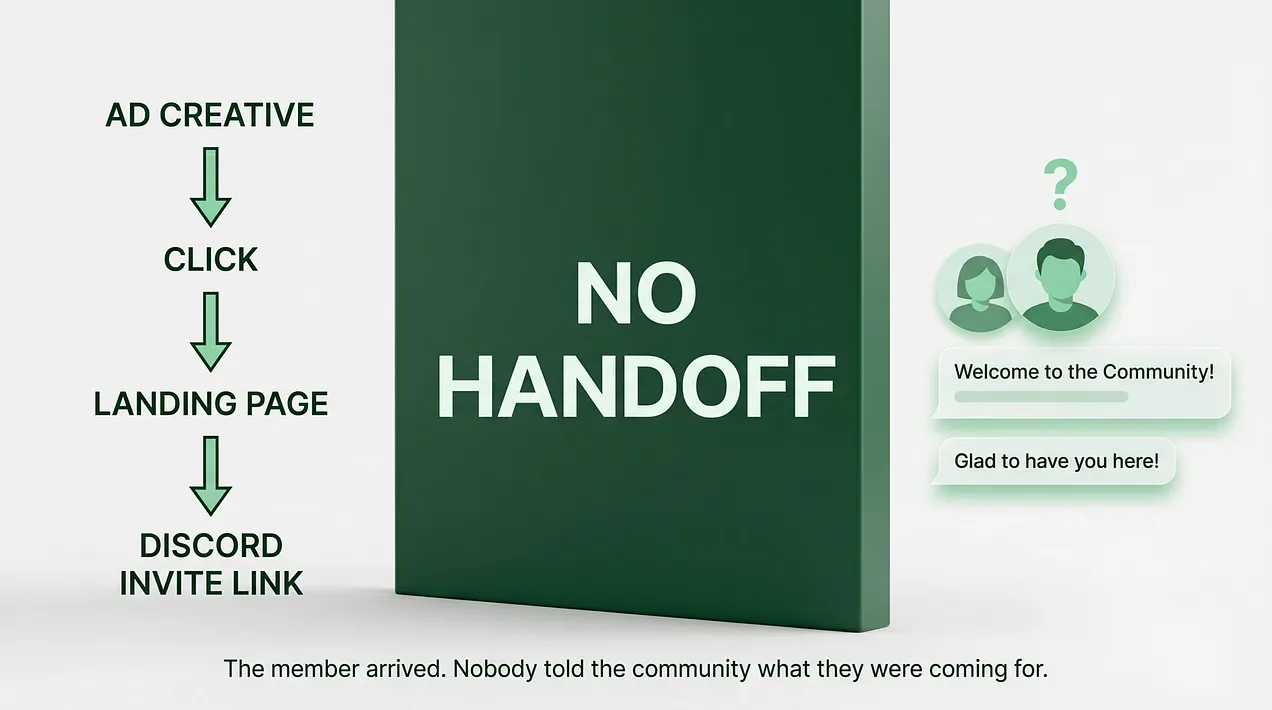 There is a specific moment where most Discord communities lose the people they just paid to acquire. It is not during the first week. It is not even during the first day. It is in the first few minutes after someone joins, when the server fails to connect to anything the member was expecting.
Understanding why that happens requires stepping back from the community itself and looking at the entire path that brought the member there.
There is a specific moment where most Discord communities lose the people they just paid to acquire. It is not during the first week. It is not even during the first day. It is in the first few minutes after someone joins, when the server fails to connect to anything the member was expecting.
Understanding why that happens requires stepping back from the community itself and looking at the entire path that brought the member there.
The Acquisition Side Knows Everything
When a company runs paid acquisition into a Discord community, the outbound team typically has a detailed picture of what is working. They know which creative angle drove the most clicks. They know which audience segment responded. They know the specific promise that got someone to stop scrolling and take action. They have dashboards and attribution models built around this information. That knowledge is valuable because it tells you why someone joined. Not in a vague demographic sense, but in a specific motivational sense. This member clicked because you promised them something. They had a context in mind when they arrived. That context is a lever. It tells you exactly what the first sixty seconds of their community experience should deliver.
The Community Side Knows None of It
The community manager, meanwhile, is operating blind. Nobody passed the information over. The onboarding channel was built once and has not changed in months. The welcome message was written generically because nobody told the community side what the acquisition side was actually promising. When the new member shows up, they land in a channel that could have been written for anyone because it was written for no one in particular. The mismatch is immediate and mostly invisible. The member cannot always articulate why the server feels off. They just know it does not match what they came for. And so they leave. This happens across industries. I have spoken with health app founders, merchandise brands, AI startups, and Web3 companies who were all experiencing the same retention problem. They were spending serious money acquiring members and losing them within the first forty-eight hours. The universal explanation was community quality. The actual problem was almost always the handoff.
What a Handoff Actually Looks Like
A proper handoff between acquisition and community is not complicated. It requires communication and a small amount of operational discipline. The outbound team should notify the community side when a new campaign launches. The core message of that campaign should be shared. If the ad is promising technical support, the community needs to be ready to deliver that support immediately on arrival. If the ad is promising exclusive content, there needs to be exclusive content visible within the first channel a new member sees. More importantly, the onboarding experience should be built around the source of the click, not built generically and left to handle every possible arrival scenario. This is source-specific onboarding. When you run a Reddit campaign, the invite link from that campaign assigns a role to every member who uses it. That role unlocks a channel built specifically for Reddit arrivals. The content in that channel speaks to the context of where they came from. The welcome message references the conversation they were already part of before they joined. Same logic applies to YouTube, Instagram, or any acquisition channel with a specific promise attached. The point is that the member's first experience inside the server should feel continuous with whatever brought them there, not like a fresh start with no context.
Why This Does Not Happen
The honest answer is that most teams are organized in a way that makes this coordination structurally difficult. The marketing team and the community team often report to different people. They have different objectives. The marketing team is measured on acquisition cost and volume. The community team is measured on engagement rate or response time or some activity metric that has nothing to do with whether the acquisition investment was protected at the point of arrival. Nobody owns the handoff. So the handoff does not get built. This is a management problem before it is a community problem. Fixing it requires someone with authority over both functions to declare that member retention starts at the moment of click, not at the moment of community engagement. Those two teams need a shared feedback loop and at minimum a regular touchpoint where active campaigns are reviewed alongside community performance data.
The Real Cost
When companies calculate acquisition cost, they typically measure cost per click or cost per download. They rarely calculate the cost per retained member. If you are acquiring a thousand members a month and losing ninety percent of them within the first week, your actual acquisition cost for a retained member is ten times what you are reporting. That math looks very different and it changes how urgently the handoff problem needs to be addressed. The fix is already partially in place on the acquisition side. The data exists. The knowledge exists. The gap is purely operational. It is a question of whether someone decided to build the bridge between two teams who are technically working toward the same goal.
Starting the Conversation
The practical starting point is simple. Get the outbound team and the community team in the same meeting once a week. Have the outbound team share what campaigns are running and what message is being used. Have the community team report on what new members are asking about and what is driving early drop-off. Do that for a month. You will find correlations you did not expect. You will find that certain acquisition angles create members who stay and certain angles create members who leave immediately. That information is worth more than any additional ad spend. The member retention problem in most Discord communities is not a community problem. It is a coordination problem. The community is just where the damage from a broken coordination shows up first.
Daniel Jeong is a Discord infrastructure consultant working with high-growth companies to design community systems that protect acquisition investment at the point of arrival. https://danieljeong.org