The Moment Your Onboarding Becomes Humanly Impossible
Manual community management breaks at a predictable point. Here is what to build before you reach it.

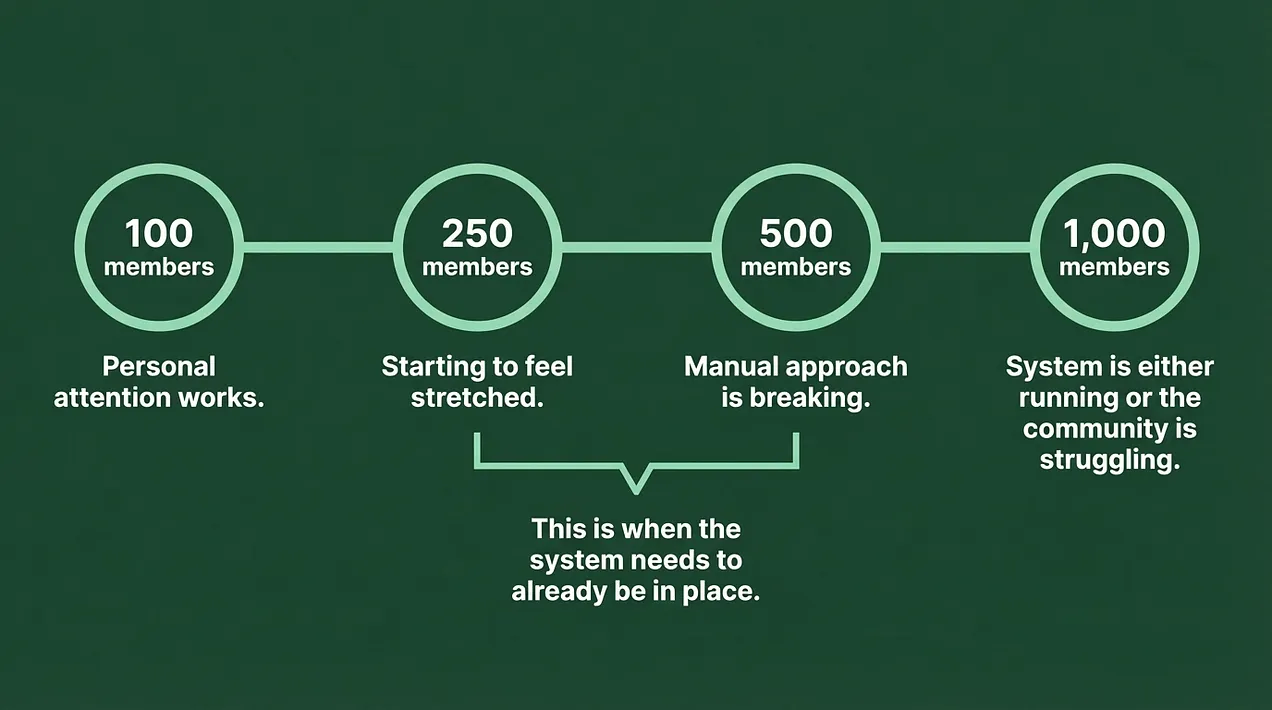
The predictable point where manual breaks
Community growth does not feel like a problem until it is. Most operators start with a personal, hands-on approach to welcoming new members, and that approach works well at small scale. The team knows most members. Questions get personal responses. New arrivals feel genuinely welcomed because someone on the team actually did take a moment to say hello and orient them. Then the server grows. And the same approach that created a warm experience at fifty members starts buckling at two hundred. Not because the team stopped caring. Because there are only so many hours in a day, and communities that grow do not pause while you figure out how to scale the operations behind them. There is a specific point in every community's growth trajectory where manual onboarding transitions from being the best approach to being the primary operational liability. I have seen it happen across servers of different sizes, in different industries, with different team configurations. The threshold varies, but the pattern is consistent.
What the breaking point looks like
I was on a call with a community operator running a membership of several hundred people. She had team members helping with support and engagement, but the onboarding process was still largely manual. Every new member who came in would receive a greeting and orientation from someone on the team. Every question that came in during the onboarding process had a human on the other end personally answering it. Her description of what the experience had become was direct. It was not humanly sustainable anymore. The volume of new arrivals meant that some people received full attention while others joined during busy periods and heard nothing at all. The inconsistency created an uneven first impression across the membership. Some members felt welcomed and oriented. Others felt dropped into a space without context and with no clear path forward. The team members responsible for onboarding were spending significant time on tasks that were repetitive and entirely predictable. The same questions appearing in the same forms. The same role assignments being done manually. The same channel orientations being walked through personally for every new arrival. All of it consuming hours that could have been spent on the conversations that actually required human judgment.
Why systems feel unnecessary early
The reason most community operators build onboarding infrastructure late is that it genuinely does not feel necessary at the beginning. When the server is small and the team is responsive, manual management works and produces quality experiences for every new member. Building automation and onboarding flows at that stage can feel like engineering a solution to a problem that does not exist yet. The problem with that logic is that community growth, when it comes, does not pause for you to build systems. Growth arrives, often faster than expected, and encounters whatever infrastructure is already in place. If the infrastructure is manual, the growth overwhelms it. If the system is already running, the growth runs through it smoothly. The servers that handle rapid growth well almost always share one characteristic: the systems were built earlier than they felt necessary. The onboarding flow was running when the community had a hundred members. By the time five hundred arrived, it had already been tested, refined, and trusted.
What automated onboarding actually handles
The goal of an automated onboarding system is not to remove human interaction from the community experience. It is to remove the repetitive, predictable tasks from human responsibility so that the team's time and attention are available for the interactions that actually require judgment. On Discord, a well-built onboarding system handles several layers automatically. New members receive a structured welcome that orients them to the server's purpose and the key channels relevant to them. Role assignment happens based on information the member provides or based on where they entered the server from. Common questions are addressed through FAQ channels or bot responses before a team member needs to step in. New members get guided through the initial steps they need to take to become full community participants, in a way that feels structured and intentional rather than arbitrary. The team's time is freed for actual conversations. A member asking a complex question that a FAQ cannot address. A moderation situation that requires judgment about context and intent. A community management decision about how to handle a recurring issue. These are the areas where human attention creates real value, and they are the areas that get crowded out when the team is handling repetitive onboarding tasks manually.
The compounding cost of waiting
There is a cost to building systems late that goes beyond the operational strain on the team. When members arrive during the period between when manual breaks and when systems are in place, they have a poor first experience. Many of them leave silently, without providing feedback. The community owner sees members who joined and went inactive, without knowing that the absence of a proper onboarding experience was the determining factor. Those members are difficult to recover. A member who experienced the community at its most chaotic and unstructured has a first impression that is hard to change, even after the systems improve. The window to make a good first impression is narrow and it does not repeat. Building before the urgency hits means the system is running and refined by the time it matters most. The investment feels early. The first members who experience it have a consistently structured welcome. By the time volume arrives, the process is already trusted by the team and proven by experience.
Starting before it feels necessary
If you are running a community that is growing and your onboarding process is still largely manual, the question to ask is not whether you need a system. You need one. The question is whether it will be in place before the growth arrives at full force, or after. Building after the urgency hits means building while managing a backlog of members who already had a poor first experience. Testing new systems on a live, growing community rather than on a small one where mistakes are recoverable. Getting the infrastructure in place after the first wave of impressions is already made. Building before the urgency means the system is running, tested, and refined by the time growth actually demands it. The investment feels like overkill at the time. That feeling is usually a good sign.
*Daniel Jeong is a Discord infrastructure consultant helping companies build scalable community systems that function as core business assets. To learn more, visit *danieljeong.org https://danieljeong.org