The Moment Your Manual Onboarding Becomes the Problem
Most Discord communities outgrow their operations before they realize it. Here is what that looks like, and what to do about it.

Why Manual Operations Break Before You Expect Them To
Most Discord community managers describe the same experience when a server starts to strain. Everything was fine, and then it was not. Not a dramatic failure. Just a growing sense that the team was always behind, always catching up, always answering the same questions in a slightly different order. The problem is rarely the team. The problem is that the community outgrew its operations without anyone designing the next layer of infrastructure. When a community is small, personal management works because the volume is manageable. One person can welcome ten new members in a morning. The same person can answer five support questions that come in over a week. It feels like good community management because it is. Personal, responsive, attentive. But communities that grow do not scale their operational demands linearly. They grow exponentially. At 100 members, one person can handle everything. At 300 members, that same person is stretched thin. At 600 members, they are behind. At 1000 members, the experience quality has already dropped in ways the community feels but cannot name. This is the operational cliff that most growing Discord servers hit without warning.
The 360-Member Threshold
There is a real pattern in community infrastructure that surfaces consistently across different types of Discord servers. Somewhere around 300 to 400 active members, manual processes start to fail in visible ways. New members join and do not complete onboarding because nobody was available to guide them through the next step. Support questions stack up because the volume exceeded what the team can clear before new ones arrive. The welcome channel starts to look abandoned because the personal touches that made it feel warm have become impossible to maintain at the current pace. The community has not changed. The operations have just hit the ceiling of what human-only management can sustain. This threshold is not a catastrophe. It is a signal. It is the moment when the question shifts from how do we manage this community to how do we design this community's infrastructure.
What Automation Actually Does in a Discord Community
There is a common misconception that automation removes the human feel from a community. That bots make things feel corporate and cold. That members can tell when they are being processed rather than welcomed. This misconception comes from seeing badly designed automation. Automation that fires generic messages at wrong times. Bots that answer questions with irrelevant responses. Role assignments that trigger on the wrong conditions. Good automation does something different. It handles the operational layer so that humans can focus on the relationship layer. When a bot assigns roles instantly after a member completes verification, the team does not have to monitor for completions manually. When an automated welcome message guides a new member through their first three steps, the community manager does not need to be available at every hour of every day. The human interaction that matters most in a community, the real conversations, the conflict resolution, the event moments, the personal connections, all of it becomes easier and more consistent when operational scaffolding runs automatically underneath. The members who describe certain Discord communities as feeling alive and well-run are describing the result of good operational design. The infrastructure is invisible to them. They just experience a server that responds when they need it to.
The Design Decision That Changes Everything
The communities that operate smoothly at a thousand members did not get there by accident. They made a decision, usually early, to treat their operations as a function worth designing rather than a problem to manage reactively. That decision looks like this: building the onboarding flow before the volume arrives, writing the FAQ documentation before questions become a flood, setting up the ticket system before support becomes chaotic, designing the role structure before the channel list grows unmanageable. None of this requires large technical resources. Most of it requires clear thinking about what a new member needs when they arrive, what questions are predictable enough to automate, and what parts of the experience must stay human. The communities that never make this decision continue scaling human effort alongside member count. They hire more moderators when they should be building systems. They expand support teams when they should be creating documentation. They continue doing manually what should run automatically, until the cost becomes unsustainable.
Building Infrastructure Before You Need It
The most common objection to building community infrastructure early is that it feels premature. Why design a ticket system for 50 members? Why write onboarding documentation before the community has a defined identity? The answer is that the cost of building infrastructure early is always lower than the cost of retrofitting it into a community that has already formed habits around the absence of structure. Members who joined during a period of manual operations develop expectations around personal attention. When that personal attention becomes impossible to sustain at scale and automation is introduced late, the transition can feel like a downgrade if not managed carefully. Communities that build infrastructure early avoid this problem entirely. New members join into a system designed for them. The experience is consistent from day one. The team has headroom to focus on the things that require people. The question is not whether your community will eventually need infrastructure. The question is whether you build it before the operational ceiling arrives, or after you have already hit it. Three hundred members is not too early to build an onboarding system. It is exactly the right time.
The Practical Starting Point
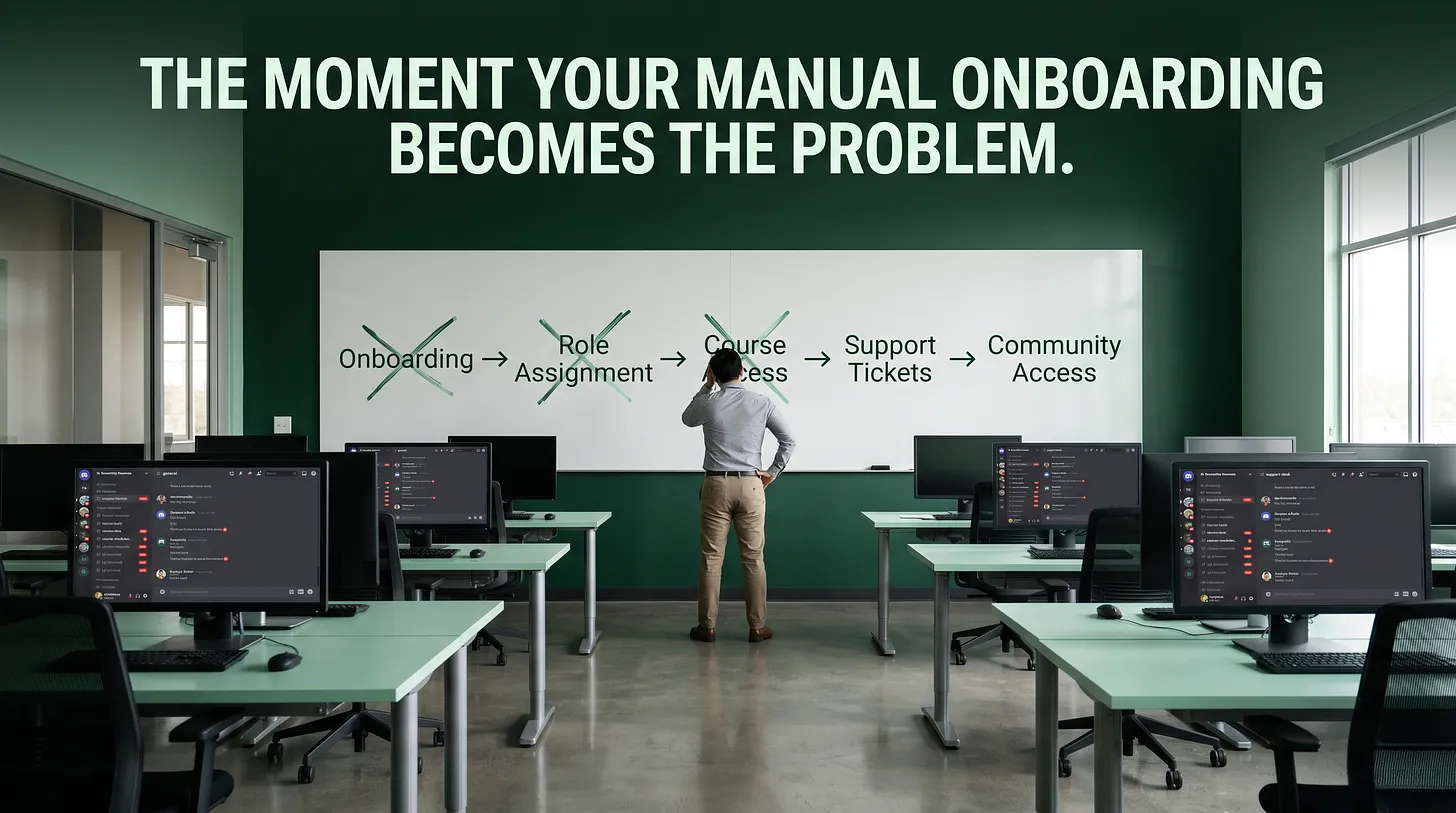
For any Discord server still operating primarily through manual processes, the starting point is not a complete rebuild. It is a single question: what tasks does your team perform repeatedly that do not require a person? Welcome messages. Role assignments. Course access. First-step guidance. Frequently asked questions. These are the operational tasks that automation handles better than humans, not because machines are more capable, but because they are always available. They do not sleep, do not have bad days, and do not forget to send the welcome message when three people join simultaneously. Start with one system. Build the welcome flow. Design it carefully, test it, and let it run for a month. The bandwidth your team recovers from that single change will show exactly what to build next. Infrastructure is not a one-time project. It is an ongoing discipline. The communities that maintain quality at scale have simply committed to treating it that way.
Infrastructure is the part of a community no member sees directly. It is also the part they feel in every interaction. https://danieljeong.org