The First Channel New Members See Is Your Onboarding System
Most communities treat the start-here channel as a formality. It is the most important piece of infrastructure in your entire server.

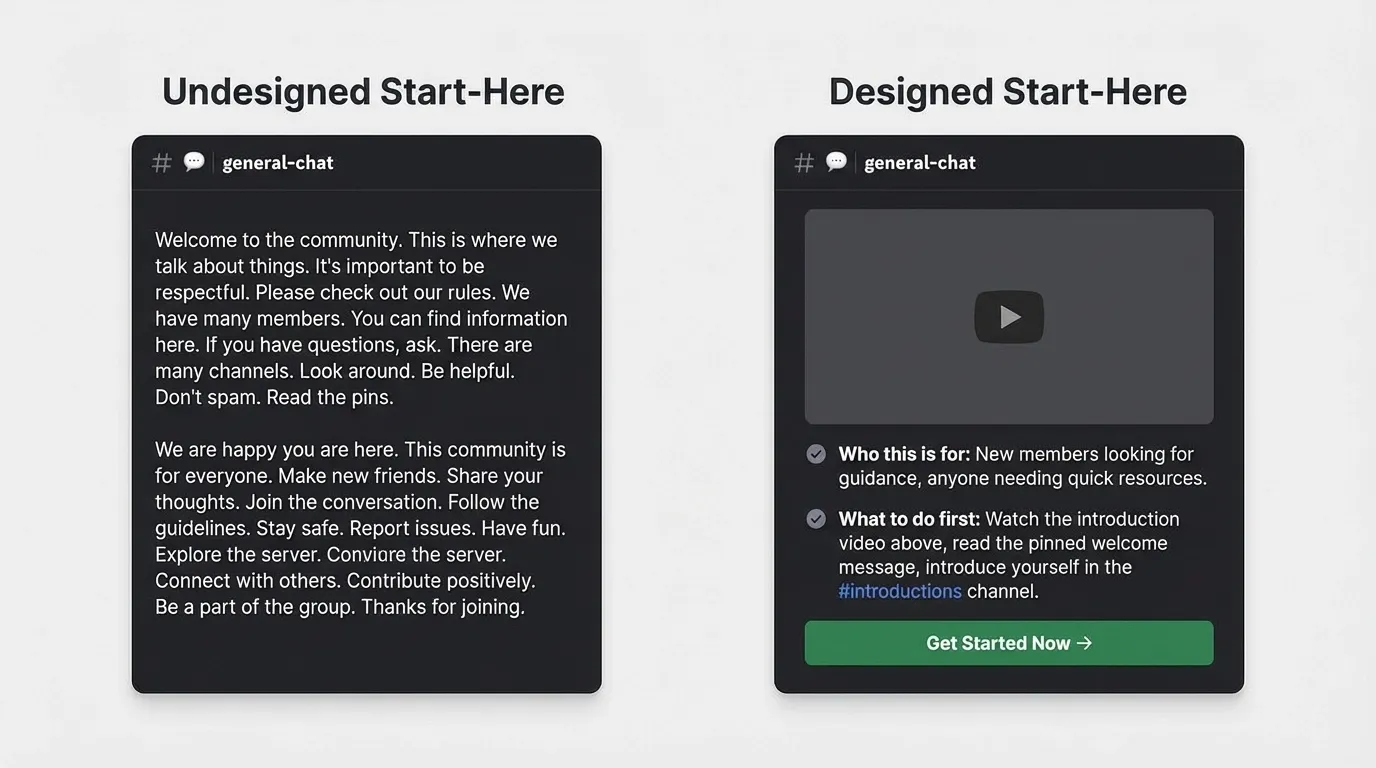
The First Channel Is the Whole Onboarding System
When a new member joins a Discord server, they arrive at a specific moment. They have just pressed a button, clicked a link, or accepted an invite. They are curious. They are willing to engage. And they have no idea what to do next. What they see in the next 90 seconds will determine whether they stay. Most community managers understand that onboarding matters. They know that members who do not engage in the first session are unlikely to return. But there is often a disconnect between understanding this and actually designing for it. The start-here channel tends to be the last thing that gets attention — a brief description of the server, a list of rules, maybe a link to a website. And then the assumption is that members will figure out the rest. They do not.
What Most Start-Here Channels Fail to Do
The fundamental job of a start-here channel is to answer two questions for every person who arrives: what is this place, and what should I do right now. Most start-here channels answer neither clearly. A rules list tells members what not to do. It does not tell them what this community is for, who belongs here, or what the experience of participating looks like. A server description explains what the brand does, but it does not give a new member an action to take. A link to a website sends them away from the community before they have had a reason to stay. None of this is bad on its own. But without a clear orientation and a clear first action, new members are left to figure things out by exploring. Some will do that. Most will look around, find nothing obvious, and leave.
Why a Video Solves the Problem
One of the most effective things a start-here channel can contain is a short video. Not a long explainer. Not a product demo. A one-to-two minute video that answers: what is this community, who is it designed for, and what should a new member do first. The reason video works here is that new members arrive with different levels of context. Some members have been following the brand for months. They have watched videos, read posts, and joined the community because they were already deeply familiar with what it is about. They do not need a full introduction. But they will not be harmed by a short one. Other members arrived through a single link — from a YouTube video, a social post, a referral from someone else. They clicked because something sparked their interest, and they are now standing in a new space with no map. A start-here video serves both groups. The informed member gets a quick confirmation that they are in the right place. The uninformed member gets exactly what they need to orient themselves and take a first step. The alternative — assuming that most members arrive fully informed — consistently fails the people who need the most support at entry.
The First Action Problem
Orientation alone is not enough. New members who understand what a community is but have no clear prompt for what to do first will still not engage. A start-here channel that orients a new member and then ends without a clear first action is like an onboarding flow that explains a product thoroughly and then closes without a sign-up button. The first action should be simple and low-commitment. An introduction post in a dedicated channel. A role selection that customizes their server experience. A link to the most active community discussion of the week. Whatever the community's natural entry point is, the start-here channel should make it explicit. The purpose of the first action is not just to generate engagement. It is to give the member a sense that they have done something. That they have crossed a threshold from visitor to participant. A member who has introduced themselves once is more likely to come back than one who only ever read.
The Scale Problem
The importance of the start-here channel design increases with community size. In a small community, the people who run it are usually present and active enough that new members get acknowledged even if the onboarding is minimal. Someone notices a new join. Someone says hello. The personal attention compensates for the lack of design. As the community grows, that personal attention becomes impossible to maintain at every entry point. New members arrive at all hours, from many different contexts, with many different levels of familiarity. The structure has to do work that was previously done by people. At scale, the start-here channel is not a nice-to-have. It is the primary system through which every new member's first experience of the community is shaped. If it is not designed, the first experience is designed by default — usually in a way that loses more members than it keeps.
What Designed Looks Like
A well-designed start-here channel typically includes a short video introduction, a clear description of who the community is for and what value participation delivers, a simple first action with a direct link to where that action happens, and optionally a brief overview of the most important channels in the server. None of this is complex to build. What it requires is a clear understanding of who is arriving and what they need in the first 90 seconds. Most of the communities I have audited could improve member retention at entry significantly by rebuilding this single channel with those two questions in mind. The first channel is the whole onboarding system. Treating it like a formality is one of the most consistent and preventable ways communities lose people before they ever begin to participate.
Daniel Jeong consults on Discord community infrastructure and operational systems for organizations building long-term community engagement strategies. https://danieljeong.org