The Enterprise Member in Your Discord Won't Post in General
Why high-value members need private paths, and what happens when those paths do not exist

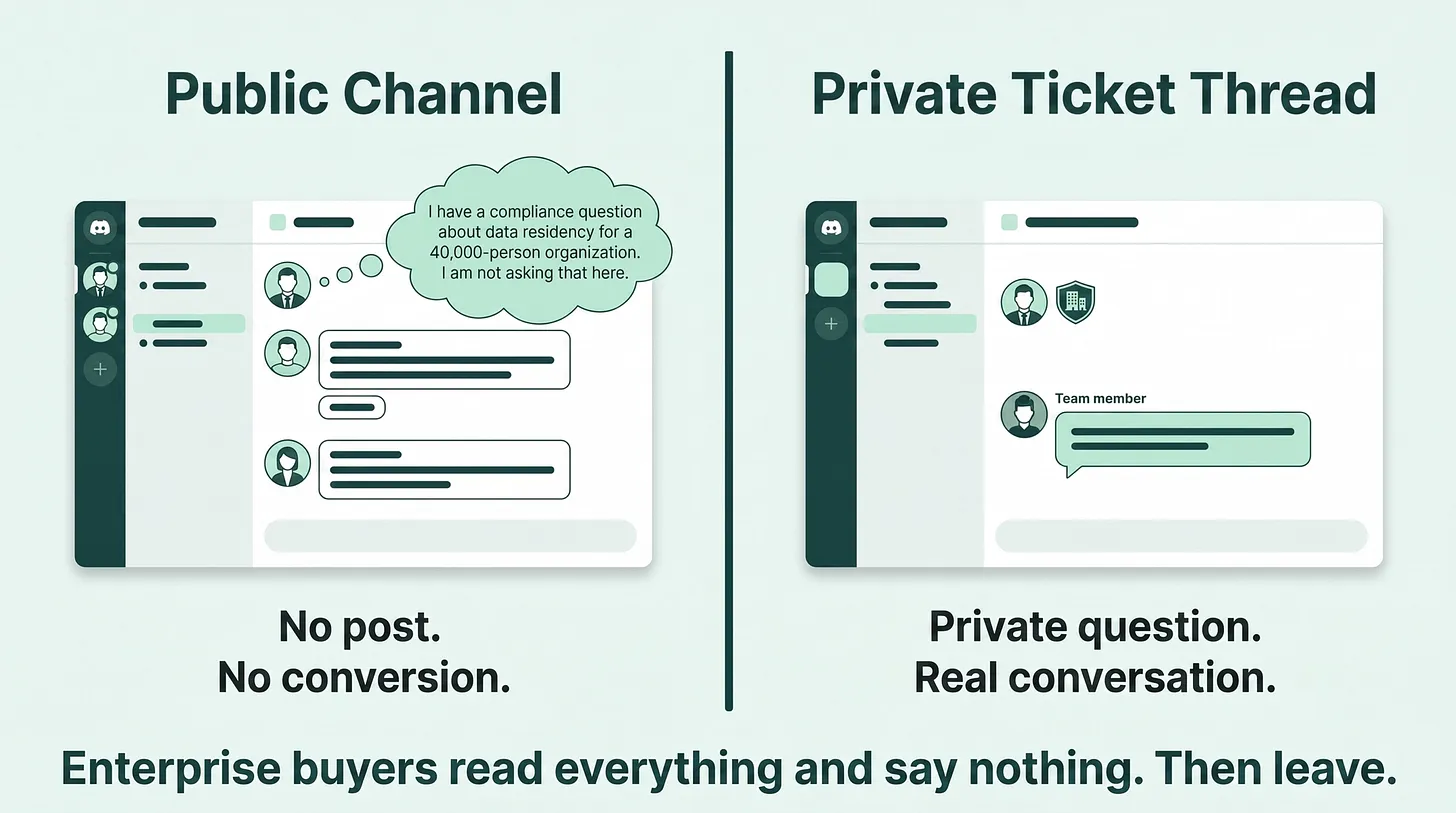 There is a member in a lot of Discord communities who never posts anything. Not because they are inactive on other platforms. Not because they lack questions. Because the public channel is the wrong place for the questions they actually have.
This is the enterprise buyer. The person evaluating your product for a deployment across an organization, or managing an account that involves custom contracts, compliance requirements, or pricing that has never been posted publicly. Their situation is specific. Their questions reveal information they do not want visible to every other member in the server. And most Discord communities give them no other option.
There is a member in a lot of Discord communities who never posts anything. Not because they are inactive on other platforms. Not because they lack questions. Because the public channel is the wrong place for the questions they actually have.
This is the enterprise buyer. The person evaluating your product for a deployment across an organization, or managing an account that involves custom contracts, compliance requirements, or pricing that has never been posted publicly. Their situation is specific. Their questions reveal information they do not want visible to every other member in the server. And most Discord communities give them no other option.
What the Enterprise Member Actually Needs
When an enterprise buyer joins a community, they are usually doing one of two things. They are doing early-stage research on your product before making a purchasing decision at scale, or they are an existing customer with a technical or contractual question that involves their organization's internal details. Either way, their needs are different from the typical community member's needs. A developer asking about an API endpoint is comfortable with a public channel. The question is generic. The answer is useful to everyone who sees it. Public channels work well for that interaction. An enterprise buyer asking about data residency for a deployment in a regulated industry is not comfortable with a public channel. The question reveals their industry, their regulatory environment, and potentially their vendor evaluation process. None of that should be public. Most community teams do not draw this distinction. They build a support channel that is open to everyone and assume it covers every type of inquiry. The members who need something different will not tell you they need it. They will just leave.
What Happens Without a Private Path
The pattern I have seen consistently across developer-focused and B2B communities is that the absence of a private path does not show up in the data as a failure. It shows up as an absence. The enterprise member joins. They browse. They read the visible channels. They see nothing that invites the kind of conversation they need to have. They leave. The team's analytics show a member joined and churned. There is no signal that the churn was caused by a structural gap in the server. Meanwhile, the team is measuring average response time in the public support channel and feeling good about it. The most valuable possible member just left and no one knew they were there. This is a real cost. Enterprise accounts typically represent a different order of magnitude of value compared to standard community members. When those members find a path to engage, the resulting conversations can drive significant revenue. When they do not find a path, they try a different route — usually a support email or a competitor's community that was set up better.
What a Private Path Actually Looks Like
The infrastructure required for private enterprise routing in Discord is not complex. It is a ticket system with an entry point that is clearly labeled and easy to find for the member who needs it. In practice, this looks like a channel near the top of the server navigation called something clear and specific, with a pinned message explaining who it is for and what to do. A bot command in that channel creates a private thread and immediately notifies the right team members. The conversation happens in that thread, invisible to the rest of the server. The member does not need to broadcast their question. The team gets the inquiry without it appearing in a public channel. The conversation can move at the pace required for an enterprise evaluation rather than the pace of a live public chat. This setup takes a few hours to configure. It requires deciding which team members should receive notifications for enterprise inquiries and ensuring those people are reachable during coverage hours. It does not require custom development.
The Multi-Audience Server Problem
Communities serving multiple distinct audience types face this challenge acutely. When developers, creators, and enterprise accounts all inhabit the same server, the channel structure that works for the most common audience type will not work for every audience type. Developers want public technical channels where questions get fast answers from the community. Creators want channels that speak to their specific use case and give them a path to formal partnership. Enterprise accounts want a way to have a private conversation with someone who has authority over pricing, contracts, and compliance. Trying to serve all three with the same channel structure produces a server that works reasonably well for the largest group and does not work at all for the others. The fix is not a major redesign. It is adding the specific paths that each audience type needs to engage on their own terms.
Why This Matters at the Acquisition Layer
When you add your Discord invite to your documentation, GitHub repository, newsletter, or sales materials, you are directing people there with an implicit promise that the community is useful for whatever need brought them. Enterprise buyers who follow that link are arriving with specific expectations. If the server has no pathway that matches those expectations, the link that was supposed to be an acquisition tool becomes a dead end. The enterprise buyer's experience confirms that Discord is a developer community tool, not a place for business-level conversations. They form that conclusion quickly and it is hard to reverse. Building the private path before you direct enterprise traffic to the server means the link works as intended for every audience type you are sending there. That alignment between expectation and experience is what keeps members in the first few minutes.
Daniel Jeong is a Discord infrastructure consultant who helps companies build community systems that work for every audience type they need to serve. https://danieljeong.org