The Discord Onboarding Problem Nobody Talks About Is Also the Most Fixable One
New members decide whether to stay within the first few minutes. Most servers fail that test for a completely avoidable reason.

Why the first few minutes determine everything
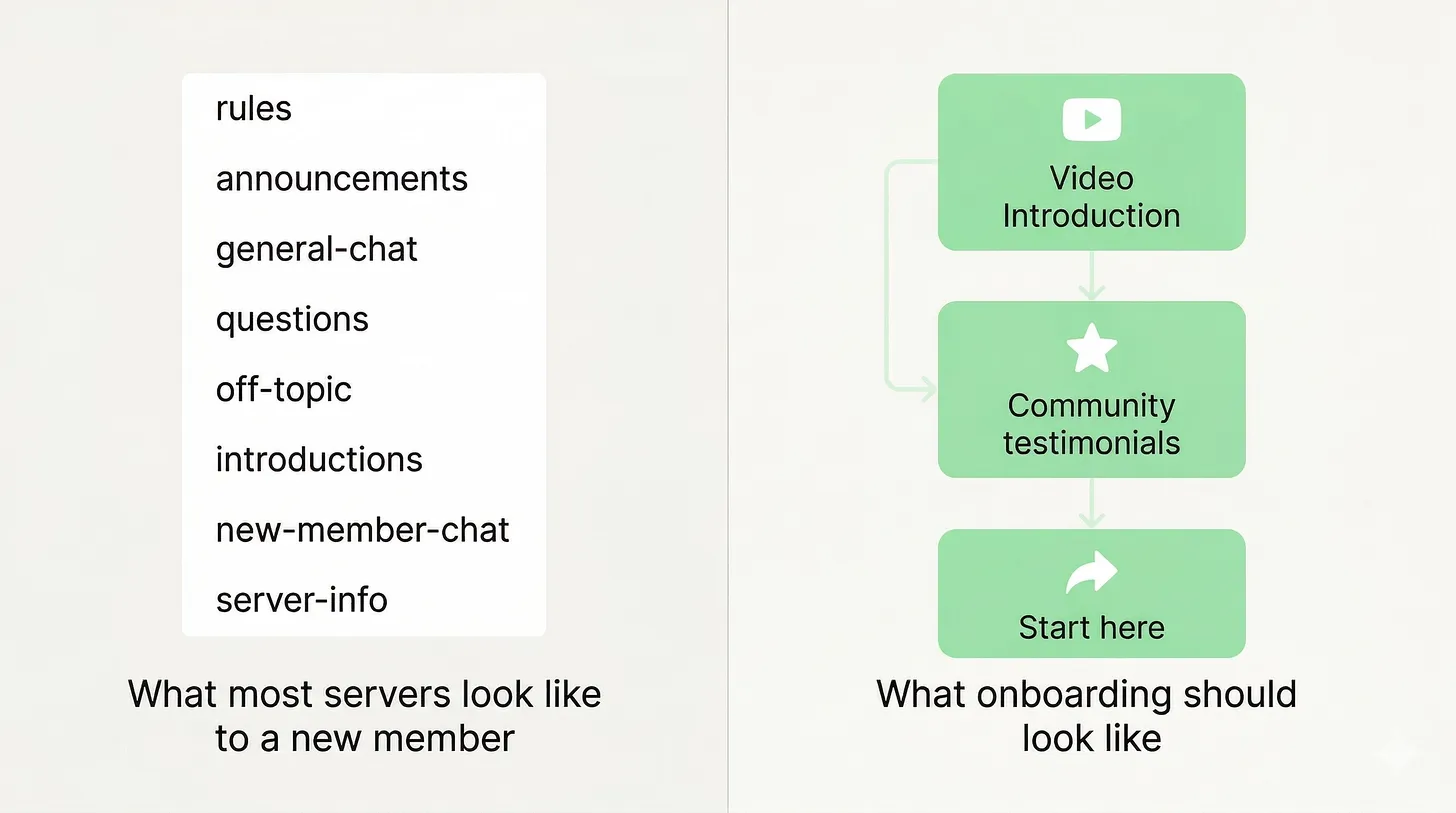
Most Discord community operators spend the majority of their setup time on channel structure. They decide how many categories to create, what to name them, how to organize the different areas of the server. They think carefully about what topics deserve their own space. Then they give almost no thought to what happens when someone joins for the first time. Onboarding is the highest drop-off point in most communities. A new member arrives, sees the channel list, and faces an immediate set of unanswered questions. What is this place? Who is it for? What am I supposed to do here? If those questions are not answered clearly and fast, the most common response is to leave. Not because the person disliked the community. Because they could not figure out quickly enough whether it was worth staying. The first channel a new member sees is doing the same job as a landing page. It has one purpose: take someone from "I just arrived" to "I understand what this is and I want to be here" as quickly and clearly as possible. Most servers fail at this job not because the operators are careless but because they copied their structure from another server they admired without understanding what actually makes onboarding work.
The copy problem in Discord server design
There is a consistent pattern in Discord server setups. A founder, a creator, or a community manager joins a server they find impressive. They notice the channel structure. The categories are organized cleanly. The naming conventions feel professional. And they reverse-engineer that layout for their own server. What they are copying is the surface. The channel names, the category hierarchy, the visual organization. What they are not copying is the thinking behind the decisions. Why does that server have those channels? What problem is each one solving? What does the onboarding flow look like and why was it built that way? The result is a server that looks structured but does not function as a coherent first experience. New members arrive and find a place that looks like someone knows what they are doing, but cannot answer their most basic questions within the first minute.
The landing page framework applied to onboarding
Good onboarding follows the same principles as a well-designed landing page. The logic is the same: a person has just arrived from somewhere else, they have incomplete information about what this place is and whether it is worth their time, and you have a very short window to establish that it is. A landing page does not start with a full catalog of everything the product does. It starts with the clearest possible answer to the question the visitor is asking: is this for me? Discord onboarding should work the same way. The first channel answers three things in order. What is this community? Who is it for? What does a new member do right now? In that sequence, in the first channel, before anything else is visible.
Why video belongs at the top
After reviewing a substantial number of servers, one of the clearest patterns is that the ones with the strongest early retention almost always have a video introduction in the first channel. This is not about production quality. The video does not need professional lighting or a scripted presentation. A phone recording, a Zoom clip, anything that shows a real person explaining who they are, what the community is, and why someone should stay is enough. The reason video works so well in this context is that most people do not read. A block of text explaining the community rules, the channel structure, and the community purpose can be accurate and thorough and almost nobody will read all of it. A two-minute video will be watched by far more of the people who arrive, and it establishes a personal connection that text cannot create in the same way. For brands and creators whose positioning is built around a specific story or personal experience, video is even more important. The first channel is the opportunity to make the emotional case for why this community exists and why it is worth participating in. That case lands better in video than in formatted text.
Social proof as the second layer
After the video introduction, the second element that moves the needle in onboarding is social proof. This does not require elaborate testimonial campaigns. The most effective approach is to take positive interactions that already exist on other platforms and bring them into the first channel. Screenshots of good comments on a YouTube video. Positive replies on X or Instagram. A few messages from members who have shared something meaningful inside the community. These are already being generated if there is any external audience at all. Posting them in the onboarding area does something specific. It tells a new member that other people have found value here and that participating is a reasonable decision. Without social proof, a new member is being asked to trust that the community is worthwhile based only on the operator's word. Social proof gives them evidence.
Clear first actions complete the sequence
The final element that most onboarding flows get wrong is the transition from orientation to participation. After a new member has watched the video and seen the social proof, the most common failure is leaving them to figure out what to do next. Good onboarding ends with an explicit first action. Not a list of all the channels they might explore. A single clear instruction: go here, do this, start here. The fewer decisions a new member has to make in their first session, the more likely they are to take that first step and begin building a sense of belonging in the space. The goal of onboarding is not to show new members everything the community offers. It is to get them to their first meaningful interaction as fast as possible. That first interaction is what converts a new arrival into a member who comes back.
Daniel Jeong is a Discord community infrastructure consultant. He works with founders, creators, and high-growth digital communities to build onboarding systems and community infrastructure that retain members at scale. https://danieljeong.org