The Best Gamification Systems Are the Ones Nobody Sees
Why invisible reward infrastructure outperforms every public leaderboard in Discord communities

The Leaderboard Trap
When someone decides their Discord community needs gamification, the first move is almost always the same. Install a bot that tracks messages. Turn on experience points. Create a channel called something like "leaderboard" or "rankings" and display the top contributors for everyone to see. The logic seems sound. People are competitive. Give them a scoreboard and they will try to climb it. Engagement goes up. Community thrives. Except that is not what happens. What happens is a small group of members starts optimizing. They send short messages. They react to everything. They find the lowest effort path to the highest point total. Meanwhile, the majority of your community sees the leaderboard, realizes they will never compete with the top five, and quietly disengages. This is not a motivation problem. It is a structural one. Visible scoring systems create a hierarchy that rewards volume over value. And the members who bring the most thoughtful contributions are rarely the ones sending the most messages.
What Invisible Gamification Actually Looks Like
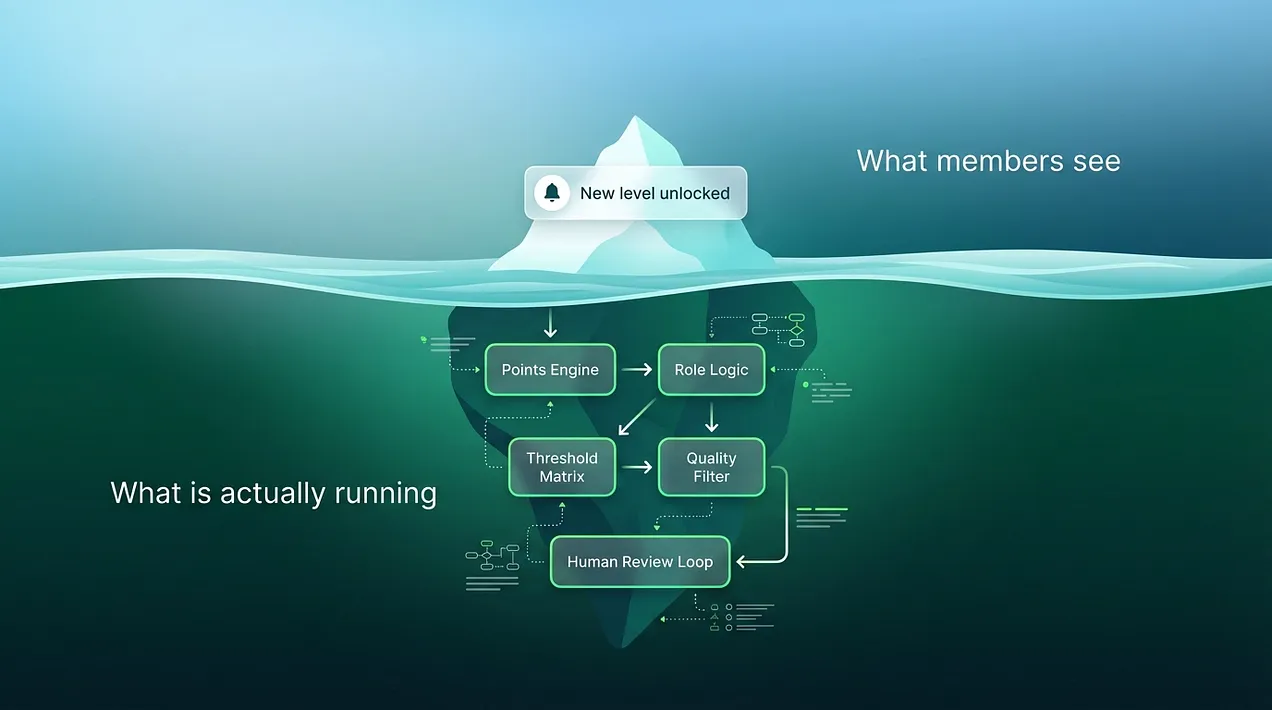
In a server I recently built, the entire gamification layer runs beneath the surface. Members earn points through specific interactions: replies to other members' questions, reactions to shared resources, time spent in voice channels, and participation in collaborative threads. The system tracks all of it. But there is no public scoreboard. No points balance visible to members. No ranking channel. No weekly announcements about who earned the most. Instead, members experience surprises. One day they open Discord and notice a channel they have never seen before. They click into it and find resources, conversations, or access they did not previously have. A notification tells them they have reached a new level, but it does not explain the formula. It just acknowledges their participation. This approach came directly from a conversation with the founding team about how their community should handle progression. They did not want competition. They wanted members to feel recognized for being genuinely present and helpful. The invisible system was the answer.
Why Surprises Work Better Than Scoreboards
There is a behavioral principle at work here that most community operators overlook. When people know exactly how a reward system works, they optimize for the mechanics rather than the outcome. If ten messages plus five reactions equals one level, that is what they will do. The quality of those messages and reactions becomes irrelevant. When the system is invisible, members cannot reverse-engineer the formula. They participate the way they naturally would. Some are active in text channels. Others prefer voice. Some contribute by answering questions. Others share resources. The invisible system captures all of these behaviors and weighs them according to your operational priorities, not the member's ability to game a visible formula. The surprise element adds a psychological layer that scoreboards cannot replicate. Unexpected rewards create a stronger positive association than expected ones. A member who discovers a new channel they have unlocked feels a genuine moment of recognition. That feeling is personal. It is not diluted by seeing where they rank relative to everyone else.
The Infrastructure Beneath the Surface
Running an invisible gamification system requires more operational infrastructure than most people expect. You cannot just turn off the leaderboard display on a standard bot and call it invisible. The entire architecture needs to be intentional. First, you need a points engine that tracks specific interaction types with different weights. Replies to questions carry more value than standalone messages. Reactions to shared resources indicate engagement that passive scrolling does not. Voice channel time, especially in collaborative or event contexts, signals investment that text metrics alone cannot measure. Second, you need role assignment logic. When a member crosses a point threshold, the system automatically assigns a new role that grants access to additional channels, resources, or features. This assignment must be silent. No public announcement. No congratulatory bot message in general chat. The member discovers the change on their own terms. Third, you need a threshold matrix. This is your internal document that defines what each level requires and what it unlocks. The matrix lives in your operational documentation and never gets shared with members. It gets adjusted over time as you observe how your specific community interacts and where the natural breakpoints fall. Fourth, and this is the component most operators skip entirely, you need a human review layer. Automated point tracking cannot distinguish between genuine helpfulness and sophisticated noise. Someone on your team needs to periodically audit what interactions are earning points and flag patterns that suggest gaming. A member sending dozens of one-word reactions to farm points needs to be identified and addressed. Without human oversight, even an invisible system will eventually reward the wrong behavior.
The Trust and Share Point Distinction
The server I worked on uses a dual-point model that separates two kinds of contribution. Trust points measure reliability and are harder to accumulate. They come from completed collaborations, peer feedback, referral quality, and verified contributions that other members can vouch for. Share points measure visible participation: messages, reactions, voice time, and responses to others. Both point types feed into the same invisible progression, but they capture different dimensions of member value. A member might be quiet in public channels but incredibly reliable in private collaborations. The trust point system recognizes that value. Another member might be highly active publicly but less consistent in follow-through. The share points reflect their engagement while the trust points reveal the gap. This dual model creates a more honest picture of who your valuable community members actually are. When both systems feed into progression, the members who unlock the most access genuinely deserve it based on a complete picture of their contribution.
When to Introduce Transparency
The question eventually comes up: should the system stay invisible forever? The answer depends on community maturity. In the early stages, keeping everything hidden is the right approach. You are still calibrating thresholds, adjusting point weights, and learning how your specific member base interacts. Exposing the system too early invites feedback on mechanics rather than participation. Members will ask why certain actions earn more than others. They will suggest changes. They will start thinking about the system instead of engaging with each other. As the community matures and your infrastructure stabilizes, selective transparency can work. Telling members that consistent engagement leads to progression without specifying the exact formula preserves the positive dynamics while giving people a general understanding that their participation is recognized. What you should never do is publish the formula. The moment members know the exact inputs and outputs, you have recreated the leaderboard problem without the leaderboard. Keep the specifics in your operational documentation and treat them as proprietary infrastructure.
The Operational Discipline Behind Surprise
Surprise and delight sounds like a marketing phrase, but in community operations it is a real mechanism with real requirements. The moment a member discovers something they have earned without expecting it, their relationship with the community shifts. They feel seen. They feel valued. And they did not have to perform for an audience to get there. Building that experience requires operational discipline. Your team needs to define clear milestones that trigger rewards. Your automation needs to execute without errors or delays. Your monitoring needs to ensure the system rewards the right people for the right reasons. And your documentation needs to track every threshold, every unlock, and every adjustment so the system remains coherent as your community grows. This is infrastructure work. It lives in bot configurations, spreadsheets, and internal documentation. It is not the kind of work that gets celebrated in public channels or showcased on social media. But the output is a community where members stay because participation feels naturally rewarding. Where retention is built into the operational layer rather than dependent on visible incentives that lose their effect over time. That is the difference between a Discord server with a leaderboard and a Discord server with real retention infrastructure. One is visible and fragile. The other is invisible and durable.
Daniel Jeong is a Discord systems architect and community operations strategist who builds retention infrastructure for communities that take their growth seriously. https://danieljeong.org