Tags Will Save Your Skill Channels From Becoming Ghost Towns
Why consolidating topic-based channels into a single tagged space creates stronger technical engagement in Discord communities

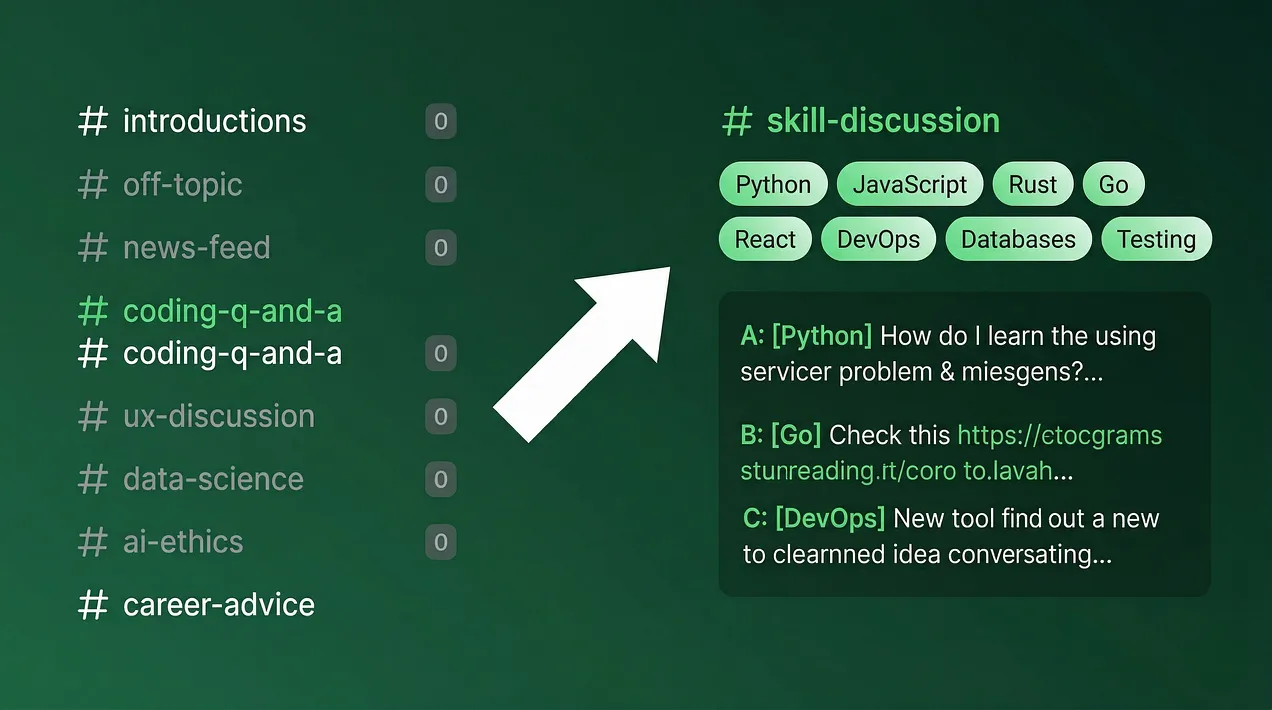
The Skill Channel Graveyard
It starts with good intentions. Your community has members with different technical specializations. Python developers, JavaScript engineers, Rust enthusiasts, DevOps practitioners, database administrators, and more. Each group deserves a space where they can discuss their specific area without cluttering a general channel. So you create dedicated channels. One for each major skill area. Eight channels, maybe ten. Each with a clear description of what belongs there. The architecture looks clean and organized. Then the community launches and reality sets in. Two of those channels get regular posts. Python and JavaScript, usually, because those communities tend to be larger. The other six sit quietly. A message appears every few days in one of them. The rest go entirely silent for weeks at a time. New members who identify as Rust developers or Go specialists click into their channel, see the last message was posted eleven days ago, and form an instant impression. Nobody here cares about my specialty. That impression is wrong, but it is the only conclusion the empty channel supports.
Why Fragmentation Kills Engagement
The fundamental problem is math. If your community has three hundred members and you create eight skill channels, you are distributing those members across eight separate conversation spaces. Even if every member is interested in at least one skill topic, the average channel has the attention of about forty people. And attention is not the same as activity. Of those forty, maybe five are likely to initiate a post in any given week. Five potential initiators per channel per week is not enough to sustain a feeling of activity. Most of those channels will have zero or one posts in a given week. And a channel with one post per week feels dead, regardless of how many people might be silently interested in the topic. This is the fragmentation problem. The total interest across all skill topics might be substantial. If all the technical discussion happened in one place, the channel would feel active and vibrant. But by splitting it across eight rooms, you have diluted the activity below the threshold where any individual room feels alive. The threshold for perceived activity varies by community, but a rough benchmark is at least one meaningful post per day. Below that, a channel starts feeling inactive. Below one post per week, it feels abandoned. Most skill-specific channels in communities under a few thousand members fall well below this threshold.
How Tags Change the Equation
Discord's forum channels and tag system offer a structural alternative that preserves topic organization without the fragmentation cost. Instead of eight skill channels, you create one skill discussion channel configured as a forum. You define tags for each topic: Python, JavaScript, Rust, Go, React, DevOps, Databases, Testing. Members create posts in this single channel and tag them with the relevant skill. A member asking about Rust memory management tags their post with Rust. A member sharing a JavaScript library tags their post with JavaScript. A member discussing CI/CD pipeline design tags their post with DevOps. All of these posts appear in the same channel. The channel's main view shows every post regardless of tag. Members who want to see everything can browse the full feed. Members who want to focus on a specific skill click the tag and see only posts with that label. The math changes completely. Instead of distributing three hundred members across eight channels, all three hundred members see a single active channel. The channel accumulates posts from every skill area, creating a consistent flow of activity. A member who opens the channel sees recent posts. It feels alive. It feels like people are here. The tag filter gives members the same specificity they would have in a dedicated channel, but without the isolation. They can engage with their specialty while also being exposed to adjacent topics. A Python developer might see a Rust post that catches their interest. A DevOps practitioner might notice a database question they can answer. The single-channel structure creates cross-pollination that separate channels prevent.
When Separate Channels Still Make Sense
Tags are not universally better than dedicated channels. The decision depends on conversation volume. If your community has enough activity to sustain separate channels where each one averages multiple posts per day, dedicated channels work well. They provide focused spaces where members can have deep, uninterrupted conversations about their specialty. The crossover point is different for every community, but you can identify it by tracking post frequency. If a skill channel averages less than one post per day over a two-week period, it is a candidate for consolidation into a tagged space. If it consistently averages three or more posts per day, it has earned its own channel. Some communities use a hybrid approach. High-volume topics like Python and JavaScript get dedicated channels because the activity justifies the separation. Lower-volume topics like Rust, Go, and specialized areas get consolidated into a tagged skill discussion channel. This hybrid preserves the benefits of dedicated space for active topics while preventing ghost towns for niche ones.
The Organizational Psychology of Empty Spaces
There is a psychological dimension to the ghost town problem that goes beyond simple activity metrics. Empty channels affect how members perceive the community as a whole. When a member joins a server and explores the channel list, they are building a mental model of the community. Each channel they click into contributes to that model. A channel with recent, substantive posts signals a healthy community. An empty channel signals disinterest or decline. The problem is asymmetric. One active channel does not offset the negative impression of three empty ones. Members weigh negative signals more heavily than positive ones when forming their initial assessment. A server with four active channels and zero empty channels creates a stronger positive impression than a server with six active channels and eight empty ones. By consolidating low-activity topics into a tagged channel, you eliminate the empty channels from the member's exploration. Every channel they click into has recent content. The mental model they build is one of an active, engaged community. The topics that would have been ghost towns are still available through tags, but they no longer occupy visible real estate that signals emptiness.
Setting Up Tags Effectively
The implementation details matter. Tags need to be intuitive, complete, and mutually exclusive enough that members do not struggle with categorization. Keep the tag list manageable. Eight to twelve tags is usually the upper limit before decision fatigue sets in. If you have more than twelve skill areas to cover, group related ones. "Frontend" instead of separate React, Vue, and Angular tags. "Infrastructure" instead of separate DevOps, Cloud, and Networking tags. You can always expand later if a grouped tag generates enough volume to justify splitting. Make tag selection required when creating a post. Optional tags lead to untagged posts that defeat the filtering purpose. If members are forced to choose at least one tag, the organizational structure stays intact. Pin a post at the top of the channel explaining the tag system and what each tag covers. New members should understand the system in thirty seconds of reading. If your tag descriptions require paragraphs, the categories are too abstract. Monitor tag usage patterns. If one tag accumulates significantly more posts than others, it might be ready for its own dedicated channel. If a tag rarely gets used, consider merging it with a related one. The tag structure should evolve based on actual member behavior, just like your channel structure.
Migration from Channels to Tags
If you already have separate skill channels that are underperforming, the migration to a tagged system needs to be handled with communication. Announce the change in advance. Explain that you are consolidating skill discussions into a single channel with tags to improve activity and make conversations easier to find. Frame it as an upgrade, not a reduction. The topics are all still available. The organization is still there. The experience is better because the channel will be active. Archive the old channels rather than deleting them. Members can still access historical conversations if they need to reference something. The channels just no longer appear in the active sidebar. Seed the new tagged channel with a few quality posts in different tag categories before the migration goes live. When members first visit the consolidated channel, they should see an active space with recent posts across multiple tags. An empty tagged channel is just a different kind of ghost town. After migration, monitor engagement for two to three weeks. You should see a noticeable increase in total posts compared to the sum of posts across the old separate channels. The concentration effect typically generates more discussion because members see more content and are more likely to respond when a channel feels active.
Tags as Infrastructure Thinking
The choice between separate channels and tags is ultimately an infrastructure decision. It is about how you organize conversation flow to maximize engagement density while preserving topic specificity. Separate channels optimize for topic purity. Every message in the channel is on-topic. But they pay for that purity with fragmentation. The total engagement gets distributed across spaces that may not have enough volume to sustain themselves. Tags optimize for engagement density. All conversation flows through a single space, creating consistent activity. Topic specificity is preserved through filtering rather than physical separation. Members get the best of both approaches: a lively channel they can browse broadly or filter narrowly. For most communities under five thousand members, tags are the better infrastructure choice for skill-based discussion. They solve the ghost town problem without sacrificing organization. They concentrate engagement where it matters most: in front of members who are looking for reasons to participate. Your skill topics deserve active discussion. Tags make that possible by putting all the conversations in the same room and letting members choose what to focus on. Separate channels make it unlikely by scattering the same conversations across rooms where most of them will go unheard.
Daniel Jeong is a Discord systems architect and community operations strategist who builds engagement infrastructure that concentrates activity instead of fragmenting it. https://danieljeong.org