Stop Splitting Your Community Into Fifteen Channels on Day One
Why fewer channels at launch creates stronger engagement and how to know when your community actually needs a new one

The Fifteen Channel Fantasy
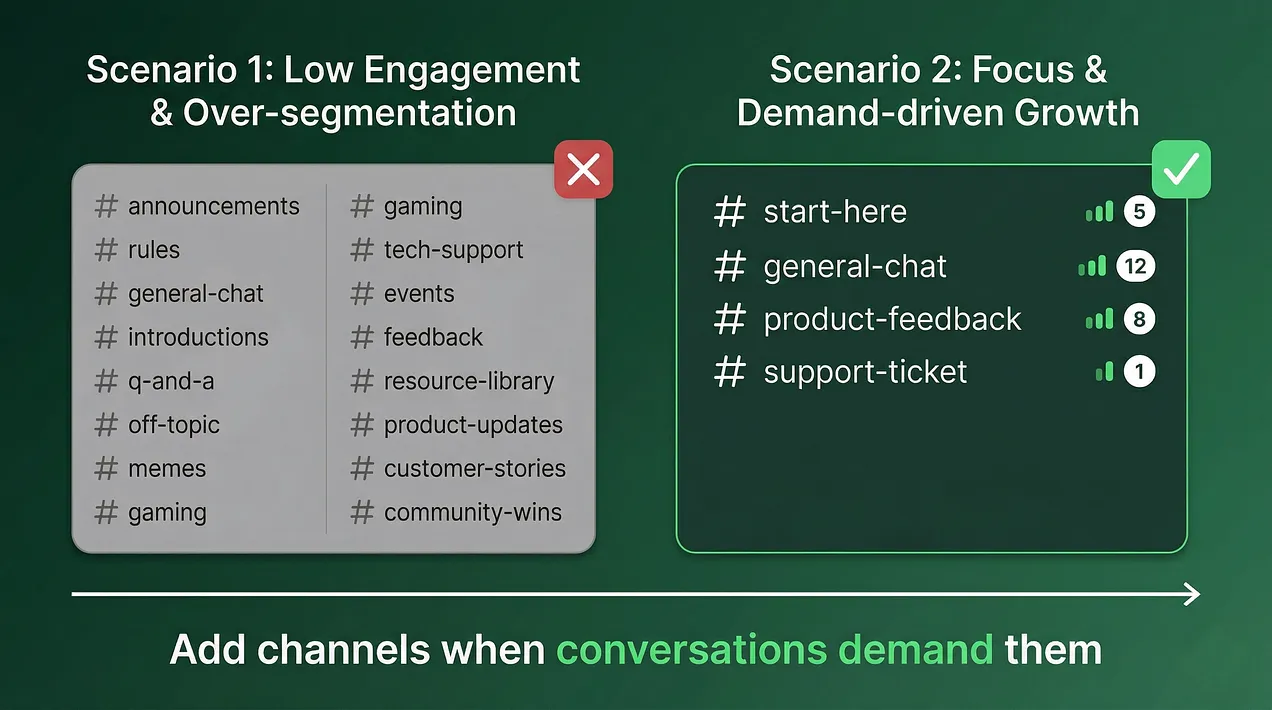
Every new Discord server operator goes through the same phase. Before the server even launches, they sit down and map out channels. They think about every possible conversation type their community might have. Welcome. Introductions. General discussion. Off-topic. Resources. Events. Wins and celebrations. Questions and answers. Showcase. Feedback. Suggestions. Collaborations. Jobs. Memes. Links. The list grows because the exercise feels productive. Each channel represents a future conversation. A space where members will naturally gather around a specific topic. The more channels you create, the more prepared you feel. Then the server launches. Members trickle in. They see the channel list and something happens that the operator did not anticipate. Instead of feeling welcomed by the variety, they feel overwhelmed by it. Fifteen channels is not a menu of opportunities. It is a wall of decisions.
Why Empty Channels Are Worse Than Missing Channels
The core problem with launching too many channels is not complexity. It is emptiness. When a new member joins and clicks into a channel, they are looking for one thing: signs of life. Recent messages. Active conversations. Evidence that other people are here and participating. An empty channel sends the opposite signal. It says nobody is talking about this. And when a member clicks through three or four channels and finds the same emptiness, they form a conclusion about the entire community. This place is dead. That conclusion happens fast, often within the first sixty seconds of exploration. The irony is that the operator created those channels to make the community feel robust and well-organized. The effect is the opposite. A server with fifteen channels and activity in only two of them feels abandoned. A server with four channels and activity in all four feels alive. This is not about perception management. It is about concentration. Community engagement follows a density principle. The same fifty messages spread across fifteen channels create the appearance of a ghost town. Those same fifty messages concentrated in four channels create the appearance of an active, engaged community.
The Three to Five Channel Launch
The servers that build lasting engagement almost always start small. Three to five channels is the typical launch configuration for communities that understand this dynamic. The essentials are straightforward. A welcome or introductions channel where new members can say hello and the community can greet them. A general discussion channel where the bulk of conversation happens. An announcements channel where the operator posts updates, events, and important information. Depending on the community's focus, one additional topic-specific channel might make sense. A community for developers might have a single code-help channel. A community for creators might have a single share-your-work channel. The key word is single. One additional space, not five. Everything else waits. Not because those conversations do not matter, but because they have not earned their own space yet.
When to Create a New Channel
The right time to create a new channel is when you observe a conversation pattern that consistently disrupts or outgrows an existing channel. This is evidence-based channel creation rather than imagination-based channel creation. If members in your general channel keep having detailed technical discussions that other members find hard to follow, that is a signal. The technical discussion needs its own space. When you create it, you can point to the existing conversations as proof that the channel is needed. Members who were already having those discussions will migrate naturally. If members keep sharing resources in general and those resources get buried in the conversation flow, that is a signal. A resources channel makes sense now because there is already content to populate it. The critical difference is momentum. A channel created in response to existing behavior launches with built-in activity. A channel created from imagination launches empty and stays that way until someone takes the initiative to use it.
The Moderation Cost Nobody Calculates
Every channel you create carries an ongoing operational cost. It needs to be monitored for spam, off-topic posts, and rule violations. It needs periodic content seeding to prevent it from going silent. It needs to be included in your community's navigation and any onboarding guides that reference channel purposes. At four channels, this cost is manageable for a small team or even a solo operator. At fifteen channels, the moderation and maintenance burden becomes significant. Most operators do not calculate this cost before launch. They create the channels and then discover, weeks later, that they cannot sustain attention across all of them. The result is selective neglect. The operator focuses on the two or three channels that have activity and ignores the rest. The ignored channels accumulate spam, go completely silent, or develop their own unmoderated cultures that diverge from the community's standards. This is not a staffing problem. It is a design problem. You solved it before it happened by not creating channels you cannot sustain.
The Psychology of Choice Overload
There is a well-documented cognitive phenomenon at play here. When people are presented with too many options, they often choose none. This applies to retail, to restaurants, and it applies to Discord channel lists. A new member who sees four channels can quickly understand the community's structure and decide where to participate. The decision takes seconds. A new member who sees fifteen channels faces a categorization challenge. They need to read each channel name, understand its purpose, evaluate which one matches their intent, and then decide. Many members skip this process entirely and default to general or leave without posting. The operators who understand this design their channel list as a decision architecture. Every channel that appears in the sidebar should have a clear, non-overlapping purpose that a new member can understand in a single glance. If two channels sound similar, they should be merged. If a channel's purpose requires explanation, it is too specialized for launch.
Growing Intentionally
The goal is not to stay at four channels forever. The goal is to grow the channel list in proportion to the community's actual behavior. Some communities will naturally expand to twelve or fifteen channels over time. The difference is that each channel was added in response to a real need, populated from day one with existing conversations, and supported by the operational capacity to maintain it. This growth pattern creates a channel list where every entry is active and purposeful. Members learn to trust that clicking into any channel will yield relevant, recent content. That trust drives exploration and participation across the server. Contrast this with the server that launches with fifteen channels. Even if activity eventually spreads to most of them, the early period of emptiness has already shaped member expectations. The members who joined in the first weeks carry the memory of a quiet, empty server. Recovering from that first impression is significantly harder than building on a strong one.
Channel Consolidation for Existing Servers
If you have already launched with too many channels, consolidation is the correct move. Identify which channels have had meaningful activity in the last two weeks. Archive or hide the rest. You do not need to delete them permanently. Discord's channel archive feature lets you remove them from the sidebar without losing the conversation history. Announce the change transparently. Tell members you are consolidating channels to improve the experience and that specific topics will get their own channels back when conversations demand them. Most members will appreciate the simplification. The ones who object are usually the power users who already know where everything is and do not experience the confusion that new members face. After consolidation, monitor the remaining channels for emerging conversation patterns that signal the need for expansion. Grow back intentionally, adding one channel at a time when the evidence supports it.
The Discipline of Restraint
Starting with fewer channels requires a specific kind of discipline. It means resisting the urge to plan for every scenario. It means accepting that your launch server will look simple, maybe even sparse. It means trusting that growth will come from member behavior rather than from your architectural imagination. That discipline pays off in engagement density, moderation sustainability, and new member experience. The server that looks simple on day one but feels active is always more successful than the server that looks comprehensive on day one but feels empty. Your channel list is not a demonstration of how much you have thought about your community. It is an operational system that needs to be sustained, moderated, and justified by real activity. Build it from evidence. Add to it with intention. And treat every new channel as an operational commitment, not a creative expression.
Daniel Jeong is a Discord systems architect and community operations strategist who builds channel infrastructure that scales with evidence instead of assumptions. https://danieljeong.org