Source-Specific Onboarding Is Not a Nice-to-Have
Why where a member came from should determine what they see first, and how to build that in Discord without custom development

 Most Discord onboarding is designed as if every member arrives with the same background, the same context, and the same expectations. They do not.
The member who found your server through a Reddit thread had a specific conversation in mind before they joined. The member who clicked an Instagram ad saw a specific promise before they arrived. The member who came from a YouTube video already has forty-five minutes of context about your product. These are fundamentally different starting points. Treating them the same is a structural choice with a measurable cost.
Most Discord onboarding is designed as if every member arrives with the same background, the same context, and the same expectations. They do not.
The member who found your server through a Reddit thread had a specific conversation in mind before they joined. The member who clicked an Instagram ad saw a specific promise before they arrived. The member who came from a YouTube video already has forty-five minutes of context about your product. These are fundamentally different starting points. Treating them the same is a structural choice with a measurable cost.
What Source-Specific Onboarding Is
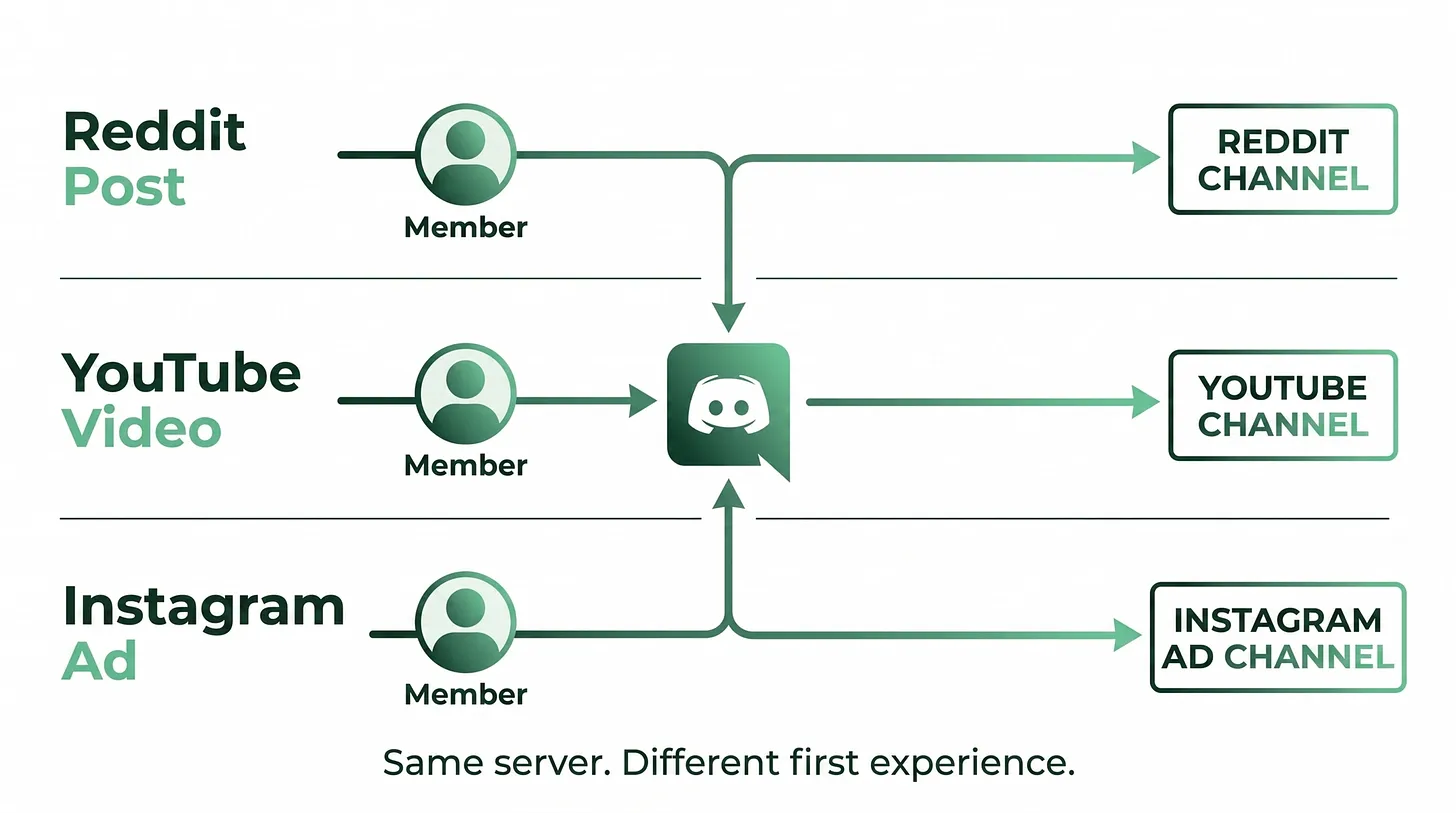
The concept is simple. Every invite link in Discord can be assigned a role. When someone joins through a specific link, they receive the role attached to that link automatically. That role controls which channels are visible to them. This means you can create an invite link for your Reddit posts that assigns a Reddit role. Members with that role see a dedicated channel that speaks to the context of where they came from. The welcome message references the type of conversation they were already having. The resources pinned in that channel match the questions that Reddit audiences tend to ask. You can do the same for YouTube. For newsletter clicks. For Instagram ads. For any acquisition source that has a consistent audience profile and a consistent set of expectations. The technical setup takes roughly thirty minutes. The operational discipline required is that you use a different link for each channel, every time. That is the only ongoing requirement.
Why the First Forty-Eight Hours Matter
Retention data from Discord communities consistently shows that the first forty-eight hours are where most servers lose most people. A member who does not find something relevant and useful within that window rarely comes back. The standard explanation is that the content was not good enough or the community was not active enough. Those things can be true. But before either of those explanations applies, there is a simpler factor: whether the first thing the member saw was relevant to why they came. If someone joins your server because a Reddit post promised them a community of developers solving a specific type of problem, and the first channel they see is a generic welcome message with no connection to that promise, the mismatch registers immediately. Not consciously, in most cases. But the sense that the server is not quite what was advertised is enough to lower engagement from the start. Source-specific onboarding eliminates that mismatch. The member arrives and their first experience extends the conversation that brought them there instead of resetting it.
Building Around the Audience You Have
One of the more consistent problems I see in community operations is that the onboarding experience is designed around the server's identity rather than the member's journey. The welcome channel explains what the community is. It does not explain why this member, specifically, should care. Source-specific onboarding forces you to think about the journey from the member's perspective. You have to ask: what did this person see before they clicked? What were they hoping to find? What would make them feel like they made the right decision by joining? Those questions produce different answers for different sources. A member from a paid ad needs reassurance that the server delivers on the specific promise of the creative. A member from organic search needs to find the specific content they were looking for quickly. A member from a YouTube recommendation needs to feel like the server extends the relationship they have with the creator, not just replaces it with a generic community experience.
The Operational Layer
Source-specific onboarding also produces a useful operational byproduct: you can track which acquisition sources produce members who stay. If the Reddit link produces members with strong first-week engagement and the Instagram link produces members who leave within forty-eight hours, that information is valuable. It tells you something about the alignment between your ad creative and your server's actual offering. It might mean the ad is over-promising. It might mean the Instagram audience is not a fit for Discord as a platform. Either way, you have data to work with instead of aggregate retention numbers that tell you nothing about where the problem is. Most community platforms cannot give you this level of attribution. Discord can, if you set it up to capture it.
The Practical Path
Start with two sources. Pick the two acquisition channels you use most actively and build a dedicated welcome experience for each. Keep the technical setup minimal: a role, a channel, a customized welcome message, and two or three pieces of pinned content that match the context of that source. Run both for thirty days. Compare early engagement between source audiences. Adjust the welcome channel content based on what the first-day questions actually are. That is the full process for a first implementation. The principle scales as you add acquisition channels. The setup cost decreases with each additional source because the infrastructure is already in place. The members you acquire through paid channels represent real budget. Source-specific onboarding is the cheapest possible way to protect that budget at the moment it is most at risk.
Daniel Jeong is a Discord infrastructure consultant helping high-growth companies design onboarding systems that retain the members they work to acquire. https://danieljeong.org