Most Founders Who Resent Their Discord Built It on a Person Instead of a System
Why the damage from the wrong community management model runs deeper than a bad hire, and what rebuilding on infrastructure actually requires

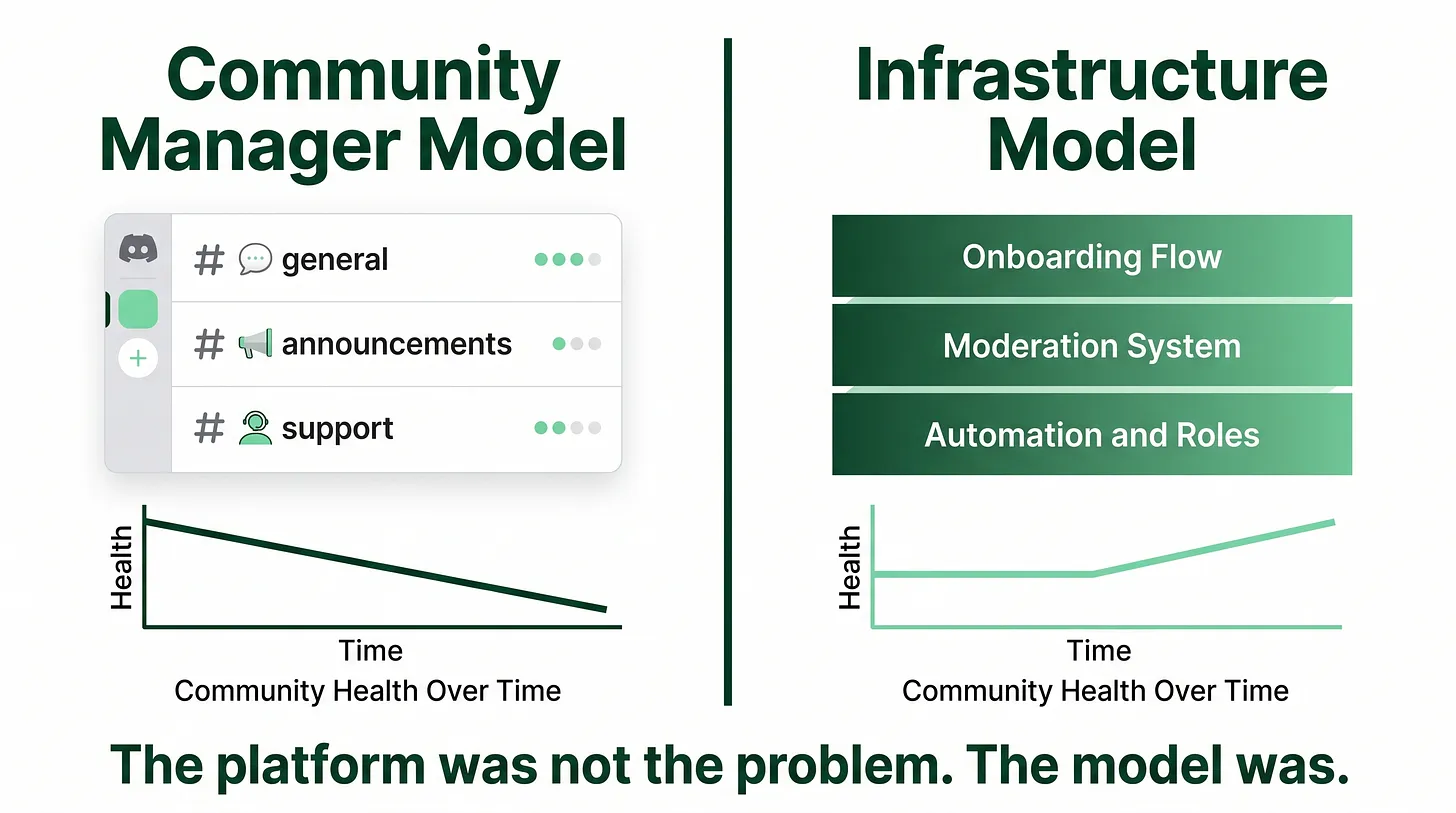 The founders who develop genuine resentment toward their Discord communities are not describing the platform when they talk about what went wrong. They are describing a staffing decision they made early on, usually under time pressure, usually without a clear sense of what they were actually hiring for.
The hire made sense at the time. The community needed someone. A community manager was brought on. That person was capable, visible, often well-liked by members. They posted regularly. They responded to questions. They kept the energy up during launches. And while they were doing all of that, nothing structural was being built underneath the activity.
No onboarding documentation. No moderation system with defined triggers and response protocols. No automation layer handling the work that does not require human judgment. No internal wiki a second operator could use to understand how the server works. The community existed as a pattern of daily individual behaviors rather than as a set of operational systems anyone could run.
The founders who develop genuine resentment toward their Discord communities are not describing the platform when they talk about what went wrong. They are describing a staffing decision they made early on, usually under time pressure, usually without a clear sense of what they were actually hiring for.
The hire made sense at the time. The community needed someone. A community manager was brought on. That person was capable, visible, often well-liked by members. They posted regularly. They responded to questions. They kept the energy up during launches. And while they were doing all of that, nothing structural was being built underneath the activity.
No onboarding documentation. No moderation system with defined triggers and response protocols. No automation layer handling the work that does not require human judgment. No internal wiki a second operator could use to understand how the server works. The community existed as a pattern of daily individual behaviors rather than as a set of operational systems anyone could run.
Why That Model Feels Fine Until It Doesn't
The person-based model is not obviously broken while the person is present and engaged. Activity looks healthy. Members are getting responses. The founder checks the server occasionally, sees movement, and moves on to other priorities. The failure mode is invisible until it triggers. The community manager gets a better offer. Personal circumstances change. Motivation drops and quality of engagement quietly declines before anyone notices. When the person leaves, the founder discovers there is nothing to hand off. No documentation. No automation logic written down anywhere. No onboarding flow that exists outside of that person's habits. The replacement hire spends the first month trying to understand what was happening before they arrived. Member quality during that period drops. Some of the most engaged members, the ones who had a personal relationship with the previous manager, quietly disengage. The community that looked healthy six months ago now requires rebuilding from a partial foundation. That is the pattern behind most of the PTSD-level descriptions I hear from founders. It was not one catastrophic failure. It was a slow erosion that only became visible when the person holding it together was no longer there.
What Discord Actually Requires
Discord is not a social media platform in the way most community managers have experience managing. It is an infrastructure platform with capabilities that require deliberate architectural decisions. Role-based access controls what different segments of your community can see and where they can engage. Invite links with attached role assignments allow you to track where members are coming from and deliver onboarding experiences tailored to each acquisition source. Automated triggers can handle moderation responses, flag content for human review, and move conversations to the appropriate channels before a team member has to intervene. Bot integrations can manage routine operational tasks that would otherwise consume significant staff time. None of these capabilities are optional at any meaningful scale. And none of them are running correctly in most Discord communities because the person hired to manage the community was hired to manage conversations, not to build and maintain operational infrastructure. The difference is significant. A conversation manager is good at the front-facing work: responding, moderating by hand, keeping the energy up. An infrastructure operator is good at the behind-the-scenes work: building the systems that make the front-facing work sustainable, transferable, and scalable. Most communities need both. Most communities are staffed for only the first.
The Onboarding System Problem
The most consistently underdeveloped area in Discord communities is onboarding. Not because teams do not understand that onboarding matters, but because it is easy to confuse activity with infrastructure. A community manager who personally greets every new member, answers their first questions, and guides them toward the relevant channels is doing real work. It also creates a system that breaks the moment that person is no longer available. The onboarding experience exists in their head and their habits, not in the server architecture. An onboarding system operates independently of who is working that day. New members arrive through a specific invite link, receive a role automatically, land in a welcome channel built for their audience type, see a structured first experience that connects to why they joined, and are guided toward their first meaningful action before a team member has to intervene. That system works at 2 AM on a Sunday. It works when the community manager is on vacation. It works when the team doubles or the server scales from ten thousand members to a hundred thousand. Building that system takes time upfront. It requires thinking through each acquisition source, designing role-based access for each audience type, writing welcome content that speaks to specific member contexts, and testing the flow from join to first engagement. Most community managers are not hired to do that work. Most founders do not know to ask for it.
The Moderation Infrastructure Gap
The second most consistently broken area is moderation. And the breakdown pattern is almost always the same. A community starts small enough that the community manager handles moderation by watching channels and responding when something surfaces. This works at a few hundred members. At a few thousand, the surface area becomes too large for reactive monitoring to cover. The community manager is managing multiple channels simultaneously, response time to moderation situations increases, and some issues pass without resolution. At ten thousand members, reactive moderation is not a viable strategy. The volume of activity is too high. The number of channels is too many. The window for intervention on a piece of negative content before it has been read by dozens of new members is too short. Moderation infrastructure changes the model. Automated phrase detection flags specific content patterns for immediate action or staff review. Escalating negativity gets routed to a private thread rather than sitting in a public channel drawing additional responses. Response libraries give any team member a documented framework for addressing the most common issues within minutes. Scheduled rule reminders during high-traffic hours maintain community standards visibly rather than relying on members to have read a rules channel they found once. This infrastructure does not eliminate the need for human judgment. It routes the situations that require human judgment to the team faster, with more context, and with less ambient damage in the meantime.
Building for Transfer
The practical test for whether a Discord community has infrastructure is simple: if the current community manager left tomorrow, how long would it take for the next person to be fully operational? In a person-based community, the answer is months. The new hire has to learn by observation and error. They have to rebuild relationships that the previous manager held personally. They have to figure out the unofficial rules and patterns that were never written down. In an infrastructure-based community, the answer is days. There is a documented onboarding flow they can read and then run. There is a moderation system with written protocols for the most common scenarios. There is automation handling the routine operational layer so the new person can focus on the judgment calls that actually require human presence. The server has been built for transfer, not just for the person currently running it. The founders who feel resentment toward their Discord are almost always describing the first model. They made a hire. The hire was a person, not a system. The person is gone, and nothing was left behind.
The Rebuild
Rebuilding a community that was constructed on individual effort rather than infrastructure is not the same as starting over. The audience is usually still there, in some form. The relationships are still real. The server still has history that matters to the members who have been around longest. What needs to be rebuilt is the operational layer underneath the activity. The onboarding documentation. The moderation protocols. The automation logic. The role structure. The internal wiki that tells any operator what the server is, how it works, and what decisions have been made and why. That work is not glamorous. It does not produce visible community activity. But it is the foundation that makes everything visible sustainable rather than fragile. The resentment founders feel toward their Discord is almost always a systems problem described as a platform problem. The platform performed exactly as it was set up to perform. The setup was never designed to outlast the person who built it. That is the actual problem. And it is fully solvable.
Daniel Jeong is a Discord infrastructure consultant who helps companies build community systems that scale without depending on any single person to hold them together. https://danieljeong.org