Most Community Managers Treat Discord Like Twitter With Channels. That Is a Structural Problem.
Platform logic that works for social media actively undermines community infrastructure. Here is the difference, and why it matters at scale.

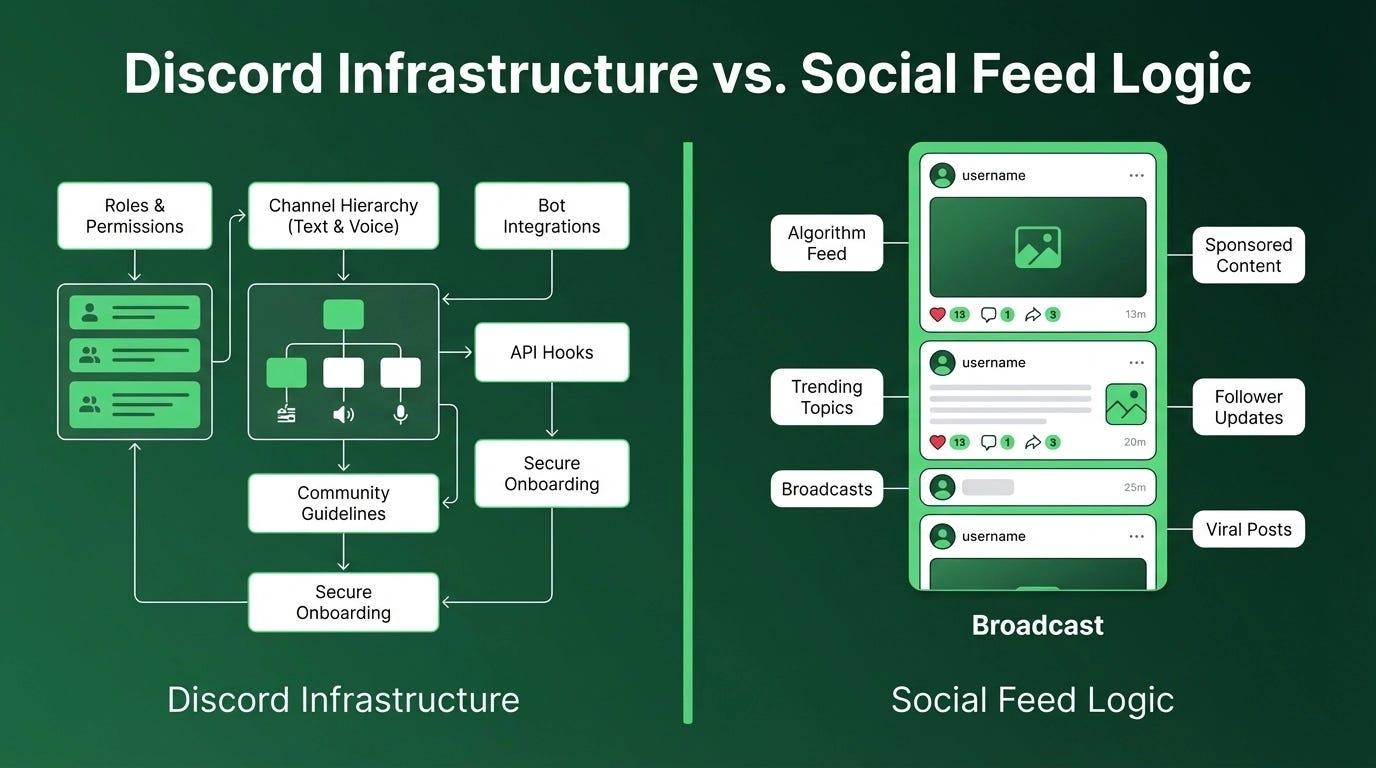
The Mental Model Problem
The most common issue I see in Discord communities that struggle is not a lack of effort. The people running them are often working hard, posting consistently, organizing events, and responding to members. The problem is that they are applying a mental model built for social media to a platform that operates on completely different logic. Twitter, Instagram, LinkedIn, and most social platforms are discovery tools. They have algorithms. They are built to push content to people who did not ask for it. Success on those platforms is partly about volume and consistency because the algorithm rewards activity and reaches people outside your existing audience. Discord does not work that way. There is no feed. There is no algorithm distributing your content to people outside the server. The people in your server chose to be there, and they stay or leave based entirely on what the experience feels like after they arrive. That is a fundamentally different operating environment, and it requires a fundamentally different approach.
What Broadcast Logic Looks Like on Discord
When a community manager applies social media thinking to Discord, the symptoms are recognizable. The announcement channel gets updated regularly. The general chat has daily posts from the team. There is content scheduled throughout the week and reminders for upcoming events posted in multiple channels. The server still feels quiet. Members join, look around, and leave. Engagement is low despite consistent output. The team cannot figure out why nobody is responding to posts that would perform reasonably well on LinkedIn or Instagram. The content calendar is not the problem. The problem is that Discord does not reward content calendars. It rewards structured environments. When a new member arrives on a social platform, the algorithm handles orientation by surfacing relevant content from accounts they follow. On Discord, there is no equivalent mechanism. A new member arrives and sees a list of channels. If those channels are not clearly organized, if there is no guided first step, if the environment does not immediately communicate what the person should do and where they belong, most of them leave without engaging. Operational data consistently shows that communities lose a significant portion of new members within the first 24 to 48 hours. Not because the community is bad. Because the arrival experience gave people no clear reason to stay and no obvious first action to take. That is an architecture problem, not a content problem.
What Infrastructure Logic Looks Like on Discord
Structural thinking starts before the server launches. It asks different questions than content planning does. Where does a new member land? What is the first channel they see, and what does it ask them to do? Is there a verification step, and what operational purpose does it serve? What information does a new member need in the first five minutes? How are questions routed to the right people? What happens when someone breaks the rules, and who handles it? These decisions shape the member experience at every scale. At 100 members, bad structure can be compensated for with personal attention and manual effort. At 1,000 members, the cracks begin to show. At 10,000 members, there is no longer enough personal attention available to patch a broken structure. The architecture either works on its own or it does not work at all. After working with servers that scaled to 1.7 million members, the clearest pattern in communities that reached significant size while maintaining strong engagement is this: the structure was designed before the growth happened. The channel hierarchy, the onboarding flow, the moderation logic, the support workflow, the engagement systems were not improvised in response to problems as they emerged. They were built anticipating the problems that come with scale. That is infrastructure thinking. It is the same approach an operations lead brings to a growing company. The systems matter before the headcount gets large, not after.
The Skills Gap Between Social Media and Community Infrastructure
This distinction matters when hiring because the skill sets genuinely differ. A skilled social media manager knows how to write platform-appropriate content, read analytics dashboards, maintain posting schedules, engage with comments, and adapt strategy as platforms change. These are real and valuable skills. They are not the same skills needed to design a Discord onboarding flow, architect a channel hierarchy for a 10,000-member server, configure a role-gating system, build a moderation infrastructure, or create support workflows that route questions appropriately. Those competencies come from operational thinking, not content thinking. Hiring someone because they use Discord regularly and are comfortable with the interface is understandable. It is also the source of most community manager failures at scale. Comfort with a platform as a user is not the same as understanding it as an operator. The gap between those two positions is where most hiring mistakes happen. Founders who have had damaging experiences with community managers often describe a similar pattern: the person hired was enthusiastic, responsive at first, and clearly engaged with the community. But when the server grew, or when a difficult moderation situation arose, or when the onboarding experience started producing drop-off at scale, there was no systematic response. There was only improvisation. That is what happens when a content mindset encounters an infrastructure problem.
What Strong Engagement Actually Requires
The industry standard for Discord community engagement sits around 1 to 2 percent of total members being active on a given day. Most servers operate at or below that baseline, not because their communities are uninterested, but because the environment was not built to retain people after their initial arrival. Servers that maintain 15% daily engagement rates are not publishing more content. They are operating with structured onboarding that gets members oriented quickly, channel architecture that remains navigable as the server grows, moderation systems that keep the environment consistent and trustworthy, and support infrastructure that answers questions before members give up and leave. Those outcomes come from systems, not schedules. Content fills the calendar. Structure builds the community.
What to Look For When Evaluating Community Management
If you are a founder evaluating a community manager for Discord, the most useful questions are not about their content strategy. They are about their operational approach. How would they structure the onboarding flow for your specific audience? What would happen in the first 48 hours after a new member joins? How would they design the channel hierarchy? What automation would they implement, and what would they handle manually? What does a healthy server look like at 500 members compared to 5,000? If the answers focus primarily on posting frequency, engagement tactics, and content themes, that is useful information. You are looking for someone who approaches Discord as an operator, not a publisher. Discord is a retention platform. It is not a discovery platform. The people running the strongest communities on it understand that distinction clearly, and it shapes every decision they make about how the server is built and maintained over time.
Daniel Jeong helps founders and operators build Discord community infrastructure that scales without depending on constant manual effort. Work with him at danieljeong.org. https://danieljeong.org