Giving Ambassadors a Role Is Not the Same as Giving Them a Purpose
Ambassador programs tend to stall not because the members are wrong but because the infrastructure was never built.

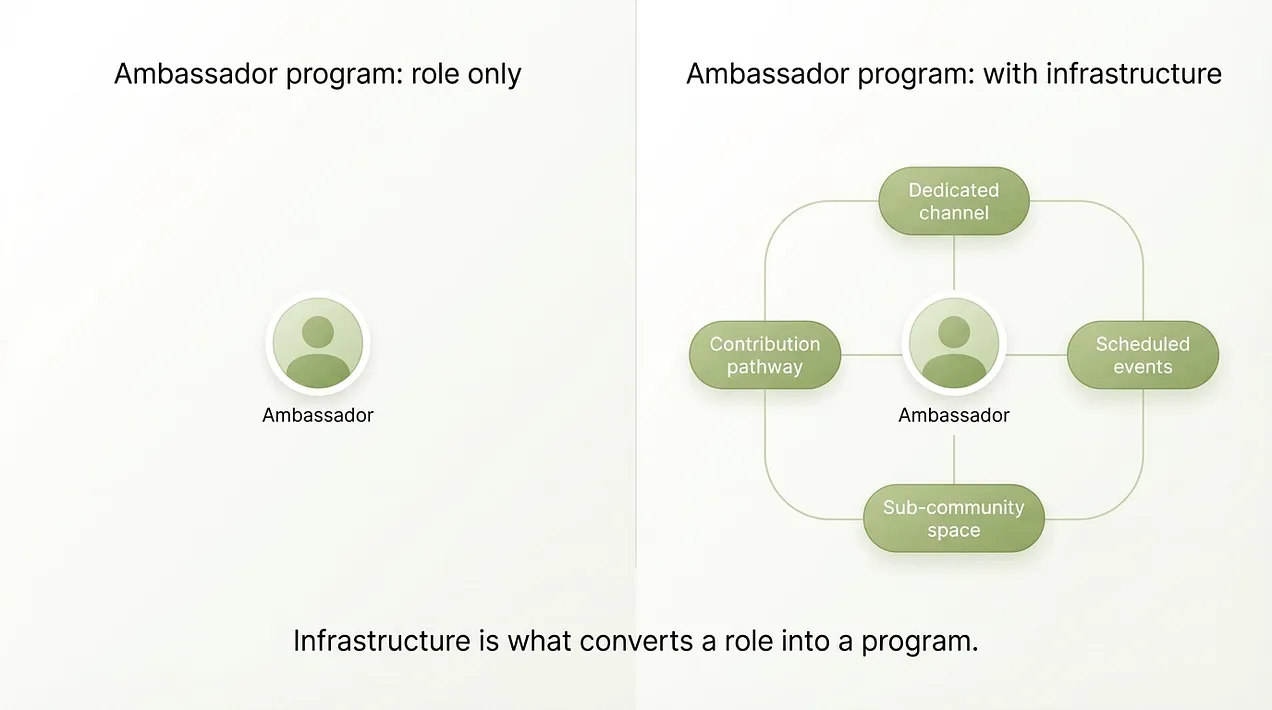
The Role Is Not the Program
Ambassador programs occupy an interesting position in community management thinking. Most community operators understand instinctively that identifying and supporting the most engaged members is important. These are the people who show up consistently, help newcomers find their way, post without being asked, and care about the community more than most members ever will. Giving these people a special role feels like a natural way to acknowledge that contribution. And it is. But the role is not the program. The role is the beginning of the conversation. The program is everything that follows. In most ambassador setups I have reviewed, the conversation ends at the role. The member receives their new designation, sees it appear in their profile, and then, nothing changes. They do not gain access to a space designed for them. They are not invited to events that involve them in a specific way. They do not receive a contribution pathway that converts their energy into visible community value. They have a new label and the same experience they had before.
What Committed Members Are Actually Offering
The members who become ambassadors are offering something rare in community contexts: intrinsic motivation. They did not join to get a role. They did not start posting because they expected a reward. They are doing it because they genuinely care about the community, the brand, or the purpose of the space. That kind of motivation is the most reliable foundation a community has. But intrinsic motivation has a specific relationship with infrastructure. When committed members are given space and structure to channel their energy, the results tend to be sustainable and self-maintaining. When they are left without structure, their energy often dissipates, not because it disappeared, but because there was no system to focus it. I have worked with communities where the ambassadors had been present for four or five years, consistently contributing, genuinely invested in the brand. And they were doing all of that without a dedicated channel, without events designed for them, without any formal system that connected their activity to the broader community goals. The program existed in name. It did not exist in practice.
The Subgroup Dynamic
One of the most consistent outcomes I have seen when ambassador programs are given actual infrastructure is the emergence of ambassador-led subgroups. When ambassadors have their own channel, their own events, and a contribution system that gives them visible ownership over something in the community, they often begin to build spaces within the server that take on a life of their own. These are not top-down initiatives. They grow because the person running them cares about them. The subgroups that emerge from this dynamic tend to be the most durable parts of a community. They do not require the same level of management that general channels do because the people running them are internally motivated. They run on the energy of members who are there because they chose to be. These subgroups also serve a function for the broader community that is difficult to replicate through any other mechanism. They provide a visible example to other members of what deep engagement with the community looks like. They create a pathway from casual member to invested participant.
Building the Infrastructure
What does a designed ambassador program actually require? At minimum, it needs a dedicated space. Ambassadors should have access to a channel or section of the community that is specifically theirs, a place where they communicate with each other and with the team running the community, separate from the general member experience. It needs events. Not events that ambassadors attend passively as audience members, but events where they have a role, hosting, contributing, moderating, representing. These events give the ambassador role a visible function in the community's ongoing operation. It needs a contribution pathway. A way for ambassadors to channel their energy into something specific, whether that is content creation, event hosting, peer support for new members, or feedback gathering. The pathway defines what being an ambassador means in practice, beyond the title. And it needs consistent contact. Regular communication from the community team to ambassadors, acknowledging their contributions, keeping them informed about where the community is going, and asking for their input. This is not time-intensive. But it signals that the program is active and that the team is paying attention.
The Retention Argument
There is a straightforward retention argument for investing in ambassador infrastructure. Ambassadors are the members most likely to stay for the long term regardless of program quality. They are already committed. But they are also influential within the community in ways that affect other members' decisions to stay or leave. When ambassadors are visibly invested, active, and thriving within the community, that signal reaches other members. The community feels alive and worth participating in at a level beyond casual browsing. When ambassadors are present but invisible, technically holding their roles but not doing anything with them because there is nothing designed for them to do, the signal is different. The program exists, but it does not seem to mean anything. The most committed members of a community are not a fixed resource. They can become more committed or less, depending on whether the environment supports their engagement. Infrastructure is what makes the difference. A role tells someone they are valued. Infrastructure gives them somewhere to take that value.
Daniel Jeong consults on Discord community infrastructure and operational systems for organizations building long-term community engagement strategies. https://danieljeong.org