Every Niche Has a Toxic Discord. Build the One That Isn't.
In almost every market, the competition for best-run Discord community is almost nonexistent. Here is why that is an advantage and how to use it.

The State of Most Niche Discord Communities
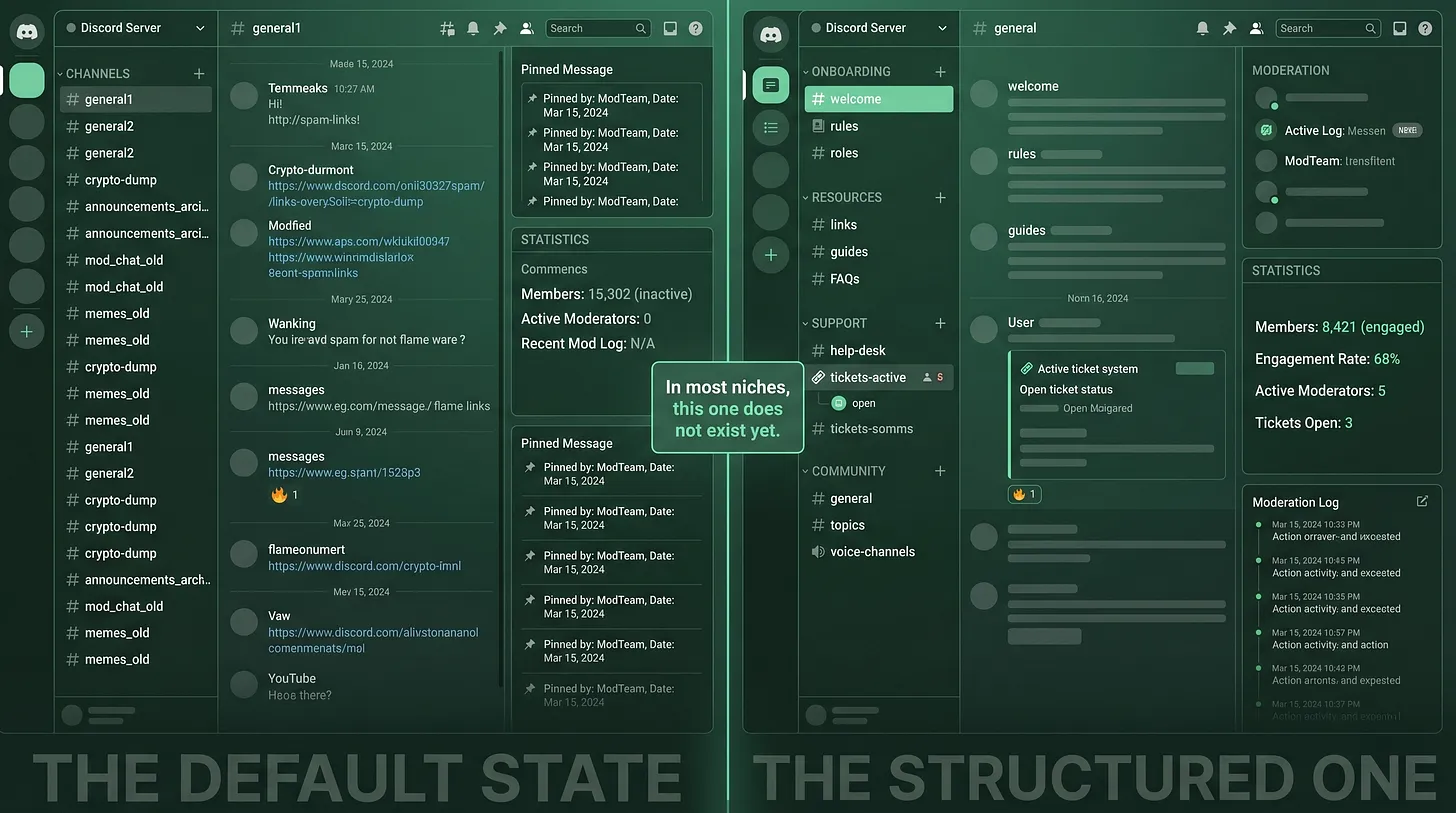
If you spend time inside Discord communities across different markets and niches, a pattern emerges that is both surprising and useful. The vast majority of servers, regardless of member count, are operating without meaningful infrastructure. This is not an exaggeration. Most Discord communities that appear active from the outside are functioning on the effort of one or two people, usually the server owner or a small mod team that has not yet burned out. The channel structure is whatever made sense when the server launched. The rules are generic and unenforced. The onboarding is a single welcome message that nobody reads. Support is answered whenever someone notices the question. When those one or two people have a bad week, go on vacation, or simply stop showing up with the same frequency, the server loses whatever quality it had. The members who were there for the energy of the early days drift away. What remains is an archive of past activity and a stream of new members joining to find a ghost town. This is the default state of Discord communities. Not malicious. Just undesigned.
Why This Is a Competitive Advantage
Understanding the state of most Discord communities in any given niche reveals something immediately actionable: the bar for being the best-run server in almost any market is remarkably low, and almost nobody is meeting it. Skincare communities on Discord are plagued by the same problems as gaming communities, creator communities, and crypto communities. Unmoderated arguments. Repeated questions with no documented answers. New members who join and find no clear path through the server. Teams that burn out because they are doing everything manually. The community that solves these problems, not through being the biggest or the most heavily promoted, but through being the most consistently well-run, occupies a distinct and defensible position. Members who have been inside chaotic servers recognize a structured one immediately. The difference is felt within the first few minutes. A clear welcome. A guided entry into the right channels. Questions that actually get answered. Moderation that handles problems without drama. These members stay. They come back. They tell people. Not because they were incentivized to, but because the experience was worth repeating.
What Makes a Discord Community Well-Run
The elements that distinguish a structured Discord community from a default one are not exotic. They are operational basics that most servers simply never implement. The first is a functional onboarding system. Members who arrive and have a clear, step-by-step path into the community are more likely to complete onboarding, find their relevant spaces, and stay engaged. This system does not need to be complex. It needs to be clear and consistent. The second is defined channel purpose. Every channel in a well-run server exists for a specific reason that members can understand. The channel list is not a collection of everything the server owner might want to discuss someday. It is a map of what the community actually does. The third is active moderation infrastructure. Not just a list of rules. Actual systems: a ticket channel, a reporting mechanism, a moderation log, and a team with clear responsibilities. Most servers post rules on day one and never build beyond that. The servers that maintain quality have moderation systems that continue to function whether or not any specific person is available. The fourth is documentation. A well-run server has answers to common questions somewhere that members can find. Not because members are expected to read documentation before asking, but because the team should not be answering the same question manually every week. These four elements do not require a large team or significant technical resources. They require operational thinking and the willingness to design the experience before the community grows large enough to make design impractical.
The Toxic Server as a Benchmark
One of the most instructive exercises for anyone building a Discord community is to spend time inside the most active existing server in their niche. This exercise is instructive not because it shows best practices, but because it almost always shows exactly what not to do. The moderation that never arrives. The channel filled with the same argument on a weekly cycle. The new member who joins, asks a question in the wrong channel, and never gets a response. The support inquiries that sit unanswered for days. The toxic server in any niche is a detailed outline of the operational gaps that the structured server can fill. Members inside these servers are not loyal to the server. They are there because it is the largest or most visible option available. The moment a better option exists, the members who care about quality will find it.
Building for the Long Term
The competitive advantage of a structured Discord community is not immediate. In the first weeks and months, the well-run server with 500 engaged members may not generate the same visible activity as the chaotic server with 10,000. Member count is a visible metric. Engagement quality is not. But over time, the difference compounds. The structured server builds a reputation that attracts the kind of members who make communities better. It develops the documentation and systems that allow it to scale without collapsing. It creates the environment where genuine relationships form, and those relationships produce the kind of organic growth that no amount of promotion can manufacture. The chaotic server, meanwhile, continues cycling through bursts of activity and long periods of decay. Its member count grows when promoted and shrinks when not. The team burns out, is replaced, burns out again. The comparison, drawn over any meaningful time horizon, is not close. In most niches, the community with real infrastructure does not yet exist. That is the opportunity. And the barrier to building it is operational thinking, not resources.
In most niches, the best-run Discord community has not been built yet. The competition for that position is smaller than it looks. https://danieljeong.org