Every Niche Has a Toxic Discord. Be the One That Isn't.
Most community servers are built without operational infrastructure. Here is why that creates a clear opportunity.

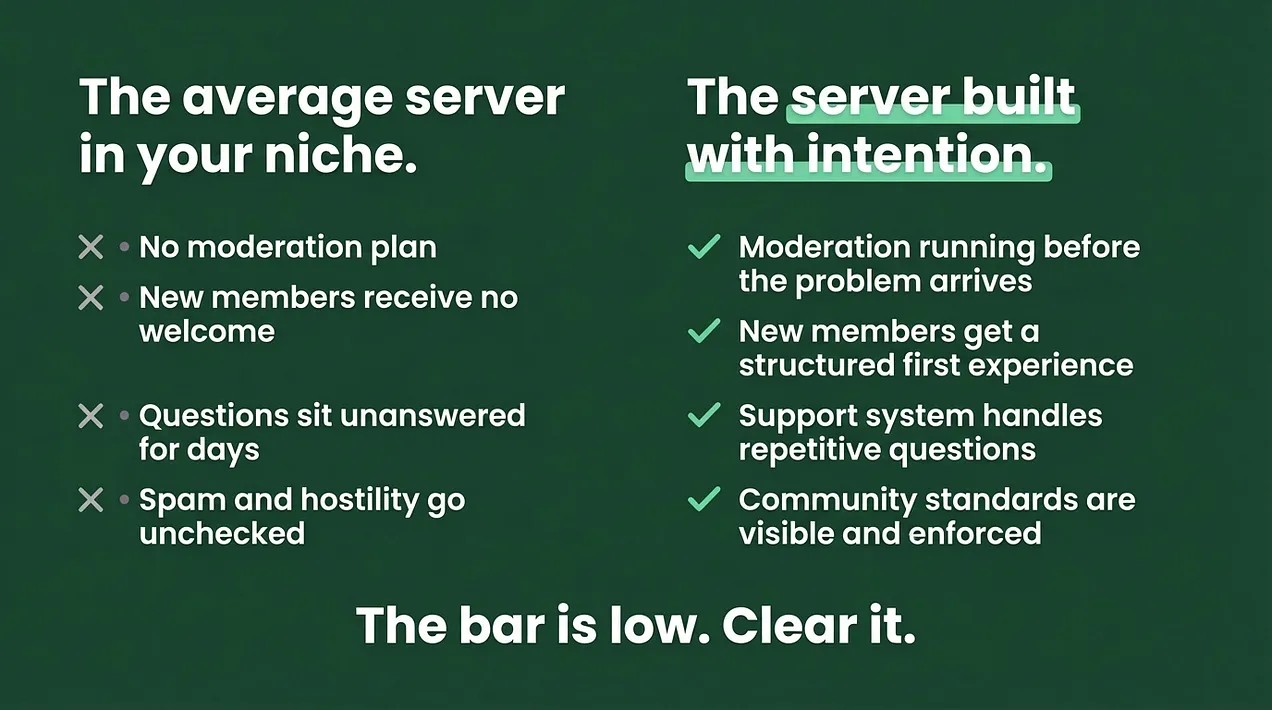
What most community servers actually look like
When I look at the Discord servers operating in a given niche, the pattern is consistent. Most of them were set up quickly, without a clear operational plan, and left to run without the infrastructure needed to maintain a quality experience as they grow. The signs are familiar. Spam posts that stayed up for days because no moderation system caught them and no team member was monitoring at the right time. Questions from new members that received no response at all, leaving those members uncertain about whether the community was even active. Conversations that turned hostile and stayed that way because there was no escalation process in place to address them before they escalated further. Channel structures that made reasonable sense when the server launched but became confusing as new channels were added without a governing architecture. None of this is typically the result of bad intentions. Most community owners genuinely want a good experience for their members. The problem is that a good experience does not happen on its own. It requires deliberate planning, functional systems, and consistent maintenance. Most servers were launched without those things in place.
What that means for anyone building in the same space
If the existing servers in your niche are disorganized or producing poor community experiences, that is useful strategic information. It tells you what the community members in your space have been experiencing and what they would notice if something were genuinely different. I was on a call with a founder planning a community in a competitive niche. The conversation turned to the Discord communities already operating in their category. The observation was consistent with what I see across different industries. Most of the existing servers did not have real operational systems behind them. You could see it in how new members were handled, how conversations developed without any moderation, and how the overall experience of being in the community did not match what the brand was communicating in its other channels. The founder's response was the right one. Not to build the biggest server in the space, but to build the one with the most trustworthy experience. Those are different goals, and the second one is often more achievable and more durable than the first.
The trust gap
Trust in a community context is built primarily through consistency. Consistent moderation. Consistent responses to new member questions. Consistent enforcement of the community standards that were visible when someone decided to join. When someone joins a Discord server and their first message gets a response, when the channel structure makes sense to them, when the community they were promised matches the experience they find on day one, they are meaningfully more likely to stay. More likely to participate over time. More likely to tell others about the community. When they join and receive nothing, or encounter spam and hostility that goes unaddressed, they leave. Often without saying anything. The server owner looks at the member count and sees people who joined and went silent, without understanding that the first experience was the determining factor. The servers that earn trust in a niche are not always the largest ones. They are the ones where the experience is predictable in the right ways. Where a new member knows what to expect because the community standards are clear and actually applied. Where a question asked in a public channel has a real chance of receiving a real response.
What infrastructure actually requires
The gap between a chaotic server and a well-run one is not primarily a resource gap. It is a planning and execution gap. Moderation infrastructure does not require a large team monitoring the server at all hours. It requires setting up automated moderation rules that catch common patterns before a human needs to step in, combined with a clear escalation process for situations that require judgment. The automated layer handles the volume. The human layer handles the exceptions. This division of responsibility is achievable for communities of almost any size. Onboarding infrastructure does not require someone available around the clock to personally welcome every new member. It requires a structured welcome flow that orients new members to the community's purpose, introduces them to the key channels, and gives them clear first steps. That flow runs automatically, regardless of when someone joins or who is online at that moment. Community standards infrastructure requires clearly documented expectations that are visible to members before and after they join, consistently enforced when they are violated, and revisited when patterns in member behavior indicate that the standards need updating. The documentation is not the hard part. The consistency is.
The competitive advantage of being the obvious choice
In almost every niche, there is room for one community that is clearly the most trustworthy option. The one where moderation actually works. The one where new members have a real first experience. The one where the standards posted at the entrance match the experience inside. Most spaces do not have that community yet. Not because no one has tried, but because operational infrastructure is less visible than audience size. A server with many members and no moderation system is more discoverable than a server with fewer members and a well-run experience. But it does not produce better outcomes for the people inside it, and over time those people notice. The server that earns trust in a niche does not need to win on scale first. It needs to win on experience. Members who feel safe in a community stay longer, participate more actively, and refer others in ways that members of chaotic servers do not. That organic retention compounds into growth that scale-first servers with poorly maintained interiors often cannot match over time.
Starting from the right question
The question is not how to build the biggest Discord server in your niche. It is how to build the one where members feel that the experience matches what was promised to them. That question has operational answers. What does the moderation system need to handle before problems escalate? What does the onboarding flow need to communicate so that new members feel oriented and included? What does the channel structure need to look like so members can navigate the community without confusion? Those answers are available before you have a large community. They are easier to implement before significant volume arrives than after. And most importantly, they are not being implemented by most of the other servers in your niche. That gap is the opportunity. The first server to close it captures something that others have given up through neglect: the trust of the members who have been looking for a community worth staying in.
*Daniel Jeong is a Discord infrastructure consultant helping companies build scalable community systems that function as core business assets. To learn more, visit *danieljeong.org https://danieljeong.org