Every Discord Event That Ends Without a Question Is a Wasted Event
How post-event feedback loops turn one-off gatherings into compounding engagement systems

The Five Minutes Nobody Uses
A Discord event wraps up. The speaker says their closing remarks. Members drop out of the voice channel one by one. A few people type "thanks" or "great session" in the text chat. The event channel activity peaks for about thirty seconds and then goes quiet. For most community operators, this is the end. The event is done. Check it off the list. Start thinking about the next one. But those five minutes immediately after the event ends are the most operationally valuable window in the entire event lifecycle. Members are still present. The experience is fresh. Their opinions are formed and accessible. If you ask them something right now, they will answer. Wait until tomorrow and you have lost half your potential respondents. Wait until next week and you will get almost nothing. The feedback window closes fast, and once it closes, the insights that would have improved your next event are gone.
Why Feedback Does Not Happen Organically
Some operators assume that if members have thoughts about an event, they will share them. This is not how most people behave in community spaces. Members will share praise easily because it is socially comfortable. A quick "thanks" or "loved it" requires no vulnerability and creates no risk of seeming critical. Constructive feedback is different. Telling someone that the pacing was off, that the topic was too basic, or that the time slot does not work requires a level of directness that most community members will avoid unless specifically invited to share. They do not want to seem ungrateful. They do not want to be the one negative voice in a chat full of praise. This is why post-event feedback needs to be structured and prompted. You cannot rely on organic sharing. You need to create a specific moment, with specific questions, that gives members explicit permission to tell you the truth.
The Three Question Framework
Keep it simple. Three questions posted in the event channel within two minutes of the event ending. The questions should be open-ended enough to capture diverse responses but specific enough to generate actionable data. Question one: What was your main takeaway from today's event? This surfaces what resonated. It tells you which parts of the content connected with your audience. Over multiple events, patterns emerge. You learn which topics generate substantive takeaways and which ones produce vague responses that indicate low engagement. Question two: What would you change about this event? This is the constructive feedback question. It invites specific criticism in a structured way. Members who would never volunteer a complaint will answer a direct question about improvement. The framing matters. "What would you change" feels constructive. "What did you not like" feels negative. The same information gets surfaced with better framing. Question three: What topic should we cover next? This is forward-looking. It shifts the conversation from evaluation to anticipation. Members who answer this question are implicitly committing to attend future events. They have a stake in what comes next because they helped shape it. These three questions take less than a minute to type and post. The return on that minute is outsized.
Timing Is the Entire Strategy
The effectiveness of post-event feedback is almost entirely determined by timing. The same three questions posted at different times produce dramatically different results. Posted within two minutes of the event ending: response rates typically range from twenty to forty percent of attendees. Members are still in the channel. They have not context-switched to other tasks. The experience is immediate and their opinions are clear. Posted one hour later: response rates drop to five to fifteen percent. Members have moved on. They are in other conversations, other tasks, other parts of their day. Coming back to an event channel to provide feedback requires a deliberate choice, and most people will not make it. Posted the next day: response rates drop below five percent. The event is now a memory rather than a fresh experience. Feedback becomes generic. "It was good" replaces the specific, actionable observations that immediate responses provide. Posted as a follow-up survey link in a separate channel: response rates approach zero for most communities. The friction of clicking a link, opening a form, and typing responses in a different context is too high for the perceived value of sharing feedback. The lesson is straightforward. Post the questions in the event channel. Post them immediately. Do not wait, do not use external tools, and do not assume members will find a survey on their own.
Turning Feedback Into Operational Data
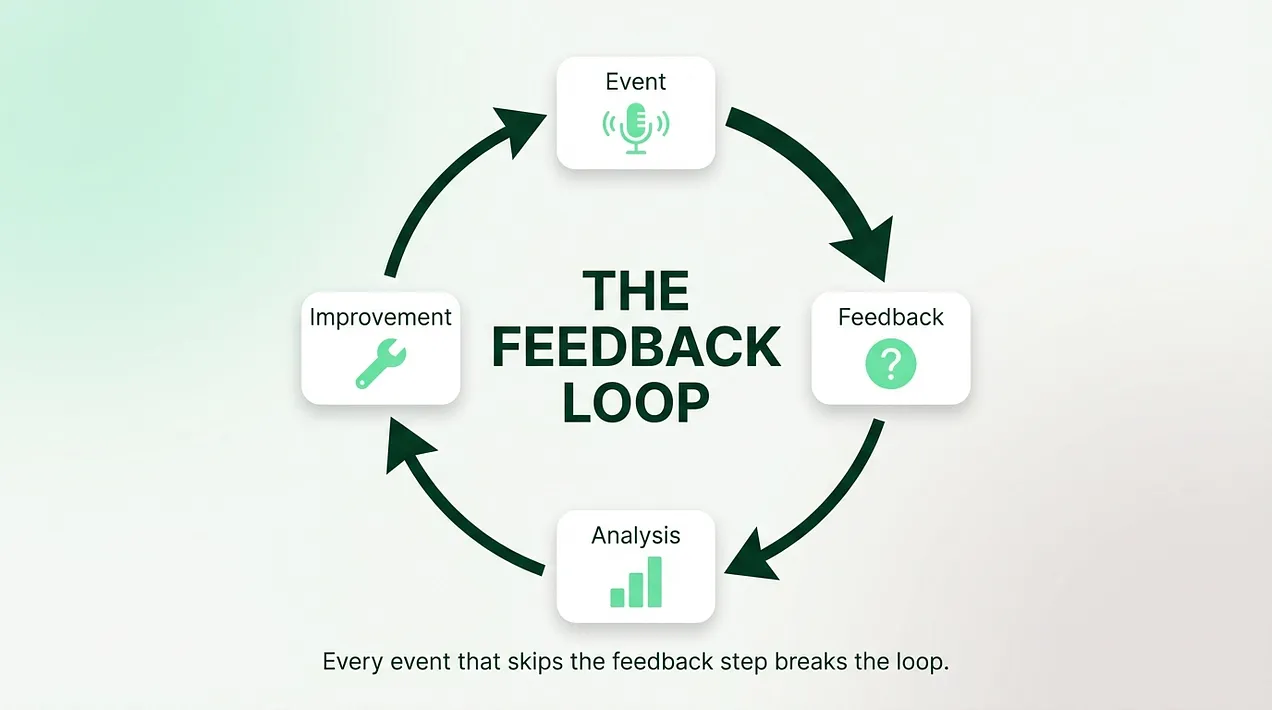
Raw feedback has limited value. The power emerges when you track responses across multiple events and identify patterns. Create a simple tracking system. After each event, review the feedback responses and log key themes. Which topics generated the most enthusiastic takeaways? Which format complaints appeared more than once? Which topic suggestions got multiple mentions? Which time slots drew praise or criticism? Over five to ten events, this data reveals your community's actual preferences with a clarity that intuition alone cannot provide. You stop guessing which speakers your members want to hear from. You stop guessing which formats work best. You stop guessing which day of the week draws the highest attendance. The data tells you. This is the compounding effect. Each event's feedback improves the next event by a small margin. Over months, those small improvements accumulate into an event program that consistently delivers what members want. Attendance stabilizes. Engagement during events increases. Post-event feedback becomes more specific and useful because members see that their input actually shapes future events.
The Feedback Loop as a Retention Mechanism
There is a secondary effect that most operators do not anticipate. When members provide feedback and then see their suggestions reflected in future events, their relationship with the community deepens. They feel ownership. They feel heard. They feel like the community responds to their input rather than operating on autopilot. This feeling of influence is one of the strongest retention mechanisms in community operations. Members who believe their voice matters stay longer, participate more actively, and recruit others. Members who feel like passive consumers of pre-planned content eventually drift away. The feedback loop creates this feeling of influence at scale. You do not need to implement every suggestion. You need to implement enough of them, visibly enough, that members can draw the connection between their feedback and the community's evolution. A simple acknowledgment goes a long way. "Several of you asked for a session on advanced API design after our last event. Here it is." That sentence closes the loop. It tells members that their feedback was read, considered, and acted on. The next time you post feedback questions, response rates will be higher because members have evidence that responding matters.
Common Mistakes in Event Feedback
The most common mistake is asking too many questions. A five-question feedback form feels like homework. Three questions feels like a conversation. Keep it to three or fewer. The second most common mistake is asking closed-ended questions. "Did you enjoy the event? Yes/No" generates a data point with almost no operational value. You learn that seventy percent of respondents said yes. You do not learn what specifically they enjoyed, what they would change, or what they want next. The third mistake is posting feedback questions in a different channel than where the event happened. Members who just attended an event in the events channel should not have to navigate to a feedback channel to share their thoughts. Meet them where they already are. The fourth mistake is inconsistency. Posting feedback questions after some events but not others creates an unpredictable pattern. Members do not develop the habit of sharing feedback because the prompt is not reliably there. Every event should end with the same three questions, posted in the same place, at the same time relative to the event ending.
Building the Habit
Consistency transforms post-event feedback from an occasional data collection exercise into a community habit. When members attend multiple events and see the same three questions appear at the end of each one, they start expecting the prompt. Some will begin formulating their responses during the event itself. This habit benefits both sides. Operators get increasingly specific and thoughtful feedback because members have practice articulating their reactions. Members get increasingly responsive programming because operators have a growing dataset of preferences and suggestions to work from. The habit also sets a cultural expectation. New members who attend their first event see existing members responding to feedback questions and understand that this community values input. They are more likely to participate in the feedback process from their first event because the behavior is modeled by others. Over time, the feedback prompt becomes as much a part of the event experience as the content itself. The event is not over when the speaker stops talking. The event is over when the community has reflected on what it just experienced together.
Events as Systems, Not Occurrences
The difference between a community that runs events and a community that runs an event program is the feedback loop. Events without feedback are isolated occurrences. Each one starts from scratch. The operator guesses at topics, formats, and timing based on intuition and anecdotal comments. Events with feedback are nodes in a system. Each one generates data that informs the next. The system improves with every iteration. Topics get more relevant. Formats get more engaging. Timing gets more convenient. Attendance patterns become predictable. The event program develops its own momentum. That momentum is what turns events from a resource drain into a retention engine. Members come back because each event is better than the last one. Each event is better than the last one because feedback told you exactly what to improve. The whole system starts with three questions posted in a channel five minutes after the event ends. That is the infrastructure. Everything else builds from there.
Daniel Jeong is a Discord systems architect and community operations strategist who builds event infrastructure that compounds with every session. https://danieljeong.org