Early-Stage Communities Need Office Hours More Than They Need Channels
Why passive channel structures fail at early stage, and how scheduled guided conversations do the work that channels cannot

 The most common mistake early-stage companies make with Discord is building their community infrastructure around the features Discord provides rather than around the problem they actually have.
Discord provides channels, roles, bots, and voice rooms. Most early-stage communities get a full set of all four, organized thoughtfully, launched carefully, and then sit mostly empty. The team assumes engagement will follow once the structure is right. It does not.
The real problem at early stage is not infrastructure. It is that the product is still being explained. Members who join do not fully understand what they have signed up for. They have questions they are not sure how to ask. They are evaluating whether the investment of engagement is worth it. A passive channel structure is the worst possible format for this situation.
The most common mistake early-stage companies make with Discord is building their community infrastructure around the features Discord provides rather than around the problem they actually have.
Discord provides channels, roles, bots, and voice rooms. Most early-stage communities get a full set of all four, organized thoughtfully, launched carefully, and then sit mostly empty. The team assumes engagement will follow once the structure is right. It does not.
The real problem at early stage is not infrastructure. It is that the product is still being explained. Members who join do not fully understand what they have signed up for. They have questions they are not sure how to ask. They are evaluating whether the investment of engagement is worth it. A passive channel structure is the worst possible format for this situation.
Why Channels Fail at Early Stage
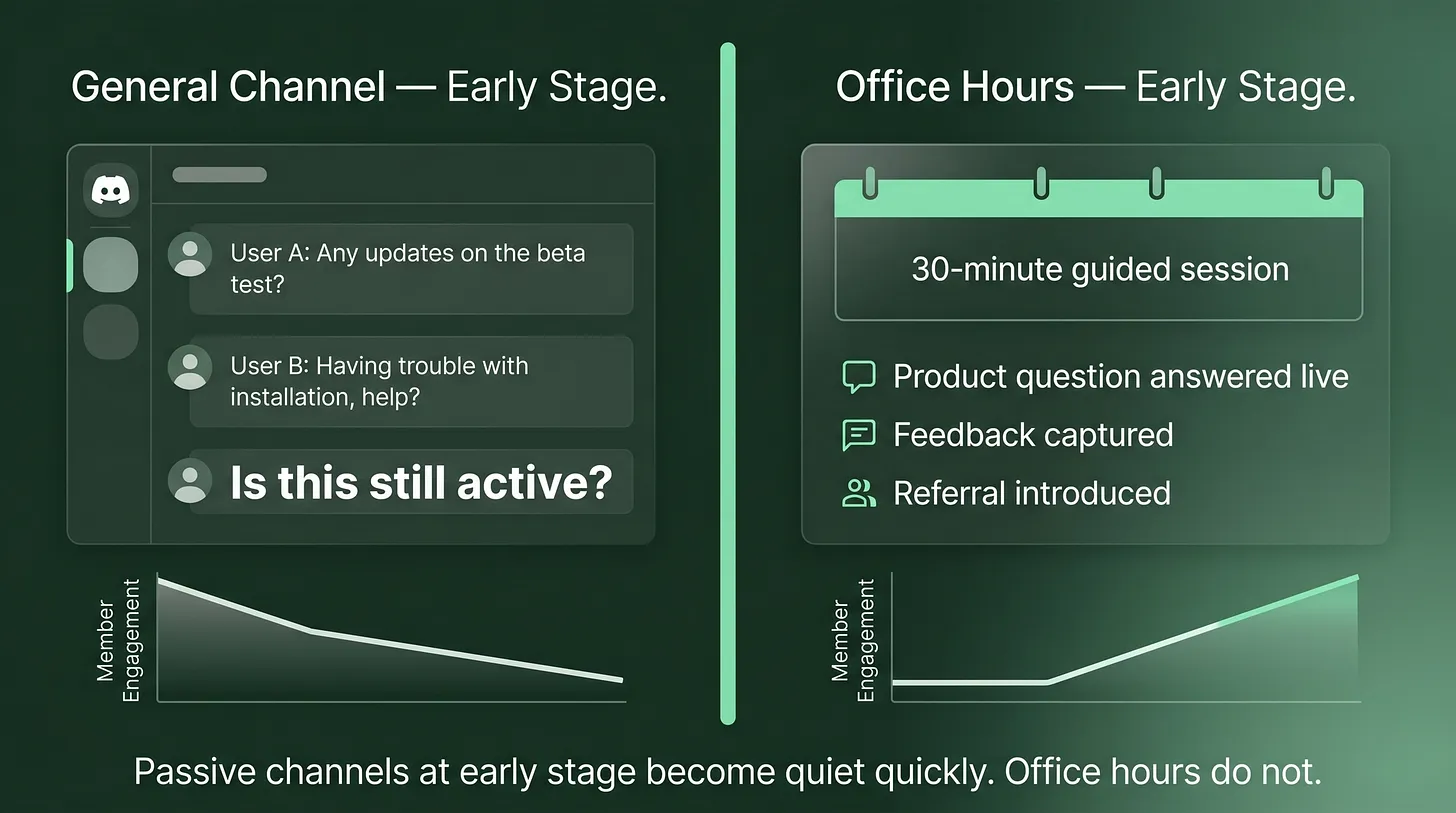
A channel is a persistent, asynchronous, public space. It works well when members already understand the product well enough to have specific questions, when there is enough ambient activity that new messages get fast responses, and when members have a reason to return regularly. Early-stage communities typically have none of those conditions. Members do not understand the product well enough to ask specific questions. They have general confusion and mild curiosity. They post vague questions that are hard to answer without knowing more about their specific context. When those questions go unanswered for hours, the member concludes the community is not active and stops checking. The channel that was supposed to build community instead trains members that the community is not responsive. The team, watching low engagement metrics, tries fixing the channel structure or adding more bots. Neither addresses the actual problem. There is also a signal problem. The questions members post in early-stage channels are usually not the questions you need answered to improve your product. They are the questions that make it to the keyboard. The questions that do not make it to the keyboard — the confused observations, the half-formed use cases, the moments where someone almost understands the product and then loses the thread — are often more valuable. You can only access those in a live conversation.
What Office Hours Do Instead
Office hours are a scheduled, structured conversation format. You announce a time. Members opt in. You spend thirty to sixty minutes in a voice channel or video call guiding members through the product, answering questions in real time, and asking your own questions about how members are using or thinking about what you have built. The format works at early stage for several reasons. First, it removes the passive waiting dynamic. Members do not need to guess whether someone is available. There is a scheduled time. They know they will get a live response to whatever they bring. Second, it creates a guided experience. Rather than asking members to figure out the product in an empty channel, you walk them through it. You control the order of information. You ensure they see the parts of the product that demonstrate the most value. Members who experience the product with good guidance form a significantly better impression than members who explore it alone and get stuck on something the team considers minor. Third, it generates useful signal. The questions members ask in a live guided session are more specific and more actionable than the questions they post in channels. You learn what is actually confusing, what terminology is not landing, what use cases members are trying to accomplish, and what the product would need to do for them to recommend it to someone else. That feedback directly improves your product and your messaging in ways that channel data rarely does. Fourth, it surfaces connections you would not find otherwise. In a thirty-minute office hour, a member may mention a colleague, a community, or a use case that opens a door the team had not considered. In a channel, that conversation never happens because the depth required to get there is never reached.
The Office Hours Infrastructure
Running office hours inside a Discord community requires three things. A scheduled event using Discord's built-in Events feature, with a description that is specific about what the session covers and who should attend. Generic language about coming to chat produces low attendance. Specific language about what the session is for — guided demo, product walkthrough, feedback session, Q&A for a specific use case — produces the right attendees. An announcement in the most active channel or announcements section, set to notify members. The announcement should be made at least 24 hours in advance and repeated closer to the session time. Members who missed the first announcement often see the second. A simple post-session note that captures the feedback, names, and action items from the conversation. This note does not need to be elaborate. It needs to be written down immediately after the session. The information gathered in a good office hour session dissipates quickly if it is not recorded. The product team, the marketing team, and the community manager all benefit from that record.
The Frequency That Works
For most early-stage communities, one office hour per week is the right cadence. Enough to create a regular touchpoint that members can plan around. Not so frequent that it becomes a burden to prepare for. The format should be kept simple: open questions for the first ten minutes, a guided walkthrough or demo for the middle portion, and deliberate feedback collection for the last segment. Questions like "What were you hoping the product would do that it did not?" and "Who else do you know who would find this useful?" extract more value per minute than any passive channel interaction. After several sessions, patterns emerge. The same confusions surface repeatedly. The same use cases come up from different members. Those patterns are the product team's roadmap and the marketing team's messaging brief, surfaced faster and more specifically than surveys or analytics alone would produce.
When to Transition to Channels
Office hours are not the permanent structure for a mature community. They are the correct structure for a community that is earlier than most teams admit. The transition point is when you have members who understand the product well enough to answer each other's questions. When the community generates peer-to-peer knowledge sharing without team facilitation, passive channels start working. They have enough ambient activity to feel responsive. New members join and find existing conversations that are relevant to their questions. Until that point, the team is the community. Office hours put that reality to work rather than trying to work around it with channel structures and automation. Most early-stage communities would move faster if they acknowledged this directly. The temptation to build out a full channel structure before the community is ready for it produces servers that look complete and feel empty. One scheduled office hour per week, for the first three months, does more for member retention, product development, and word-of-mouth than any amount of channel optimization. Build the infrastructure. Then fill it with the people who understand what they are joining.
Daniel Jeong is a Discord infrastructure consultant helping early-stage companies build community formats that match where they actually are in their product development. https://danieljeong.org