Discord Is Not Where You Find Your Audience. It Is Where You Keep Them.
The platform misunderstanding that causes most Discord communities to underperform, and what changes when you build for retention instead of reach.

The Most Common Discord Misunderstanding
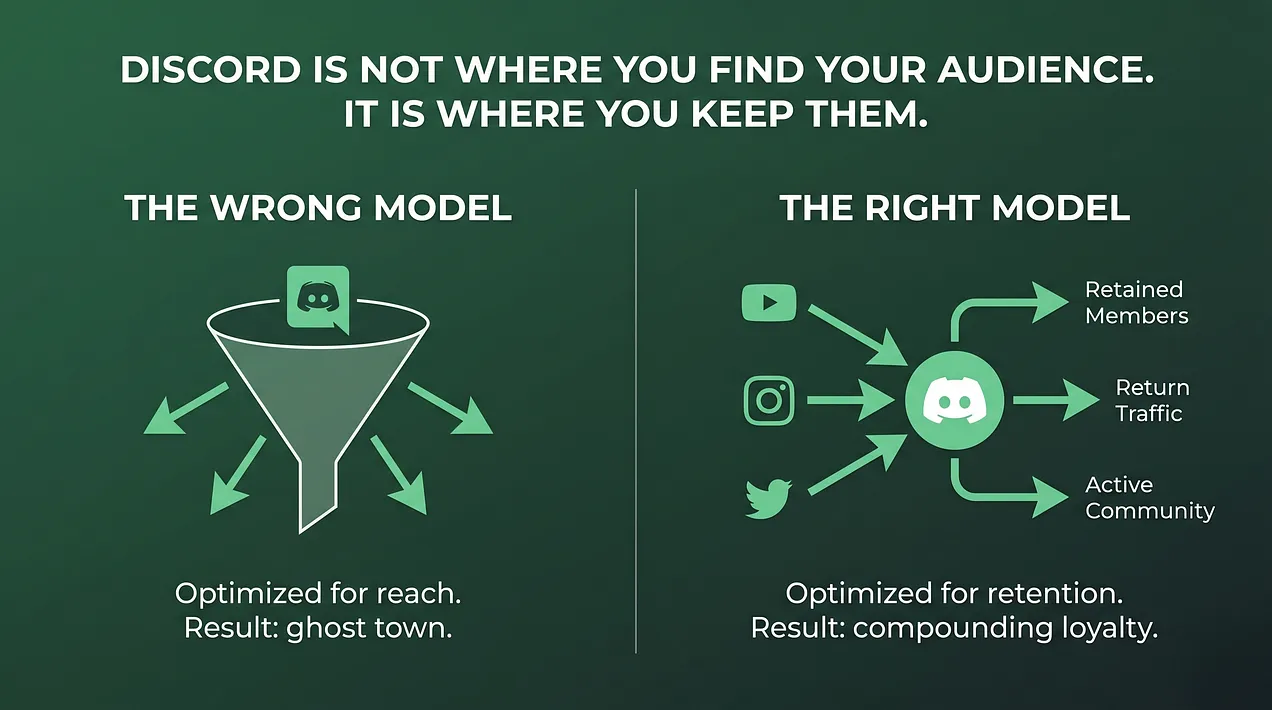
When a founder or marketing team decides to build a Discord community, the goal is usually growth. More audience. More reach. A new channel to find people who have not yet discovered the brand or product. This is the wrong goal for Discord, and it is the reason so many Discord communities underperform. Discord is not a discovery platform. There is almost no organic mechanism by which someone finds a Discord server who was not already looking for it or already connected to the community that runs it. People do not scroll Discord the way they scroll Instagram or TikTok. They do not stumble across servers in a feed. They join Discord communities because someone they already follow, already trust, or already purchased from directed them there. The implication of this is significant. If you build your Discord server as if it is an acquisition channel, you will measure the wrong things, build the wrong structure, and spend resources on the wrong problems. If you build it as a retention engine, designed to deepen the relationship with people who already know you, the entire design logic changes.
What Retention Infrastructure Looks Like
A Discord community built for retention looks different from one built for growth. The channel structure is not designed to impress visitors. It is designed to serve members who are already invested. The onboarding flow is not optimized for volume. It is optimized for depth. The goal is not to get as many people through the door as quickly as possible. It is to make sure that every person who arrives understands what the community is for and how to use it. The content and conversation inside the server is not marketing copy. It is genuine interaction between members who have a shared context. Events exist to create value for people who are already present, not to attract people who are not yet members. This is what makes a Discord community durable. Not the member count. The quality of the experience for people who are already there.
Discord as a Traffic Engine
One of the less obvious properties of a well-built Discord community is that it sends traffic outward as well as inward. When members are genuinely engaged, they carry their experience with them. They mention the community in other platforms. They share content from the server. They bring in people from their own networks. This dynamic was observable in a real pattern seen across technology-facing communities. A looksmax app built a structured Discord community that became deeply embedded in the daily habits of its members. Over time, that community began contributing traffic back to the application's website. The number was not trivial. Twenty percent of 800,000 monthly website visits originated from the Discord community. This is not a fluke. It is what happens when a community is built as a retention layer and operates well enough that members become active participants rather than passive audience members. The return traffic is a byproduct of genuine engagement. Most founders who are building Discord communities are not measuring this. They are measuring member count and daily active users. These metrics are useful but incomplete. A small, highly engaged community can drive more meaningful outcomes than a large, inactive one.
Why the Build Logic Matters
The decision about whether Discord is a growth channel or a retention channel is not just a positioning decision. It determines the entire design of the server. If you believe Discord is a discovery platform, you build a server that is optimized for first impressions. Wide channel list. Public-facing content. Marketing messaging. Invite links in every outreach campaign. If you understand Discord as a retention platform, you build a server that is optimized for ongoing value. Structured onboarding that gets members to the right place quickly. Clear channel purpose that reduces friction. Systems that support regular engagement over time. Moderation infrastructure that maintains quality as the community grows. The second model is harder to build. It requires more operational thinking. But it is the one that produces communities that actually function.
The Audience You Already Have
For most brands, startups, and creators considering a Discord community, the right starting audience is not new. It is the audience that already exists. The newsletter subscribers. The social media followers. The existing customers. The people who have already demonstrated some level of interest or trust. This audience does not need to be convinced to pay attention. They already do. What they need is a better place to deepen their relationship with the brand, product, or community of people around it. Discord, built correctly, is that place. It is a structured environment where existing relationships become more durable. Where questions get answered. Where feedback loops operate faster than on any public platform. Where members become advocates not because they were incentivized to but because the experience was genuinely good. The founders who understand this stop asking how to grow their Discord. They start asking how to make the experience inside their Discord good enough that growth becomes a natural side effect.
Building the Retention Layer
There are four operational elements that determine whether a Discord community functions as genuine retention infrastructure. The first is onboarding quality. A member who arrives and immediately understands what the community is for, where to go, and what to do is far more likely to stay engaged than one who arrives to a disorganized server and has to figure everything out alone. Onboarding is the first experience. It sets the pattern for everything that follows. The second is channel clarity. A server with thirty channels and no clear purpose for any of them is not a community. It is a list of rooms nobody knows how to use. Channel structure should be designed around what members actually do, not what the server owner wishes they would do. The third is response quality. Discord communities that maintain engagement have systems for ensuring that questions get answered, conversations get followed up, and members who contribute feel seen. This is partially about team availability and partially about automation that catches the gaps. The fourth is consistency over time. The communities that sustain engagement are the ones that show up regularly, deliver ongoing value, and do not collapse after the initial launch energy fades. This requires operational systems that do not depend on any single person's availability or enthusiasm. Built around these four elements, a Discord community becomes something that members return to because it is genuinely useful, not because they were reminded to. That is the retention layer worth building.
The communities that outlast their launch do not keep members through novelty. They keep them through design. https://danieljeong.org