26,000 Members and Nobody Talking: What a Large Community Without Structure Actually Looks Like
Member counts measure how many people pressed a button. They do not measure whether anyone belongs.

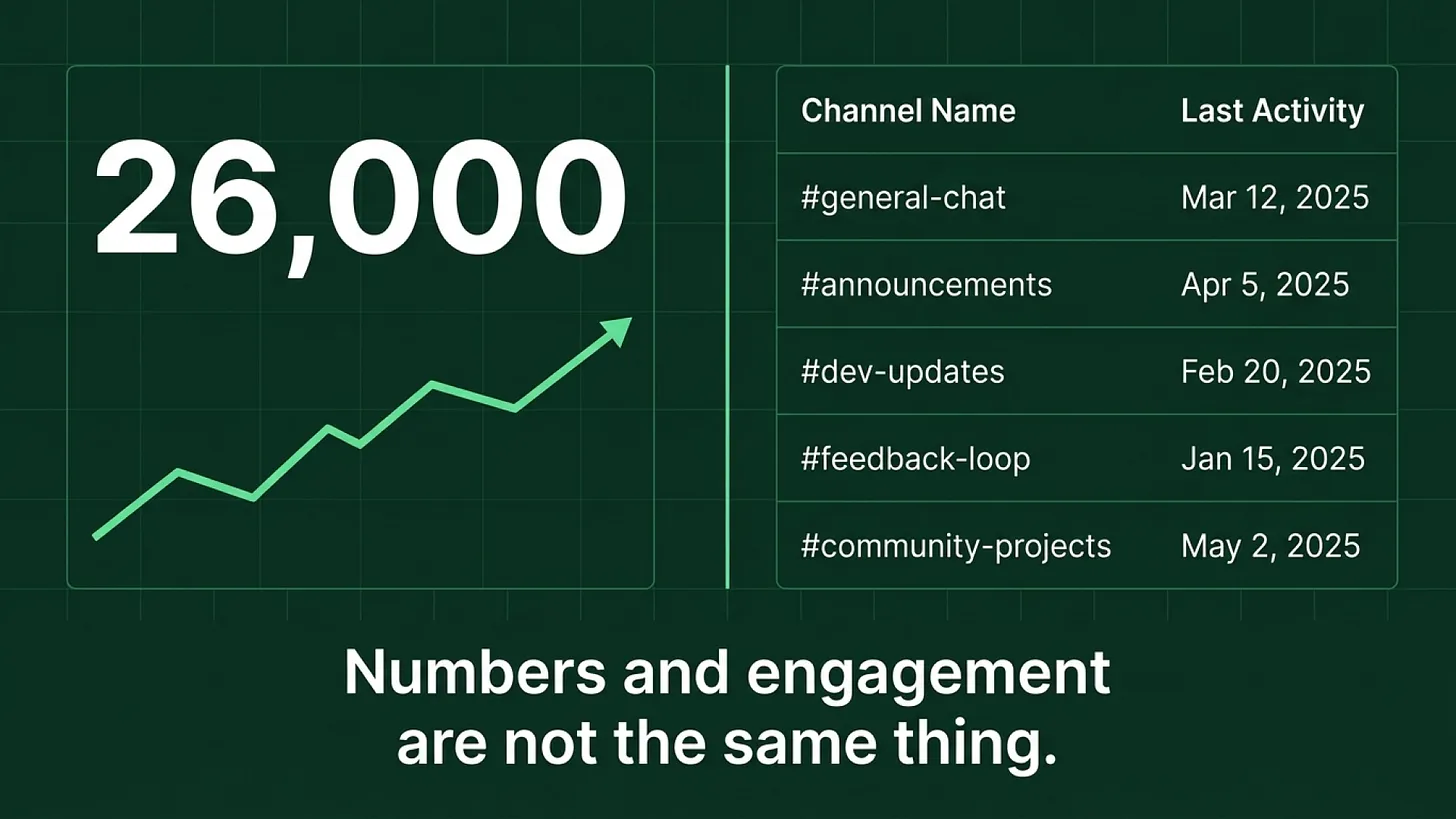
The Number Went Up. Nothing Else Did.
There is a specific kind of frustration that sets in when you look at a community platform that has tens of thousands of members and realize almost none of them are doing anything. The member count climbed. Notifications about new joins came through regularly. The dashboard showed growth. And then you scroll through the channels, look at the actual conversation history, and find post after post from months ago with no replies. This is not an unusual situation. It is one of the most common patterns in communities that were built around growth metrics rather than engagement design. A Facebook group I reviewed during a client engagement had more than 26,000 members. People were still joining. The brand had a genuine following, real customers who cared about the product. But the last meaningful conversation in the group had taken place almost two months before I looked at it. Posts went up from the company. Nobody responded. Members occasionally asked questions. Nobody answered them. New people joined, scrolled through a few weeks of silence, and left without posting anything. The group existed. The community did not.
What a List Looks Like
When a platform has tens of thousands of members but no active conversation, it is functioning as a list, not as a community. A list is a collection of people who, at some point, expressed enough interest to press a button. They clicked Join. They accepted an invite. They signed up through a form. That action means something. It is a signal of interest. But interest is not engagement, and engagement is not community. The difference matters because lists and communities serve different functions. A list can be broadcast to. You can push information at it. But a list does not create conversation, resolve customer concerns, build relationships between members, or generate the kind of peer-to-peer trust that keeps people connected to a product long after the initial excitement fades. A community does all of those things. But only if it is designed to.
Why Large Communities Go Silent
Communities do not go silent because people lose interest. They go silent because the design never gave people a reason to talk. When a new member joins a group and sees that the last message was from three weeks ago, the signal they receive is that this is not a place where people talk. So they do not talk. The silence reinforces itself. Every new member who arrives and sees nothing happening makes the same calculation and says nothing. This is not a content problem. Posting more often does not solve structural silence. It just adds more unanswered posts to the feed. The underlying issue is that the community was built as a place to broadcast rather than a place to participate. The channels or posts that exist are organized around what the company wants to say, not around what members want to do or discuss. There is no clear first action for new members. There is no reason to return after the first visit. There is no system that rewards or acknowledges participation. In the absence of structure, the default behavior is silence.
What Actually Creates Engagement
Engagement does not happen automatically when people join a space. It happens when the design of that space makes participation feel easy, worthwhile, and low-risk. That means a few specific things. First, new members need to know immediately what to do. The first thing they see when they arrive should answer two questions: what is this place, and what should I do right now. A video that explains the community purpose, a single clear prompt to introduce themselves, or a pinned guide to the most valuable channels reduces the friction of that first action dramatically. Second, the community needs active signals that it is alive. When new members see recent conversations, active posts, and replies from other members and from the brand, they understand that this is a place where things happen. Those signals make participation feel less like shouting into a void. Third, participation needs to produce a visible outcome. When a member asks a question and gets a thoughtful response quickly, they learn that this community is worth coming back to. When contributions go unacknowledged, members learn the opposite. None of this requires a large team. It requires design. It requires intentionality about what the space is for and what experience members will have when they arrive.
The Cost of Confusing Size With Health
The organizations that treat member counts as a proxy for community health tend to underinvest in the things that actually make communities work. They see the number going up and interpret that as a signal that the strategy is working. They do not look at active participation rates, at conversation volume, at how many members return after their first visit, at whether questions are being answered within a reasonable window. They look at the count and feel reassured. This produces a specific kind of drift where the community platform becomes a vanity metric while the actual work of community building goes undone. And eventually, when leadership asks why the community is not driving the results that were promised — more retention, more referrals, more product engagement — there is no good answer, because the community was never actually built. A community is not a member count. It is a system. And like any system, it produces results only when it is designed and maintained.
What to Do With a Silent Community
If you have a community platform with a large membership and very little activity, the first thing to do is stop treating the size as an asset. The 26,000 members, or whatever the number is, are people who expressed interest at some point. But they are not an active community. They are a starting point. Reactivation is possible, but it requires structural change. It requires a reason for members to return, a design that gives them something to do when they get there, and a consistent presence that signals the space is alive. The good news is that a large membership list contains real people who already care enough about the brand to have joined. The interest is there. The structure just has to meet it. 26,000 members and nobody talking is a fixable problem. But not with more posts.
Daniel Jeong consults on Discord community infrastructure and operational systems for organizations building long-term community engagement strategies. https://danieljeong.org